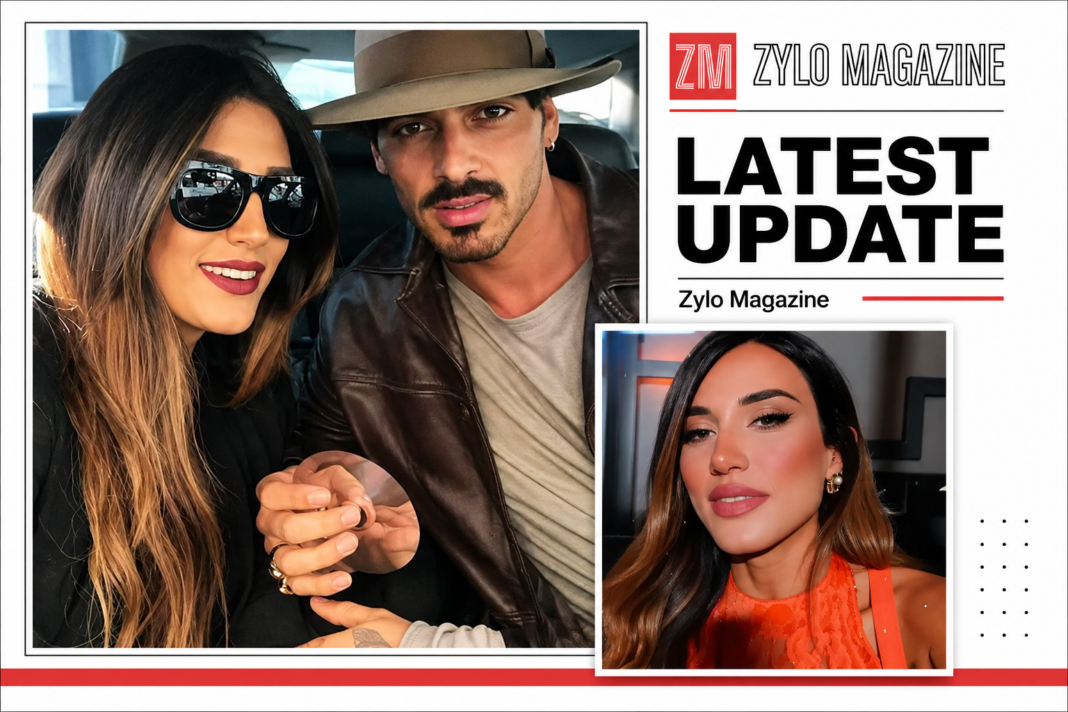
Rouba Saadeh is a Lebanese fashion professional and entrepreneur who has attracted international attention for two very different reasons: her career in the fashion industry and her former marriage to Italian actor Michele Morrone. While searches for Rouba Saadeh often begin with curiosity about her connection to the 365 Days star, reducing her story to a celebrity relationship overlooks the more interesting part of her biography. Her professional journey includes graphic design, fashion education, entrepreneurship, and work connected with the internationally recognized Lebanese fashion house ELIE SAAB.
Her story is particularly interesting because Saadeh has never followed the conventional celebrity route. She maintains a comparatively private public profile while working in an industry built around visibility, image, and luxury. This biography explores Rouba Saadeh’s background, education, career development, fashion experience, marriage, motherhood, and public identity while separating reasonably documented information from the speculation that frequently appears in celebrity profiles.
Who Is Rouba Saadeh?
Rouba Saadeh is a Lebanese fashion designer and creative professional from Beirut. To international audiences, she became widely recognized because she was married to Italian actor and singer Michele Morrone, who later achieved global fame through the film 365 Days.
However, Saadeh had an established creative and professional background independent of Morrone.
Public biographical sources consistently identify her with the fashion industry and report professional experience involving graphic design, ready-to-wear fashion, entrepreneurship, and ELIE SAAB. She has also been associated with a Beirut-based concept-store project called Le Paradis Des Fous.
This distinction is important when understanding why people continue to search for Rouba Saadeh.
She did not build her identity as a reality television personality, influencer, or celebrity spouse. Her public recognition expanded because of her former marriage, but the foundations of her career lie in design.
According to Famous Birthdays and multiple biographical profiles, Saadeh was born in Beirut on April 15, 1987. That would make her 39 years old in 2026.
Much of her private life remains exactly that—private. This creates an unusual situation in which considerable online interest surrounds someone who has revealed relatively little about herself compared with conventional celebrities.
Rouba Saadeh Quick Biography
| Detail | Information |
|---|---|
| Full name | Rouba Saadeh |
| Date of birth | April 15, 1987 |
| Age in 2026 | 39 |
| Birthplace | Beirut, Lebanon |
| Nationality | Lebanese |
| Profession | Fashion and creative professional |
| Education | Graphic design and business studies; further fashion training has also been reported |
| Known for | Fashion career, Le Paradis Des Fous, and former marriage to Michele Morrone |
| Former husband | Michele Morrone |
| Marriage | 2014–2018 |
| Children | Two sons |
| Industry | Fashion, design, luxury |
| Languages | Reportedly Arabic, English, French, and Italian |
One point deserves emphasis: celebrity websites frequently repeat personal statistics about Saadeh—including height, weight, wealth, religion, and other details—without showing strong primary evidence. Such information should therefore be treated cautiously rather than copied simply because it appears across multiple websites.
Rouba Saadeh’s Early Life in Lebanon
Rouba Saadeh was born and raised in Beirut, Lebanon, a city with an unusually rich relationship with art, architecture, design, luxury retail, and fashion.
That environment provides useful context for her later career.
Lebanon occupies an interesting position in Middle Eastern fashion. Beirut in particular has produced internationally successful designers and fashion houses, with Lebanese couture developing a reputation for intricate craftsmanship, formalwear, and luxury aesthetics.
Saadeh’s career would eventually bring her into this ecosystem professionally.
Reports about her childhood are relatively limited, which is worth acknowledging. Numerous celebrity websites provide detailed accounts of her family, personality, and early interests, but many of those details are difficult to verify independently.
More consistently reported is her education.
Saadeh reportedly attended Collège Notre-Dame de Jamhour before studying at the Lebanese American University in Beirut. Sources including Famous Birthdays and Tuko report that she studied graphic design and later completed business studies at the university.
This combination becomes particularly relevant when examining her career.
Rather than studying only fashion design, Saadeh appears to have built expertise across visual communication, business, and fashion.
Those disciplines complement one another exceptionally well in the modern luxury industry.
A designer may understand clothing but still need branding. A retailer may understand products but lack visual storytelling skills. A creative entrepreneur must often understand both aesthetics and the commercial systems that allow those aesthetics to become a viable business.
Saadeh’s educational background appears to have given her exposure to both sides.
Education and the Foundation of Her Creative Career
One of the most interesting aspects of Rouba Saadeh’s biography is the breadth of her reported education.
Biographical accounts consistently associate her with a bachelor’s-level education in graphic design from the Lebanese American University, followed by business studies. Several profiles additionally report fashion training in Europe, including study connected with institutions such as Istituto Marangoni and Central Saint Martins.
The exact details and dates surrounding every short course are less consistently documented, so they should not be exaggerated. What matters more is the broader pattern.
Saadeh appears to have deliberately moved from graphic communication toward fashion.
Why Graphic Design Matters in Fashion
Graphic design might initially seem distant from clothing design, but the two disciplines overlap significantly.
Fashion brands depend on:
- visual identity;
- typography;
- packaging;
- campaign concepts;
- digital presentation;
- editorial layouts;
- retail aesthetics;
- lookbooks;
- e-commerce imagery; and
- coherent brand storytelling.
A graphic designer learns to communicate an idea visually and to make deliberate decisions involving composition, color, hierarchy, proportion, and audience.
Those abilities can transfer naturally into fashion.
In Saadeh’s case, graphic design appears to have been the starting point rather than an unrelated first career.
The Importance of Business Education
Her reported business education is equally significant.
Fashion is a creative industry, but successful fashion operations depend heavily on commercial decisions.
Pricing, positioning, inventory, merchandising, customer acquisition, brand strategy, staffing, and financial management can determine whether an attractive creative concept becomes sustainable.
This is particularly relevant when considering Saadeh’s later entrepreneurial venture, Le Paradis Des Fous.
Her educational path therefore suggests something more substantial than an interest in beautiful clothing: it points toward an attempt to understand the entire environment in which fashion brands operate.
Rouba Saadeh’s Early Professional Career
Before becoming associated with luxury fashion internationally, Saadeh reportedly worked in graphic and web design.
A number of biographical accounts referencing her professional history report an internship with Publicis Graphics in Lebanon in 2008. She subsequently worked as a graphic web designer for Alfa-MIC1 in Beirut, with sources placing that employment roughly between 2009 and 2011.
This stage of her career is easily overlooked because celebrity biographies tend to jump directly to ELIE SAAB.
Yet it may be one of the most important periods for understanding her professional development.
Working in commercial graphic design requires more than artistic ability. Designers have to interpret briefs, communicate with clients or internal teams, work within brand guidelines, manage revisions, and produce material for specific commercial purposes.
In other words, professional design teaches the difference between creating something attractive and creating something that actually solves a communication problem.
That experience would have been useful when Saadeh moved deeper into fashion.
Her transition was not simply from “non-fashion” to “fashion.” It was more accurately a progression from one form of commercial design to another.
Moving Into the Fashion Industry
Saadeh’s professional identity eventually became increasingly connected with fashion.
Publicly available biographies report that she worked at ELIE SAAB in Beirut in an assistant role connected with the design team around 2013–2014. Later accounts have described her return to the company in ready-to-wear coordination and studio-management-related roles.
This association is significant.
ELIE SAAB is not simply another clothing company. The Lebanese luxury fashion house built an international reputation around couture, red-carpet dressing, bridal fashion, and ready-to-wear collections.
Working within such an organization requires coordination between creative ideas and production realities.
A luxury garment does not reach a runway, showroom, retailer, or client through design talent alone. Fashion operations involve numerous interconnected stages: concept development, fabric sourcing, samples, fittings, technical adjustments, production schedules, merchandising, presentation, and delivery.
Consequently, coordination roles can be central to making a collection function.
Rouba Saadeh and ELIE SAAB
The relationship between Rouba Saadeh and ELIE SAAB has become one of the most searched aspects of her career.
Multiple public profiles identify Saadeh as having professional experience with the fashion house, including work associated with ready-to-wear operations. Tuko’s updated biography, for example, describes her as working as a ready-to-wear studio manager.
It is important not to confuse such responsibilities with those of the fashion house’s founder or principal creative leadership. Online biographies sometimes inflate job titles into broader claims about creative control that are not supported by reliable evidence.
The more meaningful interpretation is that Saadeh has developed experience inside a globally recognized luxury-fashion environment.
What Does Ready-to-Wear Mean?
Ready-to-wear—or prêt-à-porter—refers to fashion produced in standardized sizes rather than created individually for a specific client.
For a luxury house, however, ready-to-wear remains highly sophisticated.
It requires the brand to translate its aesthetic identity into collections that can be produced, distributed, presented, and sold internationally.
Studio and coordination work can therefore involve communication between designers, technical teams, production personnel, management, and other departments.
Saadeh’s reported progression toward such responsibilities suggests a professional path focused not merely on fashion aesthetics but also on the execution required to turn creative concepts into finished collections.
That is an important distinction.
Le Paradis Des Fous: Rouba Saadeh as an Entrepreneur
Another notable chapter of Rouba Saadeh’s career is Le Paradis Des Fous, commonly described in biographies as a Beirut-based concept store or lifestyle/fashion project.
Reports generally place its creation around 2013.
The project appears to have focused on showcasing designers and distinctive creative products rather than functioning like a conventional mass-market clothing store.
Although detailed corporate records and long-term financial information about the business are not widely available, its existence provides insight into Saadeh’s professional ambitions.
Why Concept Stores Matter
A concept store sells more than individual products.
The retailer creates a point of view.
Instead of asking only, “What merchandise will sell?”, a concept-store founder asks:
What kind of world should the customer enter?
That means curating designers, aesthetics, accessories, clothing, objects, and experiences that work together.
For someone with Saadeh’s combination of graphic design, business, and fashion interests, such a project makes sense.
It requires several different abilities simultaneously:
Curation: deciding which products or designers fit the store’s identity.
Branding: creating a recognizable visual and emotional personality.
Merchandising: presenting products in ways that make commercial and aesthetic sense.
Customer understanding: knowing who will appreciate the concept and why.
Business management: handling the less glamorous realities behind a creative enterprise.
Le Paradis Des Fous therefore represents an important part of Saadeh’s biography even if it never became a globally dominant retail brand.
It demonstrates entrepreneurial initiative.
Rather than working exclusively within established organizations, she attempted to build and shape a fashion concept herself.
What Rouba Saadeh’s Career Actually Reveals
Celebrity profiles frequently describe careers using impressive-sounding job titles without explaining what those careers reveal about the person.
Saadeh’s professional history is more useful when viewed as a sequence.
First came visual communication.
Then business education.
Then deeper fashion specialization.
Then professional fashion-house experience and entrepreneurship.
Later came further involvement in ready-to-wear fashion.
Seen this way, her career is less random than it initially appears.
The common thread is creative organization.
Whether working in graphics, curating a concept store, or participating in ready-to-wear operations, the task involves turning creative ideas into something coherent and usable.
This may be the most interesting professional insight available from her public biography.
Rouba Saadeh and Michele Morrone
Despite her fashion career, Rouba Saadeh became globally searchable primarily because of her relationship with Michele Morrone.
Morrone is an Italian actor, model, and singer whose international profile expanded dramatically following his starring role as Massimo Torricelli in the 2020 film 365 Days.
Saadeh and Morrone married in 2014.
Reports indicate that their marriage involved ceremonies or celebrations connected with Italy and Lebanon, reflecting their different national backgrounds.
The couple had two sons together.
Their marriage ended in divorce in 2018—approximately two years before 365 Days transformed Morrone into a widely recognized international celebrity.
That timeline is significant.
People who discovered Morrone after 2020 frequently searched his personal history afterward, which brought renewed attention to Saadeh.
In other words, much of Saadeh’s international celebrity recognition occurred after her marriage had already ended.
Rouba Saadeh’s Children and Motherhood
Rouba Saadeh and Michele Morrone share two sons.
Public sources generally identify their sons as Marcus and Brando, although some websites contain spelling inconsistencies.
Morrone has publicly discussed fatherhood on various occasions, while Saadeh generally keeps the children away from excessive public exposure.
That relatively private approach is notable given the level of online curiosity surrounding their family.
Celebrity children can quickly become extensions of their parents’ public brands. Photos, birthdays, school information, and private family moments may attract substantial engagement online.
Saadeh appears to maintain a more restrained approach.
This is also where responsible celebrity biography matters.
The fact that readers are interested in a public figure’s family does not mean every available detail about children needs to be repeated. Information involving minors deserves particular restraint.
The meaningful public fact is straightforward: Saadeh and Morrone have two sons and continue to be linked as parents even though their marriage ended.
Divorce From Michele Morrone
Saadeh and Morrone divorced in 2018.
Morrone later spoke publicly about how difficult the period following the divorce was for him. His comments attracted substantial media coverage after his rise to fame.
However, the precise private reasons behind the couple’s separation have not been comprehensively documented by both parties.
That distinction matters because many celebrity websites turn incomplete information into definitive narratives.
There is a difference between:
what is publicly confirmed and what outsiders infer happened inside a marriage.
The divorce itself is well documented. Claims assigning blame, reconstructing private arguments, or describing personal motivations should be treated far more cautiously unless supported by direct statements.
Saadeh herself has generally not built a public media identity around discussing her former marriage.
That restraint has helped keep attention on her life beyond the relationship.
Life After Divorce
One of the strongest themes in Rouba Saadeh’s biography is continuity.
Divorce did not mark the beginning of her professional identity.
She already had education, design experience, entrepreneurial activity, and fashion-industry exposure.
Likewise, Morrone’s later international fame did not require Saadeh to transform herself into a full-time celebrity personality.
Public biographies indicate that she continued pursuing fashion-related work, including professional involvement with ELIE SAAB.
This provides a useful correction to the typical search-engine narrative.
Articles often describe her as though she became independent after separating from Morrone.
Her professional timeline suggests something different: she already possessed an independent career identity before and during their relationship.
That makes her story considerably more interesting.
Rouba Saadeh’s Fashion Style
Because Saadeh works in fashion, readers naturally show interest in her personal style.
Her public photographs and social-media presence generally reflect a polished contemporary aesthetic. She has appeared in outfits ranging from relatively understated casual clothing to more sophisticated fashion-forward looks.
But personal style and professional design philosophy are not necessarily the same thing.
Without extensive interviews from Saadeh explaining her creative philosophy, it would be speculative to claim that she follows a specific design doctrine.
What can reasonably be observed is that her career has exposed her to several creative disciplines.
Graphic design encourages precision and visual hierarchy.
Fashion education develops understanding of silhouette, material, construction, and trend.
Luxury fashion emphasizes craftsmanship, consistency, and brand identity.
Retail entrepreneurship demands awareness of consumer taste.
Together, those experiences provide a broader creative toolkit than fashion training alone.
Social Media and Public Image
Rouba Saadeh has maintained a social-media presence, particularly on Instagram, where fashion, personal photographs, family moments, and lifestyle imagery have contributed to public interest in her.
Yet she occupies an unusual position in the celebrity ecosystem.
She is publicly recognizable without behaving like a conventional celebrity.
There is no endless stream of interviews.
She does not appear to routinely comment on every rumor involving her former husband.
She has not turned the divorce into an entertainment brand.
And her public identity continues to retain a meaningful connection with fashion.
This relative restraint may actually explain some of the continuing curiosity around her.
The less a person explains publicly, the more online audiences often search for explanations elsewhere.
Unfortunately, that creates fertile ground for inaccurate celebrity websites.
Why There Is So Much Incorrect Information About Rouba Saadeh
Anyone researching Rouba Saadeh will quickly encounter contradictory information.
Some websites provide precise estimates of her wealth.
Others claim exact physical measurements.
Different articles describe her current job differently.
Some provide supposed details of her romantic life.
Others confidently explain events that Saadeh has never publicly discussed in depth.
Why?
Because celebrity biography content is frequently copied.
One website publishes an unsupported detail. Another repeats it. A third cites neither source but changes the wording. Eventually, the claim appears on dozens of websites and begins to look established.
Repetition, however, is not verification.
Readers should apply three simple tests when evaluating information about Saadeh or any similar public figure:
- Is there a primary source?
Look for an interview, professional profile, company page, or statement from the person involved. - Do reputable independent sources agree?
Agreement matters more when publications have actually verified the information rather than copying one another. - Would the person realistically make this information public?
Exact salaries, private relationship details, and personal financial assets are often unknowable unless disclosed.
This approach is particularly important when discussing Rouba Saadeh’s supposed net worth.
What Is Rouba Saadeh’s Net Worth?
Numerous websites estimate Rouba Saadeh’s net worth, often placing it somewhere between hundreds of thousands and several million dollars.
These figures should not be treated as verified facts.
There is no widely available authoritative financial disclosure establishing her exact personal wealth.
This is a common problem in celebrity content.
A website may estimate earnings based on a person’s occupation and then present the result as “net worth.” But actual net worth requires knowledge of assets, liabilities, investments, property ownership, business equity, taxes, and other financial information.
A job title alone cannot reveal that.
Therefore, the most accurate answer is:
Rouba Saadeh’s exact net worth is not publicly verified.
She has professional experience in fashion and has been involved in entrepreneurial activity, but assigning an exact dollar amount without reliable financial documentation would be speculation.
That answer may be less dramatic, but it is considerably more credible.
Rouba Saadeh’s Languages and International Background
Public profiles frequently report that Saadeh speaks Arabic, English, French, and Italian.
Such multilingual ability would fit naturally with her background.
Lebanon has a multilingual educational and professional culture, with Arabic, French, and English commonly appearing across different environments.
Her connection with Italy through fashion study and her former marriage also provides context for Italian-language ability.
Multilingual communication offers practical advantages in international fashion.
Luxury companies operate across markets, and designers, buyers, suppliers, photographers, production teams, models, and clients may come from numerous countries.
Being able to operate across languages can therefore be a genuine professional asset rather than simply an interesting biographical fact.
Rouba Saadeh’s Lebanese Identity and Fashion Career
Saadeh’s Lebanese background deserves attention because Lebanon has had an outsized influence on international luxury fashion relative to the country’s size.
Beirut has produced and supported designers who successfully combined regional craftsmanship with European-facing luxury markets.
Saadeh’s career exists within that broader creative environment.
Her reported studies abroad add another dimension.
Rather than belonging exclusively to one fashion tradition, her background reflects the increasingly international nature of the industry: education in Beirut, European fashion exposure, Lebanese professional experience, and personal connections with Italy.
This cross-cultural dimension may be one of the most valuable aspects of her professional profile.
Modern luxury fashion rarely operates within a single national boundary.
Design may originate in one city, textiles in another country, manufacturing somewhere else, and sales across dozens of markets.
Professionals who can move comfortably between cultural contexts are therefore especially useful.
Why Rouba Saadeh Is More Than “Michele Morrone’s Ex-Wife”
Calling Rouba Saadeh “Michele Morrone’s ex-wife” is factually relevant, but biographically incomplete.
It explains why millions of entertainment readers encountered her name.
It does not explain who she is professionally.
Before Morrone achieved his biggest international breakthrough, Saadeh had already studied design, worked professionally, moved into fashion, and pursued entrepreneurship.
Her identity therefore does not originate with his fame.
This is an important distinction in celebrity coverage, particularly when discussing women formerly married to famous men.
Search engines often organize their identities around the more famous partner because that relationship generates greater search volume.
But popularity is not biography.
A useful biography asks what a person actually studied, built, attempted, contributed, and experienced.
Viewed through that lens, Saadeh’s fashion career becomes central rather than secondary.
What Aspiring Fashion Professionals Can Learn From Rouba Saadeh’s Career
Saadeh’s career offers several practical lessons even though relatively few detailed interviews about her professional philosophy are publicly available.
1. Creative Careers Do Not Have to Be Linear
Graphic design can lead into fashion.
Fashion can lead into retail.
Retail experience can complement luxury-house operations.
Modern creative careers often reward transferable skills more than rigid specialization.
2. Business Knowledge Strengthens Creative Ability
Creative talent matters, but commercial understanding determines whether many creative projects survive.
Saadeh’s combination of design and business education illustrates why creative professionals benefit from understanding both.
3. Experience Inside Established Brands Has Value
Entrepreneurship receives enormous attention today, but working inside an established fashion organization can teach systems that are difficult to learn alone.
Production timelines, quality control, coordination, and brand consistency become clearer when experienced at scale.
4. Entrepreneurship Is Also Curation
Founding a concept store does not necessarily mean designing every item yourself.
Recognizing good work, selecting it intelligently, presenting it coherently, and building an audience around it are valuable creative abilities.
5. Publicity and Professional Success Are Different
Perhaps the most relevant lesson from Saadeh’s story is that visibility should not be confused with achievement.
Her largest wave of public recognition resulted from someone else’s entertainment fame.
Her professional career followed a separate trajectory.
For aspiring designers living in the social-media era, that distinction matters.
A large audience can help a career, but an audience is not a substitute for skills, experience, judgment, and professional credibility.
Where Is Rouba Saadeh Now?
As of the most recent publicly circulating biographical information, Rouba Saadeh continues to be associated with the fashion industry and with ELIE SAAB.
Readers should nevertheless be cautious about articles claiming to know her exact day-to-day activities, current romantic status, income, or future plans unless those claims are supported by recent primary information.
Her public profile remains comparatively private.
That makes a simple description more appropriate than speculation: she is a Lebanese fashion professional, mother, and former entrepreneur whose international recognition increased dramatically because of her former marriage to Michele Morrone.
Her career, however, began independently of that fame.
Why Rouba Saadeh Continues to Attract Interest
There are several reasons searches for Rouba Saadeh continue years after her divorce.
The first is Michele Morrone’s enduring international fan base.
New viewers discovering 365 Days or Morrone’s other work frequently search for information about his relationships and family.
The second is Saadeh’s fashion background.
Her connection with ELIE SAAB gives readers another reason to explore her professional life beyond celebrity gossip.
The third is privacy.
People who constantly appear in entertainment media can eventually become overexposed. Saadeh’s lower-key public presence produces the opposite effect: there are unanswered questions.
But those unanswered questions should not become an invitation to invent answers.
The most compelling version of her biography is already available in the documented facts: a Beirut-born creative professional who moved from graphic design into fashion, explored entrepreneurship, worked within luxury fashion, became connected to a globally famous actor, raised two children, went through a publicized divorce, and continued maintaining her own identity.
Frequently Asked Questions About Rouba Saadeh
Who is Rouba Saadeh?
Rouba Saadeh is a Lebanese fashion and creative professional from Beirut. She has worked in graphic design and fashion, has been associated professionally with ELIE SAAB, and founded the concept-store project Le Paradis Des Fous. International entertainment audiences also know her as the former wife of Italian actor Michele Morrone.
How old is Rouba Saadeh?
Rouba Saadeh is widely reported to have been born on April 15, 1987, in Beirut, Lebanon. Based on that date, she is 39 years old in 2026.
What does Rouba Saadeh do for a living?
Saadeh has built a career across design and fashion. Her reported professional history includes graphic and web design, entrepreneurial activity through Le Paradis Des Fous, and roles connected with ready-to-wear fashion at ELIE SAAB. Some current biographies describe her work in studio-management or coordination capacities.
When were Rouba Saadeh and Michele Morrone married?
Rouba Saadeh and Michele Morrone married in 2014 and divorced in 2018. They share two sons. Morrone subsequently achieved major international recognition after starring in 365 Days, released in 2020.
What is Rouba Saadeh’s net worth?
There is no authoritative public source confirming Rouba Saadeh’s exact net worth. Although numerous celebrity websites publish estimates, these figures are speculative unless supported by verified information about her assets, liabilities, earnings, and investments. It is more accurate to say that her precise wealth is not publicly known.
Conclusion
Rouba Saadeh’s biography is more substantial than the celebrity label most commonly attached to her name. Although her marriage to Michele Morrone introduced her to a much larger international audience, her professional story began independently, through education in design and business, early graphic-design work, fashion training, entrepreneurship with Le Paradis Des Fous, and professional experience associated with ELIE SAAB.
What makes Rouba Saadeh particularly interesting is the contrast between substantial public curiosity and her relatively private approach to fame. She has not relied on constant publicity to maintain relevance, and many aspects of her personal and financial life remain unverified. That is precisely why responsible profiles should distinguish documented facts from internet speculation. Ultimately, Saadeh is best understood not simply as Michele Morrone’s former wife but as a Lebanese creative professional whose career demonstrates the value of multidisciplinary education, international experience, entrepreneurship, and maintaining an identity beyond celebrity attention.
Continue Exploring Our Latest Article: Willie Nelson and Angelina Jolie: The Surprising True Story Behind Their Connection