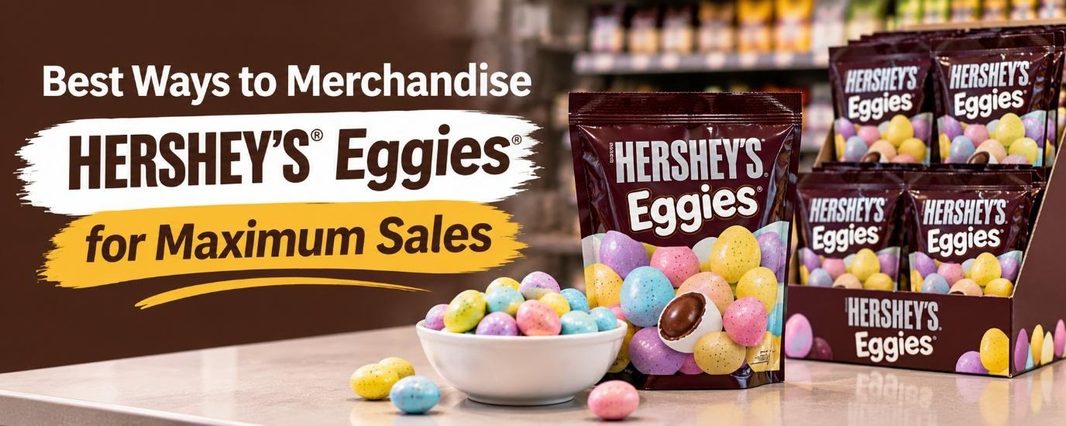
Easter creates a limited window for retailers to turn seasonal confectionery into incremental sales.
For grocery stores, convenience stores, specialty retailers and foodservice businesses, simply stocking Easter chocolate is not enough. Customers need to see it, understand the occasion and have a reason to add it to their basket.
HERSHEY’S EGGIES Milk Chocolate Candy Coated Eggs are particularly suited to seasonal merchandising because Hershey Canada identifies them specifically as an Easter product. The classic version features milk chocolate surrounded by a crunchy candy shell and is offered in multiple package sizes in Canada.
The question for retailers is therefore not only what to stock, but how to merchandise it.
From checkout displays and Easter sections to cross-merchandising and bakery applications, here are practical ways Canadian businesses can merchandise HERSHEY’S EGGIES to improve visibility and support seasonal sales.
Why Easter Confectionery Deserves a Merchandising Strategy
Seasonal chocolate has a relatively short selling period.
Unlike everyday confectionery, Easter products need to generate much of their sales within a defined window.
That makes visibility particularly important.
Statistics Canada has historically identified Easter as one of the major annual periods for chocolate sales in Canada. More recent Canadian convenience-industry reporting also shows that chocolate remains a resilient category despite considerable price pressure.
Seasonal products therefore should not simply disappear into the regular candy aisle.
They need merchandising that communicates:
Easter is coming.
This product is seasonal.
Here is how you can use it.
That creates several merchandising opportunities for HERSHEY’S EGGIES.
1. Build a Dedicated Easter Display
Start with the most obvious strategy.
Create a clearly identifiable Easter candy display.
Depending on the store, this might be:
- An endcap
- A seasonal table
- A freestanding display
- A shelf section
- A front-of-store display
- A countertop display
The goal is immediate recognition.
Customers should not have to search through the regular chocolate aisle to discover seasonal products.
Spring colours and simple Easter signage can help distinguish the area from everyday confectionery.
Canadian convenience-industry experts have specifically recommended using Easter and spring to bring more colour and freshness into stores and encourage impulse purchasing.
Keep the display organized rather than overcrowded.
A customer should be able to understand the assortment within seconds.
2. Put EGGIES Near the Checkout
Checkout is valuable territory for confectionery.
Customers waiting to pay have already completed most of their purchasing decisions, but they can still make one more.
That makes smaller confectionery products natural impulse candidates.
Historical Hershey category-management research reported by Convenience Store News Canada found that shoppers spend a meaningful share of their in-store time around checkout and that the area generates a significant proportion of candy and snack sales.
For HERSHEY’S EGGIES, consider placing appropriate packages:
- Beside the register
- Along the queue
- Near self-checkout
- On a small counter display
Keep the display clean and easy to shop.
The objective is not to block the checkout with Easter products.
It is to give customers one final opportunity to notice them.
3. Use More Than One Location
One display may not be enough.
A customer who does not visit the candy aisle may never see the product.
Consider secondary merchandising.
For example, HERSHEY’S EGGIES might appear:
Location 1: Easter confectionery section
Location 2: Checkout
Location 3: Baking aisle or seasonal baking display
Location 4: Front-of-store Easter display
Recent Canadian confectionery merchandising advice reinforces this approach. Industry specialists recommend high-visibility areas such as front-end displays and checkout zones, noting that secondary placements can expose products to shoppers who were not specifically looking for candy.
Multiple touchpoints can increase the chances of discovery.
4. Merchandise Different Pack Sizes for Different Missions
Hershey Canada currently lists classic HERSHEY’S EGGIES in both 220 g and 900 g bags.
Those formats can serve different shopping missions.
A smaller package might appeal to someone looking for:
- A personal treat
- A small Easter gift
- An impulse purchase
- A baking ingredient
A larger package can potentially suit:
- Easter gatherings
- Sharing
- Easter baskets
- Egg hunts
- Baking
- Foodservice applications
Do not assume every shopper wants the largest package.
Providing appropriate formats can help serve different budgets and occasions.
5. Cross-Merchandise With Easter Baking Supplies
HERSHEY’S EGGIES are not limited to eating straight from the bag.
They can also be used in seasonal baking.
Hershey Canada’s own recipe collection provides a useful example: its Easter Eggie Hunt Stuffed Cookies incorporate EGGIES inside and on top of cookies.
That creates a natural cross-merchandising opportunity.
Place EGGIES near products such as:
- Baking chocolate
- Cookie mixes
- Cake mixes
- Flour
- Sprinkles
- Frosting
- Baking decorations
Simple signage can communicate the idea:
Add some Easter colour to your baking.
The retailer is no longer selling only a bag of chocolate.
It is selling an Easter activity or dessert idea.
6. Create an Easter Baking Display
Take cross-merchandising one step further by creating a complete Easter baking destination.
The display could combine:
HERSHEY’S EGGIES
HERSHEY’S CHIPITS
Sprinkles
Baking mixes
Frosting
Decorations
The exact assortment should depend on what the store carries.
This approach can help customers discover several related products during one shopping occasion.
For retailers, the objective is increasing basket value through relevance rather than placing unrelated products together.
7. Merchandise EGGIES Near Easter Baskets
Hershey Canada specifically positions EGGIES around Easter traditions, and its seasonal assortment includes products designed for sharing, baking and Easter activities.
That makes Easter-basket merchandise a natural partner.
Retailers could cross-merchandise EGGIES with:
- Easter baskets
- Gift bags
- Tissue paper
- Easter grass
- Small toys
- Greeting cards
- Seasonal decorations
This changes the shopping context.
Instead of asking:
“Do I want chocolate?”
the shopper begins thinking:
“What do I still need for the Easter basket?”
That distinction can be powerful in seasonal retail.
8. Create a Build-Your-Own Easter Basket Section
Retailers with sufficient space can make the concept interactive.
Create a small area where customers can select:
- A basket or gift bag
- Easter confectionery
- Small gifts
- Decorations
HERSHEY’S EGGIES can become one component of the experience.
This strategy can be particularly useful for shoppers looking for a quick Easter gift.
Convenience matters.
If all the required products are located together, the customer does not need to search throughout the store.
9. Merchandise the Broader EGGIES Range Together
The EGGIES range in Canada extends beyond the classic milk chocolate version.
Hershey Canada currently lists seasonal varieties including:
- HERSHEY’S EGGIES Milk Chocolate Candy Coated Eggs
- HERSHEY’S RAINBOW EGGIES
- HERSHEY’S EGGIES with REESE’S Peanut Butter
- HERSHEY’S EGGIES with WHOPPERS
- HERSHEY’S EGGIES Triple Flavour Fun Pack
Availability can vary by retailer and season, so stores should confirm current supplier availability.
When multiple varieties are available, merchandising them together can create a stronger brand block.
Customers can immediately compare flavours and package formats.
10. Use Colour to Your Advantage
Seasonal confectionery is highly visual.
Hershey Canada’s Rainbow EGGIES, for example, are specifically designed around a colourful Easter presentation.
Retailers can reinforce this visually with:
- Clean seasonal signage
- Spring-themed display materials
- Easter baskets
- Colour-coordinated shelf organization
Avoid making the display too busy.
Products should remain the focal point.
Seasonal decoration should attract attention rather than make the merchandise difficult to identify.
11. Keep Signage Simple
Customers should not need to read a paragraph to understand a promotion.
Effective signage might communicate:
Easter Favourite
Limited Seasonal Availability
Easter Baking
Build Your Easter Basket
Perfect for Sharing
Any promotional wording should accurately reflect the product and offer.
Canadian retail experts have emphasized that clear, simple signage is particularly important when communicating bundles and price promotions.
If there is a discount, make the offer obvious.
If there isn’t, don’t create signage that implies one.
12. Make Seasonal Availability Clear
Hershey Canada explicitly identifies EGGIES as a seasonal product available during the Easter season.
That is valuable merchandising information.
Seasonal availability naturally creates urgency because customers understand the product will not remain on the shelf indefinitely.
Retailers can communicate that accurately with language such as:
Seasonal Easter Favourite
or
Available for the Easter Season
There is no need to create artificial scarcity.
The genuine seasonal nature of the product already gives shoppers a reason not to postpone the purchase indefinitely.
13. Start Merchandising Before Easter Weekend
Waiting until the final few days before Easter can reduce the selling window.
Customers purchase seasonal confectionery for different reasons and at different times.
Some buy early for:
- Baking
- Easter baskets
- Parties
- Events
- Gifts
Others purchase closer to Easter weekend.
Retailers should therefore plan a merchandising calendar rather than treating Easter as a one-week event.
A simple approach might be:
Early Season
Introduce the seasonal assortment and establish visibility.
Mid-Season
Expand displays and cross-merchandising.
Final Weeks
Increase high-traffic placement and reinforce urgency.
Final Days
Focus on convenience, gifting and last-minute purchases.
The exact timing should reflect store traffic and historical sales data.
14. Use EGGIES in Foodservice Desserts
The opportunity is not limited to packaged retail.
Restaurants, cafés, bakeries and other foodservice businesses can potentially use HERSHEY’S EGGIES as part of seasonal menu development.
Ideas could include:
- Easter cookies
- Brownies
- Cupcakes
- Ice cream desserts
- Milkshakes
- Cakes
- Dessert bars
- Bakery decorations
Hershey Canada’s own Easter recipe uses EGGIES both inside and on top of cookies, demonstrating that the product can function as a baking ingredient as well as confectionery.
Foodservice operators should calculate portion cost before developing a limited-time dessert.
15. Create Limited-Time Easter Desserts
Seasonal products can help restaurants create menu excitement without making a permanent menu change.
A café might introduce an:
EGGIES Easter Cookie
A bakery might offer:
Easter Chocolate Brownies
A dessert operation might develop:
EGGIES Chocolate Sundae
Limited-time products can create a reason for existing customers to try something new.
The key is operational simplicity.
Use the seasonal ingredient with menu components already present in the kitchen where possible.
That can make the promotion easier to execute.
16. Use EGGIES as a Dessert Add-On
Another foodservice strategy is allowing customers to add seasonal confectionery to an existing dessert.
For example:
Add EGGIES to your sundae
or
Add EGGIES to your milkshake
This can provide customization without requiring an entirely separate recipe.
Operators should establish a standard portion and calculate its cost before setting the add-on price.
17. Pair EGGIES With Hot Beverages
Chocolate and hot beverages naturally occupy similar indulgence occasions.
Cafés and foodservice locations can explore merchandising packaged EGGIES near:
- Coffee
- Hot chocolate
- Tea
- Seasonal beverages
A small Easter confectionery display beside the beverage area may encourage customers to add a treat to an existing purchase.
The same idea can be used digitally.
If a customer orders a seasonal beverage online, an appropriate Easter treat could appear as an optional add-on.
18. Create Seasonal Bundles
Bundles can simplify purchasing decisions.
Potential retail combinations might include:
Easter Basket Bundle
Basket + confectionery + seasonal accessories
Easter Baking Bundle
EGGIES + baking ingredients + decorations
Movie Night Bundle
Chocolate + popcorn + beverages
Coffee Break Bundle
Hot beverage + seasonal chocolate
Bundles should provide a logical customer benefit.
Do not combine products merely because they happen to be available.
19. Use Front-of-Store Visibility
Customers may enter the store without thinking about Easter confectionery.
A seasonal display near the entrance can change that.
The objective is to introduce the occasion early in the shopping journey.
Canadian convenience merchandising experts recommend high-visibility seasonal presentation and cross-category displays as ways to capture spring impulse opportunities.
For larger stores, front-of-store exposure can work alongside the main seasonal aisle rather than replacing it.
20. Consider High-Traffic Secondary Locations
Retailers should identify where customers naturally travel.
Potential secondary locations include:
- Near checkout
- Endcaps
- Beverage coolers
- Coffee stations
- Baking aisles
- Gift sections
- Seasonal aisles
Not every store needs every location.
Choose placements based on traffic and customer behaviour.
The objective is exposure without creating clutter.
21. Keep the Display Full—But Not Overloaded
A half-empty seasonal display can look neglected.
An overloaded display can become difficult to shop.
Maintain enough product to communicate abundance while keeping:
- Product names visible
- Prices visible
- Varieties organized
- Shelves clean
- Signage unobstructed
Staff should regularly straighten high-traffic displays during the Easter selling period.
Presentation matters particularly for impulse products because the purchase decision can happen within seconds.
22. Keep Pricing Easy to Find
Seasonal displays lose effectiveness when customers cannot quickly determine the price.
Clearly display:
- Regular price
- Promotional price
- Multi-buy offer
- Bundle price
where applicable.
Value remains important because confectionery prices have risen substantially in recent years. Canadian convenience-industry reporting cited Statistics Canada data showing confectionery prices in July 2025 were 34.6% higher than in July 2020.
Customers may therefore be more price-conscious even when purchasing seasonal treats.
23. Don’t Discount Too Early
Easter inventory creates an obvious concern:
What happens if product remains after the holiday?
The temptation may be to begin discounting early.
That can protect sell-through, but it may also reduce margin unnecessarily.
Use sales data.
Monitor:
- Units sold
- Daily sales velocity
- Inventory remaining
- Days until Easter
- Margin
- Historical seasonal performance
Promotional decisions should reflect actual inventory risk rather than fear of leftovers.
24. Monitor Sell-Through
Seasonal merchandising should be measured.
A simple metric is:
Sell-Through Rate = Units Sold ÷ Units Available × 100
Suppose a store receives 200 bags and sells 150:
150 ÷ 200 × 100 = 75% sell-through
Track this throughout the season rather than waiting until Easter is over.
If sales are slower than expected, operators can adjust:
- Placement
- Signage
- Promotion
- Secondary displays
- Bundling
Early information gives retailers more options.
25. Compare Display Performance
Retailers with appropriate POS data can go further.
Compare sales when EGGIES are:
Only in the seasonal aisle
versus:
Seasonal aisle + checkout
or:
Seasonal aisle + checkout + baking display
This helps determine whether secondary placement is generating incremental sales.
Do not rely only on intuition.
Merchandising should eventually become measurable.
26. Use Last Year’s Data to Plan Next Easter
After Easter, record what happened.
Review:
- Best-selling pack size
- Best-performing variety
- Strongest weeks
- Most effective display location
- Promotional performance
- Inventory remaining
- Markdown requirements
These insights can improve next year’s order.
Seasonal merchandising becomes more profitable when each year informs the next.
A Hershey’s EGGIES Merchandising Checklist
Before the Easter selling period, ask:
Inventory: Do we have the appropriate quantity?
Formats: Are we carrying pack sizes that fit different shopping missions?
Visibility: Can customers easily find EGGIES?
Seasonal display: Is Easter clearly communicated?
Checkout: Is there an appropriate impulse opportunity?
Secondary placement: Can we merchandise the product elsewhere?
Cross-merchandising: Can EGGIES be paired with baking or Easter-basket products?
Price: Is pricing clear?
Promotion: Does the offer make financial sense?
Foodservice: Can the product support a seasonal dessert or add-on?
Sell-through: Are we monitoring sales throughout the season?
Inventory risk: Do we have a plan for the final days before Easter?
These questions turn seasonal confectionery merchandising into a strategy rather than simply filling a shelf.
Turn a Seasonal Product Into a Seasonal Destination
HERSHEY’S EGGIES already have one major merchandising advantage: they are clearly connected to Easter.
Hershey Canada describes classic EGGIES as milk chocolate in a crunchy candy shell and identifies the product as available specifically during the Easter season. The Canadian range also includes multiple EGGIES varieties and formats, creating opportunities for assortment-based displays.
Retailers can build on that seasonal recognition.
Create a dedicated Easter destination.
Give EGGIES secondary visibility at checkout.
Cross-merchandise them with Easter baskets and baking supplies.
Use multiple pack sizes to address different purchasing occasions.
Keep pricing clear.
For foodservice, consider limited-time desserts and seasonal add-ons.
Most importantly, measure what happens.
Track sales velocity, sell-through, placement performance and remaining inventory throughout the Easter period.
The objective is not simply to put HERSHEY’S EGGIES on the shelf.
It is to put them where customers will notice them, when they are most relevant, and alongside products that give shoppers another reason to buy.