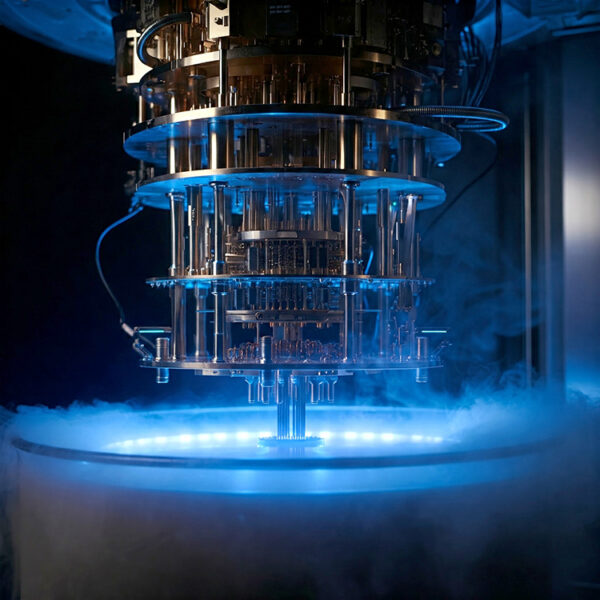
Most coverage of quantum computing focuses on the processor. Headlines count qubits, compare error rates, and speculate about when these machines might train better AI models or crack problems that classical computers can’t touch. The photos usually show the same striking image: a gold-colored chandelier of plates and tubes hanging from a frame, looking more like sculpture than hardware.
That chandelier is mostly a refrigerator, and most of what hangs inside it isn’t the processor at all. It’s wiring, connectors, and signal components that carry instructions down to the qubits and bring their faint responses back up. Whether a quantum computer works depends on that unglamorous plumbing as much as on the chip at the bottom.
Why Quantum Machines Need Extreme Cold
Many leading quantum computers use superconducting qubits, tiny circuits that only behave in quantum ways when they are almost perfectly still. Heat is vibration, and vibration destroys the delicate states that make a qubit useful.
To remove nearly all of it, these systems sit inside dilution refrigerators that cool the processor to a few thousandths of a degree above absolute zero. That is colder than deep space. The refrigerator works in stages, with each plate in the chandelier sitting at a lower temperature than the one above it, stepping down from room temperature to the coldest point at the bottom.
Every wire that passes through those stages brings a little heat with it. Every component mounted along the way has to keep working at temperatures where many ordinary materials behave very differently from how they do on a lab bench.
Talking To Qubits With Microwaves
Superconducting qubits are controlled and read using microwave signals, typically in the range of a few gigahertz. A carefully shaped pulse can flip a qubit or entangle two of them. Another signal measures the result.
Those signals have to travel from room-temperature electronics down through the refrigerator and back again, and they need to arrive clean. Noise from warmer stages can leak downward and disturb the qubits. Weak readout signals coming back up need to be separated, measured, and amplified without being drowned out.
That means the signal chain needs many of the same building blocks found in radar or satellite equipment, adapted for a far stranger environment. Directional couplers take precise samples of a signal so engineers can monitor what is reaching the processor. Power dividers split one signal into several paths. Hybrid couplers combine or separate signals with defined phase relationships, useful for some readout schemes. Terminations absorb unused energy so it doesn’t bounce back into the system as interference.
What Changes When Parts Get Cold
Designing cryogenic products isn’t simply a matter of taking a standard component and chilling it. Several problems appear that don’t exist at room temperature.
Thermal contraction. Materials shrink as they cool, and different materials shrink by different amounts. A connector or housing that fits perfectly at room temperature can loosen, warp, or crack after cooling, so material choices have to account for the full temperature drop.
Magnetism. Qubits are extremely sensitive to stray magnetic fields. Many common metals and plating materials contain traces of magnetic elements that are harmless in most electronics but can disrupt a quantum processor. Components intended for these systems are often made with non-magnetic designs for exactly this reason.
Changing electrical behavior. Resistance, loss, and impedance can all shift at very low temperatures. A part that matches its specifications at room temperature may drift once cooled, so manufacturers select materials chosen to hold up in extreme cold and often provide temperature guidance for specific uses.
Heat load. The coldest stages of a dilution refrigerator can only remove a tiny amount of heat. Components that dissipate energy, or cables that conduct too much warmth from above, can overwhelm that budget.
The Scaling Problem
Today’s quantum processors often need several lines per qubit for control and readout. That’s manageable with a few dozen qubits. It becomes a serious engineering challenge as systems grow toward hundreds or thousands.
Every additional line takes up space inside a refrigerator with limited room, adds heat, and adds components that must perform reliably at temperatures near absolute zero. Much of the work on scaling quantum computers is happening here, in wiring density, compact components, and cryogenic electronics, rather than in the qubits alone.
For readers following AI, the parallel is familiar. Large language models get the attention, but progress has also depended on data centers, power delivery, cooling, and networking. Quantum computing has its own version of that infrastructure story, and it happens inside a cryostat.
Why This Matters For AI’s Future
Claims about quantum computing transforming AI deserve skepticism. Useful, error-corrected quantum machines remain a work in progress, and researchers are still debating which AI tasks would benefit and by how much. Proposed areas include optimization, simulating molecules and materials, and certain sampling problems.
What is clear is that any of those outcomes depends on machines that run reliably for long periods. Reliability, in turn, depends on the full chain of hardware that keeps qubits cold, quiet, and controllable. Improvements in that supporting hardware tend to arrive quietly, but they are part of what moves the field from lab demonstrations toward practical systems.
What Researchers Look For
Teams building cryogenic setups tend to weigh a similar set of factors when choosing components.
Does the part cover the frequency range used for control and readout?
Is it built from non-magnetic materials?
Will it hold its electrical performance after cooling?
Does it fit the limited space on each refrigerator stage?
Is it available quickly enough to keep experiments on schedule?
Quantum computing will keep producing headlines about qubit counts and record-breaking calculations. Behind each of them sits a cold column of carefully chosen hardware, doing the dependable work that lets the processor at the bottom do something remarkable.