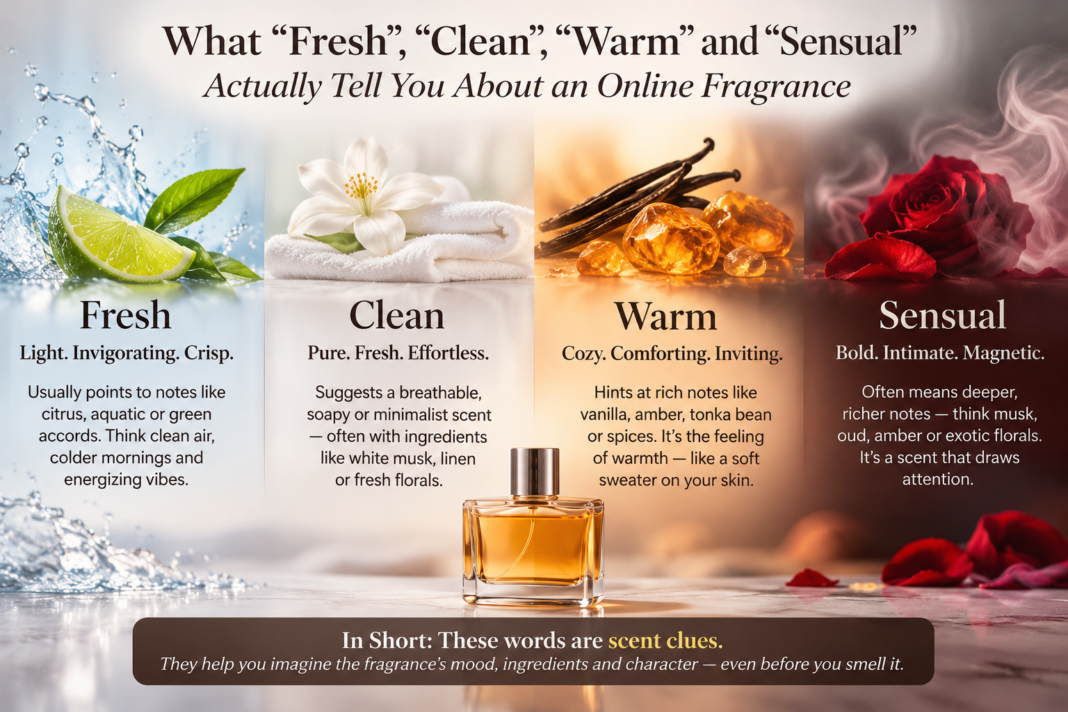
Two perfumes can both be described as “fresh”. One smells like grapefruit peel. The other reminds you of sea air. If you like the first and can’t stand the second, a page full of fresh fragrances hasn’t narrowed your search much.
When you’re buying perfume online, fresh points to brightness, clean points to a familiar association, warm points to richness or texture, and sensual usually describes the mood the brand wants to convey. These are clues of different kinds. None tells you how far the perfume will project, how long it will last on you, or whether the part you like will still be there at lunchtime.
The useful move is to turn each word into a more specific question. Fresh like what? Clean in what way? What makes it warm? And if the page calls it sensual, what would you know about the scent if you took that word out?
Which words are useful when you can’t smell the bottle?
| Word on the page | What it can tell you | What to check next |
| “Fresh” | Some part of the scent is presented as bright, crisp or airy. | Is it citrus, green, herbal or marine? Does that describe the opening or the overall scent? |
| “Clean” | The writer is making an association, perhaps with soap, laundry or washed skin. | Does the description point to powder, musk, soap or a detergent-like effect? Which of those do you enjoy? |
| “Warm” | The scent may have a rounded, spiced, woody, sweet or resinous character. | Is the warmth sugary, dry or smoky? How does the scent develop after the opening? |
| “Sensual” | The brand is suggesting a mood. | What actual scent details support it? How noticeable is it, according to someone who wore the exact version? |
Read across the table rather than treating the rows as four boxes a perfume has to fit into. A bright opening can lead to a warm base. A powdery scent can be described as both clean and sensual. The words only seem to contradict each other if you assume they’re describing the same part of the perfume in the same way.
“Fresh”: Find out where the brightness comes from
The Perfume Society’s guide to the fresh family separates citrus, aromatic, green, aquatic and fruity styles. That’s a useful split for anyone who knows they like freshness but keeps ordering the wrong kind. A bitter orange opening and a cool watery scent may both feel fresh. You might wear one every weekend and give the other away.
Consider Acqua di Giò Eau de Toilette. Armani’s description pairs bergamot with marine notes. The same version appears among ScentRepublic’s men’s fragrances. The useful clue is the marine side: someone looking for an aquatic freshness has a reason to shortlist it. Someone trying to avoid a watery effect has a reason to keep looking, even though bergamot is a note they enjoy.
Also check where the seller puts the word. “A fresh opening” tells you something about the first part of the wear. “A fresh fragrance” suggests that brightness is part of the overall character, although a product description can’t guarantee how you’ll experience the later hours. If the copy gives you bright citrus up front and describes a sweet vanilla finish, ask which part you’re buying it for. If your goal is a crisp scent for a warm afternoon, the finish matters just as much as the first spray.
“Clean”: Soap, laundry and skin are different requests
Imagine asking for a perfume that smells clean and being handed three options: one that recalls a bar of soap, one that smells like a freshly washed shirt, and one that gives a soft impression of clean skin. All three fit the request. For someone who dislikes the smell of laundry products, two people can agree on the word and still choose completely different bottles.
Look for the comparison the writer makes after using “clean”. A description that mentions powder and iris points you in a different direction from one that talks about a soft musk or a sharp, just-showered effect. These are reading clues rather than fixed rules. Musk can be used in very different ways, and a single note doesn’t tell you whether the fragrance will smell like soap.
Keep that distinction in mind when you see “clean fragrance” on a badge or filter. In scent copy it can describe how the perfume smells. Elsewhere a retailer might use it for its own ingredient criteria. If ingredients matter to your decision, read the retailer’s definition and check the ingredient information for the exact product. A description of the scent is no evidence that a particular ingredient is absent.
“Warm”: Ask whether it’s sweet, dry or smoky
Think of creamy vanilla, dry cedar and a smoky resin. Each can make a perfume feel warm. They have very little in common if what you’re really deciding is whether the scent will remind you of dessert. A person looking for cosy warmth might be delighted with vanilla. Someone who wants the smell of dry wood would rather know about the cedar.
ScentRepublic’s description of Mon Guerlain Eau de Parfum gives the word a job: lavender and citrus provide brightness near the start, while vanilla and sandalwood account for a softer warmth later on. If you like the idea of that transition, you have a reason to try it. If you’re trying to avoid sweetness after the opening, the lavender alone is a poor reason to order a full bottle.
Warmth also says little about strength. You can have a quiet, warm scent or a bright perfume that people notice across a room. If you’re choosing something to wear in a shared office, look for comments about how noticeable it was after a few hours. The label “warm” can help you choose a style; it can’t tell you how much of it the person at the next desk will smell.
“Sensual”: The same mood can sell very different scents
There’s a good example in two official product descriptions. Prada calls L’Homme Prada Eau de Toilette sensual and lists notes including neroli, iris, geranium, amber and patchouli. Guerlain uses the same idea for Mon Guerlain Eau de Parfum, where it highlights lavender, jasmine, vanilla and sandalwood.
The comparison shows what survives if you delete the adjective. With Prada you still have iris, neroli and an amber element to investigate. With Guerlain you have an ambery fragrance described through lavender, jasmine, vanilla and sandalwood. If you’re deciding between a more powdery direction and an aromatic vanilla, those details help you frame a shortlist. The shared mood word does very little to separate the two.
This is a comparison of published copy. It doesn’t establish that everyone will smell those perfumes the same way, or that either will feel romantic to you. A description can set a scene quite well without telling you whether you’d enjoy spending four hours in it.
Why a word can change what you expect to smell
In a 2005 experiment on how labels affect smell, researchers gave the same test odour two different labels. Participants rated it as more unpleasant when it was labelled “body odor” than when it was labelled “cheddar cheese”. This was a controlled test using a particular odour. It doesn’t prove that calling perfume sensual will make you like it. It does show why the label can matter even when the substance hasn’t changed.
There’s another reason to ask for specifics. In a 2014 study comparing Jahai and English speakers, Asifa Majid and Niclas Burenhult found that the Jahai speakers in their study could name odours about as readily as colours, while the English speakers had more difficulty naming odours. That doesn’t mean English descriptions are useless. It’s a reminder that how readily people can put a smell into words depends partly on the language available to them. When two reviewers use different comparisons, look at what each is describing before deciding that one of them must be wrong.
A better way to read a perfume page before paying
Start with a preference and a deal-breaker. “I want something bright and green, but I don’t like marine notes” is more useful than “I want something fresh.” You don’t need a trained nose to do this. If you hate a scent that reminds you of washing powder, write that down in those words. It gives you a concrete detail to look for when a listing says clean.
Next, find the exact version and read beyond the first line. Compare the official notes with a retailer or reviewer’s account of how it develops. Notes are clues to the intended smell, rather than a formula or a guarantee of which note will dominate. A vanilla note by itself doesn’t tell you how sweet the whole perfume will be. If several descriptions of that exact version mention a sweet finish, that’s a better reason to sample first when sweetness is your deal-breaker.
Finally, look for the missing answer. If what you need is something discreet for work, the missing answer is likely how noticeable the perfume is after it settles. If the scent is for summer and you dislike syrupy finishes, you need to know where the initial brightness goes. A detailed review or a small sample can help answer that question. If a full bottle is expensive and the only evidence in its favour is a word you happen to like, leave it on the shortlist until you have more to go on.
Frequently asked questions
Can a perfume be fresh and warm at the same time?
Yes. The words can describe different parts of the wear: a bright citrus opening and a warm wood or vanilla finish, for example. If you want a bright scent that stays that way, look for descriptions of the dry-down before buying.
Does a clean perfume always smell like soap?
No. The writer may mean laundry, soft musk, powder or simply a just-showered impression. Look for a more concrete comparison and watch for any description that resembles something you already know you dislike.
Is a fresh perfume usually weaker than a warm one?
Those words describe character, and neither gives you a reliable measure of strength. Check how wearers describe the exact version after it settles. If it matters how noticeable it will be in close quarters, try it in that setting before committing.
Is warm the same as sweet?
Warmth can come from a sweet vanilla effect, but it can also come from dry woods, spice or resins. If sweetness is what you want to avoid, look for a description of the finish rather than relying on the family name alone.
What if a retailer and the perfume brand describe the same bottle differently?
Check the full product name first. If the versions match, see whether they’re describing different stages or using different comparisons for the same effect. One might focus on a bright opening while the other describes the warm base. A disagreement about the feature that matters to you is a good reason to sample.
Before your next order, choose one word from the page and finish the sentence it leaves open: fresh like what, clean in which way, warm from what? If the copy can answer that, you’ve got a useful clue. If all it gives you is a mood and a price, keep looking for a description that helps you decide.