Diane Lou Oswald is best known as the mother of acclaimed American actor Woody Harrelson, but reducing her story to a famous family connection misses what makes her life interesting. Long before her son became an internationally recognized actor, Diane faced the practical challenge of raising a family while dealing with the absence and notorious criminal history of her former husband, Charles Harrelson. She worked, maintained a strongly religious household, and became one of the central influences in her children’s lives.
Interest in Diane Lou Oswald has grown partly because Woody has repeatedly credited his mother with shaping his values, particularly his respect for other people. Her maiden surname has also produced persistent questions about a possible connection to Lee Harvey Oswald, although credible reporting says there is no known relationship.
This article separates documented facts from internet speculation and explores Diane’s family, work, relationship with Charles Harrelson, influence on Woody, and unusual place in a famous American family story.
Who Is Diane Lou Oswald?
Diane Lou Oswald, also known publicly as Diane Harrelson, is the mother of actor Woody Harrelson and the former wife of Charles Voyde Harrelson.
Unlike her famous son and controversial former husband, Diane never built a public career. Much of what can reliably be learned about her comes from Woody Harrelson’s interviews, historical reporting about Charles Harrelson, and photographs from occasional public appearances.
That distinction matters.
The internet contains numerous biographies assigning Diane an exact birth date, net worth, present residence, and other personal details. Many of these claims are repeated from one website to another without identifying an original record or reliable source. A responsible biography should therefore distinguish between established information and details that simply circulate online.
What is much better documented is her role within the Harrelson family.
Woody Harrelson has described growing up in a heavily female household. In a 2006 interview with The Guardian, he said that he and his two brothers were raised in what he called a “matriarchy.” He identified his mother as a substantially greater influence on him than his father and associated his upbringing with respect for both other people and the wider world.
Those observations provide something more valuable than an unsupported list of dates: they offer direct evidence about the person Diane was from the perspective of the son she helped raise.
Diane Lou Oswald’s Early Life: What Do We Actually Know?
This is one area where online biographies often become less reliable.
Various websites provide detailed accounts of Diane Lou Oswald’s childhood, birth year, parents, hometown, and upbringing. The problem is that many do not provide strong primary documentation for those claims, and some accounts contradict one another.
For example, online profiles have placed her early life in different locations. That alone should encourage caution.
The more defensible approach is to acknowledge that Diane came from outside the entertainment industry and lived most of her life as a private individual. She was not a celebrity whose childhood was extensively documented by newspapers, magazines, or television interviews.
Historical reporting does provide a useful piece of information about her early adult life. A Midland Reporter-Telegram article described the former Diane Oswald as working as a stenographer for Atlantic Refining while she and Charles Harrelson lived in Midland, Texas. The same report specifically noted that she had no known relationship to Lee Harvey Oswald.
That employment detail is significant because it places Diane’s story in a more realistic context. Before she became known to the public as the mother of a Hollywood actor, she was a working woman supporting herself and, eventually, helping support a family.
Her story was rooted in ordinary work and family responsibility rather than celebrity.
Diane Lou Oswald and Charles Harrelson
One cannot explain public interest in Diane Lou Oswald without discussing Charles Harrelson.
Diane married Charles Voyde Harrelson, Woody Harrelson’s father. Their relationship eventually ended, and historical reporting states that Diane divorced Charles in 1964.
Charles later became notorious for a very different reason.
He was convicted in connection with multiple killings, most famously the 1979 assassination of U.S. District Judge John H. Wood Jr. The federal judge was shot outside his San Antonio home.
The murder became a major federal case. Government historical material describes the investigation, known as “Woodmur,” as an extraordinarily large undertaking involving millions of documents and pieces of evidence and costing the federal government millions of dollars.
In December 1982, Charles Harrelson was found guilty of killing Judge Wood. Contemporary reporting said prosecutors alleged that he received $250,000 to carry out the murder.
His conviction was subsequently considered on appeal by the U.S. Court of Appeals for the Fifth Circuit.
Charles ultimately spent the remainder of his life in federal custody and died in prison in 2007.
The contrast between Diane and Charles inevitably attracts attention: one parent became associated with a notorious criminal case, while the other provided much of the everyday parental stability described by their famous son.
Yet Diane’s biography should not simply be treated as an appendix to Charles Harrelson’s crimes. By the time of his most notorious offense, their marriage had been over for years.
That chronological distinction is essential.
Raising Woody Harrelson and His Brothers
Diane was the mother of three sons: Woody, Brett, and Jordan Harrelson.
Woody Harrelson, born in Texas in 1961, eventually became by far the most publicly recognizable member of the family. His career would include major television and film performances and multiple Academy Award nominations.
His childhood, however, was far removed from Hollywood.
After Charles ceased being a conventional presence in the family, Diane became the dominant parental influence. Woody’s own accounts emphasize not simply his mother but a wider network of women around him.
In a 2015 interview, he confirmed that his childhood family structure was highly matriarchal and included his mother, grandmother, and great-grandmother.
This detail provides an important way of understanding Diane’s influence.
Single-parent narratives are sometimes written as though one person existed completely alone. Family life is usually more complicated. Diane appears to have been the central parent, but Woody has also described a wider circle of women who contributed to his upbringing.
That environment seems to have had a lasting effect on him.
In his 2006 comments about his upbringing, Woody connected his mother with respect for other people and the world around him. He also described her as deeply religious.
The importance of these comments is easy to overlook. They show that Diane’s influence was not simply financial or logistical. Her son associates her with a particular moral framework.
Diane Lou Oswald’s Career and Working Life
One of the more interesting parts of Diane’s story is also among the least glamorous: she worked.
Historical reporting identifies her as a stenographer at Atlantic Refining during her time in Midland. Later biographical reporting has described her as a legal secretary.
Those occupations provide useful context for understanding the Harrelson family.
Diane was not living off the earnings of a successful actor while raising Woody. His fame came much later. Nor was her household built around a conventional two-parent arrangement with a reliably present father.
Work was therefore not an incidental detail in her life. It was part of the structure that supported her family.
It also helps explain why Woody’s descriptions of his mother repeatedly emphasize action and example rather than celebrity-style anecdotes.
Parents communicate values in two ways: through what they tell their children and through what their children repeatedly observe.
A child who watches a parent go to work, meet responsibilities, maintain a household, and continue functioning through family disruption receives a practical lesson about persistence. It does not require a motivational speech.
This may be one reason Diane’s story resonates despite the limited amount of information publicly available about her. Her influence seems to have come primarily through daily life rather than public achievement.
Diane Lou Oswald’s Influence on Woody Harrelson
The strongest evidence for Diane’s character comes from Woody himself.
In a 2018 Guardian interview, Woody described his mother as a major influence and said she had taught him important values about treating people properly and behaving honorably. He called her a role model who continued to influence him as an adult.
That statement is particularly useful because it avoids vague celebrity-biography language.
It identifies specific areas of influence:
Respect for people. Woody directly associated his mother with how people should be treated.
Honorable conduct. He connected her example with an ethical standard for personal behavior.
Long-term role modeling. He did not describe Diane merely as someone who influenced his childhood. In the 2018 interview, when he was already a globally famous actor in his fifties, he described her influence in the present tense.
That suggests something important about parenting: its effects are not necessarily limited to childhood.
Successful adults frequently reassess their upbringing once they have children, careers, and responsibilities of their own. Woody’s continued public appreciation for his mother indicates that he sees aspects of his adult values as extensions of lessons learned at home.
The Importance of the Matriarchal Harrelson Household
A particularly revealing phrase in Woody Harrelson’s descriptions of his childhood is “matriarchy.”
He has repeatedly discussed being surrounded by influential women. In addition to Diane, his grandmother and great-grandmother played significant roles.
This helps place Diane within a larger family culture.
Woody’s later admiration for strong women did not emerge in a vacuum. His childhood model of authority, care, discipline, and continuity appears to have been overwhelmingly female.
In 2006, he explained that his mother was much more influential in his life than his father.
Almost a decade later, discussing his family background again, he confirmed that the household had been highly matriarchal.
The consistency between interviews is noteworthy.
Rather than viewing Diane merely as “Woody Harrelson’s mother,” it is more accurate to understand her as a central member of the female family structure that shaped his formative years.
That distinction makes her story considerably more interesting.
Religion and Values in Diane Lou Oswald’s Household
Religion was another important part of the household in which Woody Harrelson grew up.
Historical reporting has described Diane as religiously devout, while Woody himself has said that his mother was highly religious.
The family’s religious environment appears to have been significant during Woody’s youth. He has spoken in interviews about his own early religious experiences and how his beliefs later changed.
It would be misleading, however, to assume that every aspect of Woody’s adult worldview came directly from his mother.
Children absorb parental values, reinterpret them, reject some, and adapt others.
What appears to have endured most strongly in Woody’s descriptions of Diane is not a particular theological doctrine but an ethical emphasis: respect, honorable conduct, compassion toward others, and responsibility.
This distinction is useful.
Influence does not require ideological duplication. A child can develop dramatically different beliefs from a parent while retaining lessons about kindness, discipline, work, and how other people deserve to be treated.
Woody’s public comments suggest that this was an important dimension of Diane’s legacy.
A Family Defined by Two Very Different Parental Influences
The Harrelson family story contains an extraordinary contrast.
Charles Harrelson became associated with murder-for-hire and one of the most infamous judicial assassinations in modern U.S. history. Diane, meanwhile, became associated in her son’s recollections with work, religion, family care, and moral guidance.
That contrast makes for a compelling story, but it should not be simplified into a movie-like narrative of a purely “good” parent versus a purely “bad” one.
Real families are more complicated.
Woody eventually had contact with his father and has discussed him in nuanced terms. In his 2018 interview, he even identified his father’s advice about keeping an open mind as something that had benefited him.
Nevertheless, Woody has been clear about which parent had the greater formative presence.
Diane was there.
That simple fact matters enormously in childhood development. Consistency, daily contact, expectations, and repeated example can exert more influence than dramatic but infrequent interactions.
The Harrelson story therefore offers a broader lesson: public notoriety is not the same thing as personal influence.
Charles generated headlines. Diane shaped everyday life.
Is Diane Lou Oswald Related to Lee Harvey Oswald?
This is one of the most frequently searched questions about Diane, and it deserves a clear answer.
There is no known family relationship between Diane Lou Oswald and Lee Harvey Oswald.
The confusion comes primarily from their shared surname.
Lee Harvey Oswald was the former U.S. Marine identified by official investigations as President John F. Kennedy’s assassin. He was born in New Orleans in 1939 to Marguerite Frances Claverie and Robert Edward Lee Oswald Sr.
Diane’s maiden surname was also Oswald, but historical reporting about the Harrelson family explicitly describes her as having no known relation to Lee Harvey Oswald.
The confusion becomes more complicated because Charles Harrelson himself became associated with JFK conspiracy theories.
That coincidence has encouraged speculation linking otherwise unrelated stories.
But a shared surname is not genealogical evidence.
Without reliable records demonstrating a family connection, claims that Diane Lou Oswald was related to Lee Harvey Oswald should not be presented as fact.
For readers arriving through Google specifically to answer this question, the evidence-based conclusion is straightforward: no credible documentation establishes that they were relatives.
Why the Oswald Confusion Persists
Search engines tend to amplify associations.
When users search “Diane Lou Oswald,” the surname naturally produces results related to Lee Harvey Oswald. Add Charles Harrelson’s controversial history to the equation, and unrelated threads of American crime history can easily become tangled together.
This demonstrates a broader problem with online celebrity biographies.
One website publishes an unsupported claim. Another repeats it. A third paraphrases the second. Eventually, the statement can appear widely established despite all versions tracing back to weak or nonexistent evidence.
Diane’s biography requires particular caution because she has not maintained the kind of extensive public record associated with celebrities.
The best sources are therefore those closest to the events: historical newspaper reports, court records, government material, contemporary photographs, and direct interviews with Woody Harrelson.
Using that hierarchy produces a less sensational biography but a more credible one.
Diane Lou Oswald and Woody Harrelson’s Hollywood Success
Woody Harrelson eventually followed a path dramatically different from either of his parents’ early lives.
After studying English and theater at Hanover College, he pursued acting and achieved his breakthrough playing bartender Woody Boyd on the television sitcom Cheers. His career later expanded into acclaimed dramatic and comedic film performances.
What is interesting about Diane’s place in this story is that she remained relevant to Woody even after his success.
Fame could easily have created distance between his childhood world and adult identity. Instead, Woody continued referring publicly to the values he associated with his mother.
Diane has also occasionally appeared alongside her famous son.
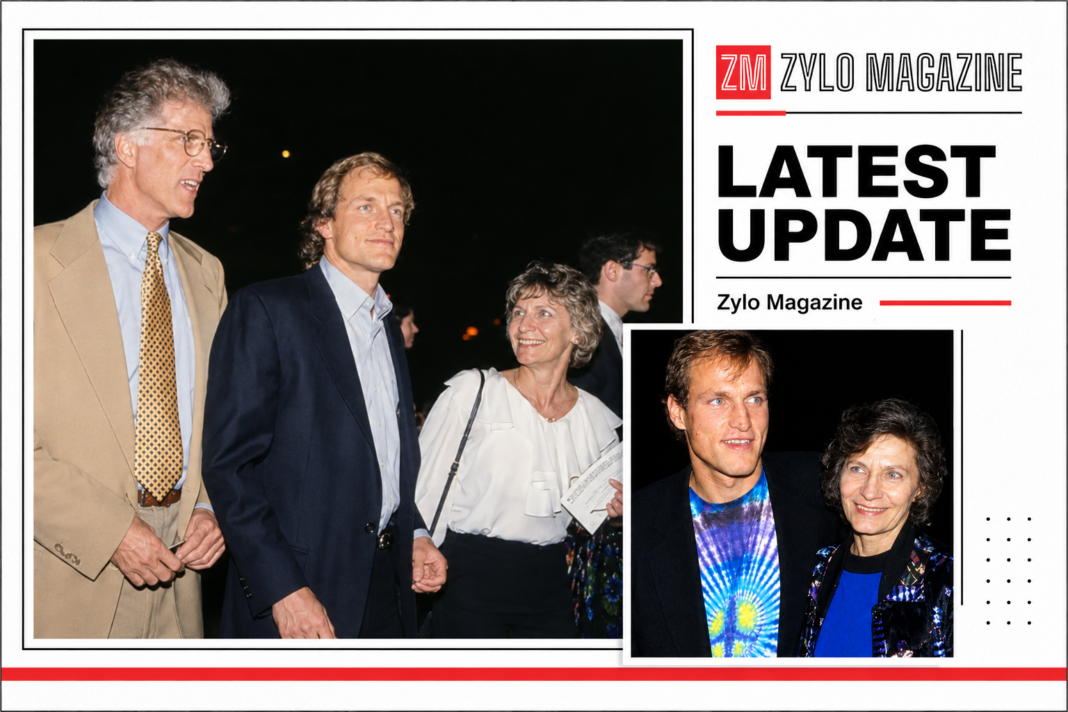
Photographs have documented her attending entertainment-related events with Woody, and later reporting also records her accompanying him to Wimbledon in 2017.
Those appearances are useful for another reason: they help correct inaccurate internet biographies.
Some genealogy-style pages and low-quality profiles have circulated questionable death dates for Diane. A documented public appearance in 2017 obviously contradicts any claim that she died years earlier.
It is a reminder that even apparently simple biographical facts should be verified before being repeated.
Diane Lou Oswald’s Private Life
Diane’s limited public profile is arguably one of the most defining characteristics of her biography.
She never transformed her connection to Woody into an obvious celebrity platform. There is no substantial body of interviews, memoirs, public commentary, or entertainment projects centered on her.
As a result, reliable information about her current personal life is limited.
That uncertainty should be respected rather than filled with speculation.
Some websites provide a precise present-day residence, age, lifestyle, net worth, and other details. Unless those claims can be traced to credible contemporary documentation, they should be treated cautiously.
Privacy is not missing information that writers have permission to invent.
This is especially important when writing about relatives of celebrities. Fame can make public curiosity understandable, but it does not automatically make every detail of a relative’s private life a matter of public record.
What can be discussed confidently is the influence Diane has had because Woody himself has chosen to discuss it.
What Diane Lou Oswald’s Story Teaches About Resilience
It is easy to use the word “resilience” in celebrity biographies until it loses meaning. Diane’s story gives the concept a more practical definition.
Resilience is not necessarily a dramatic comeback.
Sometimes it is continuity.
It is continuing to work when family circumstances change. It is providing structure for children despite instability elsewhere. It is maintaining routines while another family member attracts negative attention. It is ensuring that children are exposed to expectations and values that are not defined by someone else’s behavior.
This perspective helps explain why Diane’s influence deserves attention independently of Woody’s fame.
Her achievement was not producing a Hollywood star according to some predetermined plan. There is no evidence that this was her objective.
The more meaningful accomplishment was helping create an environment in which her children did not have to be defined by their father’s criminal history.
Woody eventually became famous, but the underlying lesson applies far beyond celebrity families.
A difficult family history influences a child, but it does not necessarily dictate the child’s future.
Why Diane Lou Oswald Remains a Popular Search Topic
Several different audiences search for Diane Lou Oswald.
Some are Woody Harrelson fans who want to understand the actor’s upbringing.
Others encounter her name while reading about Charles Harrelson and the murder of Judge John H. Wood Jr.
A third group is interested in the surname Oswald and wants to know whether Diane has any connection to Lee Harvey Oswald.
These interests overlap, producing an unusually complicated search topic.
But perhaps the strongest reason Diane remains interesting is the contrast between fame and influence.
She was not the household name.
Her son was.
She was not the person generating sensational headlines.
Her former husband was.
Yet when Woody discusses the people who shaped his character, his mother occupies a central place.
That inversion makes Diane’s story valuable. It reminds us that the most visible person in a family is not necessarily the most influential.
Separating Facts From Myths About Diane Lou Oswald
Readers researching Diane should keep several distinctions in mind.
Documented: She is Woody Harrelson’s mother and Charles Harrelson’s former wife.
Documented: Historical reporting identified the former Diane Oswald as a stenographer at Atlantic Refining.
Documented: Woody has repeatedly described his childhood household as matriarchal and credited his mother with influencing his values.
Documented: Charles Harrelson was convicted of killing federal judge John H. Wood Jr.
Documented: There is no known relationship between Diane Oswald and Lee Harvey Oswald.
Needs caution: Exact claims about Diane’s present residence, personal wealth, health, and current activities.
This evidence-first approach makes the biography more useful because it prevents speculation from being presented as established history.
Diane Lou Oswald’s Lasting Legacy
Diane Lou Oswald’s legacy is difficult to quantify because it is primarily personal rather than professional.
She did not leave behind a celebrated filmography, political career, major company, or collection of published works.
Instead, the clearest evidence of her influence comes through the people she raised.
Woody Harrelson’s public descriptions of his mother consistently return to character: respect, values, honorable treatment of others, and the influence of the women who raised him.
There is something revealing about that.
When people describe an influential parent decades later, the qualities they remember are often not dramatic moments. They remember habits, standards, attitudes, and examples.
That appears to be the most meaningful way to understand Diane.
Her legacy is not that she happened to give birth to a successful actor. It is that the successful actor, after decades of extraordinary experiences, continued identifying her as one of the people who taught him how to approach others.
That is a much more substantial form of influence.
Frequently Asked Questions About Diane Lou Oswald
Who is Diane Lou Oswald?
Diane Lou Oswald, also known as Diane Harrelson, is best known as the mother of actor Woody Harrelson and the former wife of Charles Harrelson. She worked outside the entertainment industry and played the dominant parental role in the household in which Woody and his brothers grew up. Woody has repeatedly credited his mother with strongly influencing his values.
Is Diane Lou Oswald related to Lee Harvey Oswald?
There is no known family relationship between Diane Lou Oswald and Lee Harvey Oswald. Historical reporting about the Harrelson family specifically notes the absence of a known relationship. Their shared surname has nevertheless generated considerable online confusion.
Who was Diane Lou Oswald married to?
Diane was married to Charles Voyde Harrelson, Woody Harrelson’s father. The marriage ended years before Charles committed the crime for which he became most notorious. Charles was convicted in 1982 of killing U.S. District Judge John H. Wood Jr.
What did Diane Lou Oswald do for a living?
Historical reporting describes Diane as a stenographer for Atlantic Refining during her years in Midland, Texas, while other reputable biographical reporting identifies her as having worked as a legal secretary. Her working life is particularly significant because she carried substantial responsibility for raising her children.
How did Diane Lou Oswald influence Woody Harrelson?
Woody has directly credited his mother with teaching him important values about respecting other people and behaving honorably. He has also described his upbringing as matriarchal, with his mother, grandmother, and great-grandmother forming an influential network of women around him.
Conclusion: Why Diane Lou Oswald’s Story Matters
Diane Lou Oswald’s story is compelling precisely because she was never the most famous person in her family. Her former husband, Charles Harrelson, became notorious for violent crime, while her son Woody Harrelson became an internationally recognized actor. Diane followed a quieter path centered on work, family, religion, and raising her children.
The strongest evidence of her legacy comes from Woody himself. Across interviews separated by many years, he has consistently described a matriarchal upbringing and credited his mother with teaching respect, honorable behavior, and values that remained important in adulthood.
Her biography also offers a useful warning against internet misinformation: there is no established connection between Diane and Lee Harvey Oswald, and many highly specific claims about her private life remain poorly sourced.
Ultimately, Diane Lou Oswald is worth understanding not because she pursued fame, but because her quiet, sustained influence demonstrates how profoundly an ordinary working parent can shape an extraordinary life.
Continue Exploring Our Latest Article: Natalie Oglesby Skalla: The Private Life and Story of Frank Sinatra Jr.’s Daughter