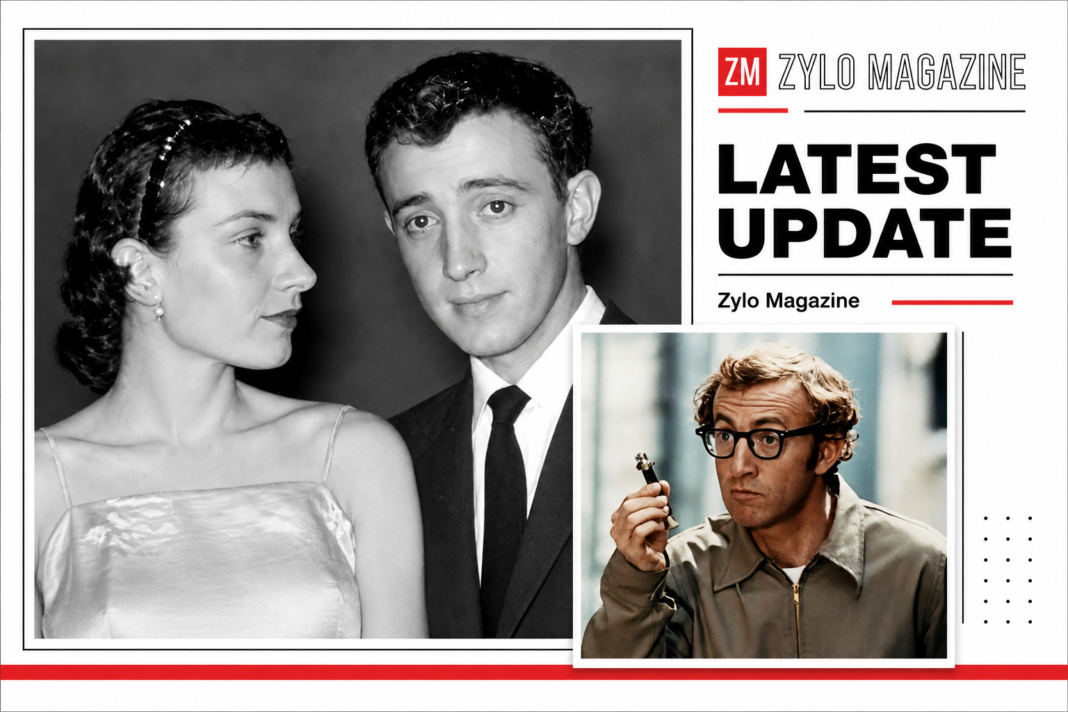
Harlene Rosen is best known as the first wife of filmmaker, comedian, and writer Woody Allen, but reducing her story to that single description misses what makes her an interesting figure in entertainment history. Rosen knew Allen before international fame, Academy Awards, celebrated films, and decades of public controversy. They married while both were remarkably young and spent formative years together as Allen was beginning to establish himself as a professional comedy writer. Their relationship eventually deteriorated, and Rosen later objected to the way her former husband transformed aspects of their marriage—and her identity—into material for his comedy.
What makes the story of Harlene Rosen particularly intriguing today is how little of her later life she chose to make public. Unlike many people connected to celebrities, Rosen did not build a career from that association. Understanding her therefore requires separating documented history from recycled internet claims, while examining what her experience reveals about privacy, comedy, fame, and personal reputation.
Who Is Harlene Rosen?
Harlene Rosen, also referred to in biographical material as Harlene Susan Rosen, was Woody Allen’s first wife. Their relationship began years before Allen became internationally known for movies such as Annie Hall, Manhattan, and Hannah and Her Sisters.
Rosen was a teenager when she married Allen in 1956. Allen was 20, while Rosen was approximately 17. Sources describe her as a philosophy student, and The Guardian reports that she studied at Hunter College.
This detail is significant because Rosen is sometimes portrayed online almost entirely through her relationship with Allen. The historical picture is more interesting. She was pursuing an education while her young husband was attempting to establish himself in entertainment.
The couple belonged to a very different period of Allen’s life from the one most audiences recognize today. He was not yet the famous filmmaker associated with sophisticated New York comedies. He was a young comedy writer trying to turn his ability to produce jokes into a sustainable career.
Rosen was consequently present during an important developmental period.
She did not, however, become a Hollywood celebrity herself. There is no substantial public record establishing a later career as an actress, filmmaker, media personality, or professional celebrity. After her marriage and the subsequent controversy surrounding Allen’s comedy, she maintained an exceptionally private profile.
That distinction is essential when researching Harlene Rosen. Much of what people want to know about her simply was never reliably documented.
Harlene Rosen Quick Facts
| Topic | Available information |
|---|---|
| Full name | Commonly reported as Harlene Susan Rosen |
| Known for | Woody Allen’s first wife |
| Nationality | American |
| Education | Described as a philosophy student; The Guardian identifies Hunter College |
| Marriage | Married Woody Allen in 1956 |
| Age at marriage | Approximately 17 |
| Woody Allen’s age at marriage | 20 |
| Separation | Commonly placed around 1959 |
| Divorce | Reported as finalized in 1962 |
| Children with Woody Allen | No publicly documented children together |
| Public profile | Extremely private after the marriage |
| Notable later appearance in the historical record | A message contributed in connection with David Evanier’s 2015 biography Woody |
One complication deserves immediate attention: readers will encounter different dates for the end of the relationship.
Some accounts describe the marriage as lasting from 1956 until 1959, while biographical sources also identify 1962 as the divorce year. The Guardian, for example, lists the marriage in 1956 and divorce in 1962.
The most useful way to understand the discrepancy is to distinguish the breakdown or separation of the relationship from the legal completion of the divorce.
Harlene Rosen’s Early Life
Reliable details about Harlene Rosen’s childhood are surprisingly scarce.
This is an important point because modern celebrity-biography websites frequently create the impression that virtually every detail of a person’s childhood, family, career, net worth, residence, and relationships is publicly available. In Rosen’s case, it is not.
She became historically notable because of her relationship with Allen, not because she had previously sought public attention.
One of the more useful pieces of information comes from The Guardian, which described Rosen as the daughter of a shoe-store owner and a philosophy student at Hunter College. The publication also placed her and Allen’s early connection within Jewish social circles in Flatbush.
Her education is especially relevant.
Rosen’s later recollections indicate that she completed four years of college while Allen developed his career. That helps restore some balance to a story frequently narrated entirely through the trajectory of her famous former husband.
She was not simply waiting on the sidelines while Allen became successful. Both young people were trying to develop their adult identities.
How Did Harlene Rosen Meet Woody Allen?
Harlene Rosen and Woody Allen met when they were teenagers in New York.
Biographical reporting connects their early relationship to the Jewish social-club environment in Brooklyn.
At that point, Allen was Allan Stewart Konigsberg, an ambitious young comedy writer rather than an internationally famous filmmaker.
He had already demonstrated an unusual ability to write jokes in large quantities. His professional ambitions were increasingly taking him toward television and entertainment, but the enormous cultural reputation that would later surround his name did not yet exist.
That context matters.
It is easy to view Rosen retrospectively as someone who “married Woody Allen,” as if she had married an established celebrity. She did not. She entered a relationship with a young man whose future was far from guaranteed.
Their shared youth also helps explain both the attraction and the instability that followed.
Rosen’s much later reflections suggest that music, movies, creativity, and youthful excitement formed part of their connection. What eventually became a contentious marriage began as a teenage romance.
Harlene Rosen and Woody Allen’s Marriage
Harlene Rosen married Woody Allen in 1956.
Allen was 20 and Rosen was about 17.
Those ages are crucial to understanding their marriage.
Rather than judging the relationship only through the people they eventually became, it is useful to remember that both were entering adult life at the same time.
Marriage created adult responsibilities while their personalities, careers, ambitions, and expectations were still developing.
Allen was intensely focused on comedy.
Rosen was pursuing her education.
Their later accounts and biographies suggest that the relationship became difficult relatively quickly. In a 1972 Time profile, Allen’s first marriage was already being discussed in connection with the development of his comedy and his tendency to transform unhappiness into jokes.
That habit would eventually become central to Rosen’s public story.
Harlene Rosen’s Influence During Woody Allen’s Early Development
It would be an exaggeration to claim that Harlene Rosen created Woody Allen’s intellectual identity. There is not sufficient evidence for such a sweeping conclusion.
However, she was present during a period of significant intellectual development in his life.
The Guardian reports that after marrying Rosen, Allen arranged for a Columbia University tutor to take him through major writers and thinkers including Plato, Aristotle, Dante, and James Joyce. The same account describes Rosen as a philosophy student.
That is an intriguing historical connection.
Allen later became famous for a comic and cinematic persona saturated with references to philosophy, literature, psychoanalysis, European cinema, classical music, mortality, and existential anxiety.
Rosen should not automatically be credited with producing that transformation. But their marriage coincided with a period when Allen was deliberately broadening his cultural education.
This makes Rosen more relevant to his formative years than the label “first wife” suggests.
It also demonstrates why studying the early relationships of creative figures can be valuable. Artists rarely develop in isolation. The intellectual environments, friendships, relationships, books, arguments, and cultural experiences surrounding them often contribute to their evolution.
Why Did Harlene Rosen and Woody Allen Separate?
There is no responsible way to reduce the failure of a marriage to one simple cause, particularly when much of the surviving public narrative comes from one partner.
What can be said is that the marriage became unhappy and the couple separated while still young.
Sources commonly place their separation around 1959, with the legal divorce completed later, in 1962.
The relationship’s difficulties subsequently became public because Allen incorporated his marriage into his emerging stand-up persona.
That decision transformed what could have remained a private failed marriage into something more complicated.
Allen’s comedy often depended on self-deprecation, anxiety, romantic failure, and exaggerated stories about personal relationships. His unhappy marriage therefore provided potentially useful material.
But there was an obvious problem.
A joke about a fictional spouse is one thing. A joke recognizable as being about a real former spouse can affect another person’s reputation.
For Rosen, that distinction eventually became significant enough to prompt legal action.
“The Dread Mrs. Allen”: When Private Life Became Comedy
One of the most famous phrases associated with Harlene Rosen is Allen’s description of her in his comedy as “the Dread Mrs. Allen.”
The phrase was part of a comic construction of married life in which the performer presented himself as unlucky, anxious, humiliated, and trapped in difficult relationships.
From a comedy-writing perspective, this approach was effective because it turned personal frustration into narrative material.
From Rosen’s perspective, however, she was a real person.
That difference is essential.
Biographical accounts note that Rosen became the target or subject of jokes in Allen’s early comedy. A Guardian review of John Baxter’s biography of Allen similarly observes that Rosen became the subject of his gags.
The situation illustrates a problem that has become even more relevant in the era of podcasts, memoirs, YouTube, TikTok, and autobiographical stand-up comedy:
Who owns the story of a relationship?
A comedian has the right to talk about personal experiences within legal limits. But the other person in those experiences also has interests involving privacy, dignity, accuracy, and reputation.
The Harlene Rosen episode is therefore more than an obscure piece of celebrity history. It is an early example of the tension between autobiographical entertainment and the rights of people turned into characters without controlling the narrative.
Harlene Rosen’s Defamation Dispute With Woody Allen
The most controversial chapter in Harlene Rosen’s public history concerns her legal dispute with Allen.
Accounts of Allen’s early career report that Rosen pursued a defamation claim after comments and jokes concerning her were made publicly. Allen himself later referred to being sued by his former wife.
The important point is not to reproduce the most offensive material unnecessarily. The historical significance lies in Rosen’s objection to having her identity and painful personal circumstances converted into public comedy.
This episode deserves more thoughtful treatment than it often receives.
It can be tempting to frame the dispute simply as another amusing anecdote in the biography of a famous comedian: the young comic tells jokes about his ex-wife, and she sues him.
But that framing automatically centers the entertainer.
Viewed from Rosen’s position, the situation looks different.
Her former husband possessed something she did not: a growing public platform.
He could repeatedly present a version of their relationship to audiences who had never met her. Those audiences knew the character created in the comedy, not necessarily the private person behind it.
A legal response offered Rosen one way to challenge that imbalance.
Whatever readers think about the limits of comedy, the dispute demonstrates a basic principle: when artists use real people as material, creative freedom and personal consequences can collide.
The Power Imbalance Between Performer and Private Person
This may be the most valuable modern insight in Harlene Rosen’s story.
When one person in a relationship becomes famous, the historical record can become dramatically uneven.
The celebrity gives interviews.
The celebrity publishes books.
Journalists profile the celebrity.
Biographers interview the celebrity’s friends and colleagues.
Audiences repeat the celebrity’s stories.
Eventually, one person’s interpretation can begin to look like objective history.
Harlene Rosen did not have an equivalent public platform.
Consequently, much of what the public learned about their marriage came through Allen or people documenting Allen’s career.
That does not automatically make every account inaccurate. It does mean responsible readers should distinguish between three things:
- documented events;
- Allen’s autobiographical or comedic version of events; and
- Rosen’s own comparatively rare statements.
This distinction is useful far beyond celebrity biography.
Whenever one participant in a private event has significantly greater access to media, their narrative can dominate simply because it is repeated more often.
Visibility is not the same as neutrality.
When Did Harlene Rosen and Woody Allen Divorce?
This is one of the most confusing questions surrounding Harlene Rosen because different sources use different dates.
The simplest chronology is:
- 1956: Harlene Rosen and Woody Allen married.
- Around 1959: their relationship had broken down and they separated.
- 1962: their divorce was legally finalized.
This explains why some references describe the marriage as ending in 1959 while others give 1962.
The Guardian lists Rosen as Allen’s wife from 1956 until a 1962 divorce.
When researching historical relationships, this type of discrepancy is common. “Marriage ended” can informally refer to the date a couple separated, while official records and biographies may use the date of the legal divorce.
Understanding that difference prevents an apparent contradiction from becoming misinformation.
Did Harlene Rosen and Woody Allen Have Children?
There is no well-established public record of Harlene Rosen and Woody Allen having children together.
This is another area where careful wording matters.
A responsible biography should not convert the absence of publicly available information into speculation about private family matters.
Similarly, detailed claims about Rosen’s later relationships or family should be treated cautiously unless they are supported by reliable sources.
Her post-divorce life was largely private.
That privacy is not a missing chapter that writers are obligated to fill with guesses.
It is part of the story itself.
What Happened to Harlene Rosen After the Divorce?
After the end of her marriage and the public dispute involving Allen’s comedy, Harlene Rosen largely disappeared from public view.
That is one of the most distinctive facts about her life.
Many people associated with major entertainers eventually write memoirs, sell interviews, appear in documentaries, develop social-media followings, or periodically comment on their famous former partners.
Rosen did not become known for doing those things.
Reliable public information about her later employment, romantic relationships, finances, residence, and everyday life is extremely limited.
Readers should therefore be skeptical of websites offering precise claims about subjects such as Harlene Rosen’s net worth, current address, later husband, children, or detailed career unless those claims are backed by credible evidence.
The internet has created an odd incentive in celebrity publishing: search engines reveal that people are asking a question, so websites feel pressure to provide an answer—even when no reliable answer exists.
Good biography works differently.
Sometimes the accurate answer is simply: this information has not been reliably established in the public record.
Why Harlene Rosen’s Privacy Matters
Rosen’s absence from celebrity culture can itself be interpreted as meaningful, although her motives should not be invented.
She had a connection that could easily have kept her name in entertainment coverage for decades.
Instead, her public footprint remained small.
This makes writing about Harlene Rosen an unusual exercise. The ethical objective should not be to reconstruct every undocumented detail of her private life. It should be to understand what is genuinely known.
Her story provides a useful lesson about the difference between public interest and public curiosity.
A historical connection to a famous person can make someone interesting to readers. It does not automatically make every later relationship, address, financial detail, or family circumstance legitimate public knowledge.
Privacy is particularly relevant when the individual did not choose a career based on publicity.
Harlene Rosen’s Remarkable 2015 Message
One of the most revealing developments in Rosen’s story occurred decades after the marriage ended.
Biographer David Evanier published Woody: The Biography in 2015. Promotional material for the book specifically emphasized that Evanier had spoken with Harlene Rosen, noting that she had not publicly commented about Allen since the end of their marriage decades earlier.
Kirkus Reviews also identified Rosen among the people Evanier interviewed for the biography.
Her later reflection was striking because it was not simply angry or accusatory.
Rosen remembered Allen’s creativity and energy while also acknowledging that their marriage had been difficult. She recalled that Allen established his career as she completed college and that the two of them learned about adulthood during those years.
The emotional picture she offered contained affection as well as pain.
That complexity is important.
Human relationships rarely fit the simple categories that celebrity storytelling prefers. A marriage can be unhappy without every memory being unhappy. Someone can object strongly to how a former partner behaved while still remembering meaningful experiences with that person.
Rosen’s later reflection therefore complicates the caricature that had followed her for decades.
Why the 2015 Reflection Changes the Story
For years, the most culturally visible version of Harlene Rosen was mediated through Woody Allen.
She was the former wife in the jokes.
The difficult spouse.
The woman associated with a lawsuit.
Her later contribution to Evanier’s biography provided something different: her own retrospective voice.
It did not erase the conflict or prove that every earlier disagreement had disappeared. Nor should it be exaggerated into a complete public reconciliation for which we lack sufficient evidence.
What it did demonstrate was perspective.
Rosen could apparently look back on a youthful relationship and recognize several truths at once: it had been difficult, both people were growing up, there had been sadness, and there had also been affection.
That is arguably a more mature historical portrait than either romanticizing their teenage marriage or reducing it entirely to hostility.
Harlene Rosen and Woody Allen’s Early Career
Rosen’s story also overlaps with an important transitional stage in Allen’s professional development.
Before filmmaking made him internationally famous, Allen worked as a comedy writer and stand-up performer.
A 1972 Time profile described the trajectory from poorly paid early comedy work toward much better earnings and noted how his apartment, psychoanalysis, and marriage became sources for his comedy.
That transformation helps explain why Rosen became part of his material.
Allen was developing a persona built around a nervous, intellectually insecure, romantically unsuccessful New Yorker. Personal experience could be reshaped to support that character.
The crucial word is reshaped.
Stand-up comedy is not a deposition.
Stories are compressed, exaggerated, rearranged, and optimized for punchlines. Audiences therefore should not automatically interpret autobiographical comedy as literal historical documentation.
This distinction is particularly important when another identifiable person appears in the story.
Was Harlene Rosen a “Muse”?
The word “muse” is frequently overused in celebrity writing.
There is evidence that Allen drew comedy material from his marriage and that Rosen was part of his life during an important stage of his intellectual and professional development.
That does not necessarily make “muse” the most accurate description.
Calling the spouse of a male artist his muse can also unintentionally reduce her role to inspiring his creativity.
Rosen was a student pursuing her own education. Her later recollection emphasized that while Allen was establishing a career, she was completing college.
A more precise interpretation is that Rosen was one of the important people present during Allen’s formative adulthood, and their marriage became part of the autobiographical material from which he constructed his early comic persona.
That statement is both more specific and better supported.
Is Harlene Rosen Still Alive?
This is a frequently searched question, but reliable current public information about Harlene Rosen is limited.
Because she has maintained such a private life, claims about her present circumstances should not be presented as established fact without strong sourcing.
Her documented participation in material connected with David Evanier’s 2015 biography confirms that she was alive and communicating with the biographer at that time.
Beyond well-sourced information, responsible reporting should avoid pretending certainty.
This principle is especially important with older private individuals. Search-oriented websites sometimes infer a person’s present status from an estimated birth year or simply repeat claims from other websites.
Repetition does not constitute verification.
What Is Harlene Rosen’s Net Worth?
There is no credible, widely documented public estimate of Harlene Rosen’s net worth.
Any highly specific figure should therefore be treated skeptically.
Rosen did not maintain the kind of public entertainment career that generates readily accessible information about salaries, contracts, business interests, property portfolios, or endorsements.
Celebrity “net worth” numbers are frequently estimates even for very famous people. For a private individual such as Rosen, precision is especially difficult to justify.
The useful answer is not an invented dollar figure.
It is that Harlene Rosen’s financial circumstances are private and not reliably established in the public record.
That answer may be less sensational, but it is considerably more informative.
Why People Are Still Searching for Harlene Rosen
Interest in Harlene Rosen comes from several overlapping directions.
Some readers encounter her while researching Woody Allen’s marriages and relationships. Others discover her through accounts of his early stand-up career. Some are interested in the legal controversy surrounding jokes about his first wife.
There is also a broader fascination with people who knew famous cultural figures before they became famous.
Rosen belongs to that category.
She knew Allen before Annie Hall, before Manhattan, before his major awards, and before the enormous body of public debate surrounding his personal and professional life.
She therefore represents a window into an earlier version of him.
But her appeal also comes from the fact that she did something unusual: she largely disappeared from the celebrity narrative.
The lack of information creates curiosity.
Ironically, the most respectful response to that curiosity is not to manufacture more information.
What Harlene Rosen’s Story Teaches Us About Fame
The most valuable interpretation of Harlene Rosen’s biography goes beyond the question of whom she married.
Her experience demonstrates how fame can retroactively transform an ordinary private relationship into cultural history.
Two young people married.
Their marriage failed.
One became extraordinarily famous.
Suddenly, the other person’s teenage relationship became something strangers would investigate generations later.
Fame also determines whose account survives.
Allen’s version of his early marriage circulated through stand-up performances, television appearances, recordings, interviews, biographies, and profiles.
Rosen’s voice appeared far less frequently.
That imbalance should encourage readers to approach celebrity history carefully.
The most repeated version of a story is not necessarily the complete version.
Comedy, Consent, and Personal Reputation
There is another reason Rosen’s story feels surprisingly modern.
Today, creators constantly turn private experiences into content.
Stand-up comedians discuss former partners.
Podcasters reveal family arguments.
TikTok creators describe dates.
Memoirists reconstruct marriages.
Influencers tell millions of followers about people who may have no comparable audience with which to respond.
The technology has changed, but the central question visible in Rosen’s dispute remains:
What responsibility does a storyteller have toward the real people inside a personal story?
There is no universal answer.
Creative expression matters. So do reputation, context, dignity, and the difference in power between a public performer and a private individual.
Harlene Rosen’s experience offers an early illustration of that tension.
That may ultimately be why her story deserves more thoughtful attention than a conventional “celebrity ex-wife” biography provides.
Frequently Asked Questions About Harlene Rosen
Who is Harlene Rosen?
Harlene Rosen is best known as the first wife of American filmmaker and comedian Woody Allen. They married in 1956 when both were very young, years before Allen achieved international fame as a filmmaker. Rosen was a student and has maintained a largely private life since their relationship ended.
How old was Harlene Rosen when she married Woody Allen?
Rosen was approximately 17 years old when she married Woody Allen in 1956. Allen was 20. Their young ages are important context for understanding a marriage that took place while both were still developing their adult identities.
When did Harlene Rosen and Woody Allen divorce?
The couple married in 1956, separated around 1959, and their legal divorce is generally reported as having been finalized in 1962. This separation-versus-divorce distinction explains why different biographies sometimes appear to give conflicting dates. The Guardian lists their divorce as 1962.
Why did Harlene Rosen sue Woody Allen?
Rosen pursued legal action connected to derogatory public comments and comedy material concerning her. Allen had incorporated his first marriage into his comedy, sometimes referring to Rosen through an insulting comic persona. The dispute became one of the best-known episodes associated with their post-marriage relationship.
What happened to Harlene Rosen after her divorce?
Rosen largely withdrew from public attention, and reliable details about her later career, relationships, finances, and residence remain scarce. One notable exception occurred in connection with David Evanier’s 2015 Woody: The Biography, for which Rosen communicated reflections about Allen and their youthful marriage after decades of public silence.
Conclusion: Understanding Harlene Rosen Beyond the “First Wife” Label
Harlene Rosen occupies a small but revealing place in American entertainment history. She married Woody Allen before fame transformed him into one of the most recognizable filmmakers of his generation, pursued her education while he built his early comedy career, and later found herself turned into material for the public persona he was creating. Their youthful marriage ended, and Rosen challenged comments she believed had crossed the boundary between comedy and personal harm. Decades later, however, her reflections showed that she could remember their shared youth with considerably more complexity than the old public caricatures suggested.
The most important fact about Harlene Rosen may ultimately be that much of her life remains hers. She did not convert proximity to fame into a permanent public identity. Her story therefore offers not only insight into Woody Allen’s formative years, but a valuable lesson about privacy, storytelling, reputation, and the danger of confusing a celebrity’s version of another person with that person’s complete life.
Continue Exploring Our Latest Article: Diane Rogers Kiel: The Life, Family, and Story of Richard Kiel’s Wife