Searches for “Peter Orszag hair” reveal an unusual side of public curiosity surrounding one of America’s best-known economists and financial executives. Peter R. Orszag has spent decades in economics, government, academia, and finance, yet his distinctive, consistently neat hairstyle has generated its own stream of questions online. People want to know whether his hair is natural, whether he wears a wig or toupee, why his hairline sometimes appears unusually uniform, and how his appearance has changed over the years. The important point is that photographs can tell us only so much. Lighting, styling, camera lenses, aging, hair color, and image quality can dramatically alter how someone’s hair appears. This guide examines what is actually observable about Peter Orszag’s hair, separates credible information from internet speculation, and explains why a seemingly ordinary executive haircut has attracted so much attention.
Who Is Peter Orszag?
Before examining Peter Orszag’s hair, it helps to understand why enough photographs and television footage exist for people to scrutinize his appearance in the first place.
Peter R. Orszag is an American economist and financial executive who currently serves as CEO and Chairman of Lazard. He joined the global financial advisory and asset-management firm in 2016 and subsequently held several senior positions before becoming CEO and a member of its board in October 2023. His chairman role became effective in January 2025.
Long before becoming a Wall Street executive, Orszag was prominent in American economic policymaking. He directed the Congressional Budget Office and later served as Director of the Office of Management and Budget during the Obama administration. Earlier in his career, he worked in the Clinton administration. His academic credentials include an economics degree from Princeton and a Ph.D. from the London School of Economics, where he studied as a Marshall Scholar.
That career has put Orszag in front of cameras for years: congressional appearances, government briefings, television interviews, conferences, official portraits, and corporate events. Consequently, the public has an unusually long visual record of him.
And that helps explain how his hair became an internet curiosity.
What Does Peter Orszag’s Hair Actually Look Like?
The most defensible description of Peter Orszag’s hair is surprisingly simple: it is generally short, controlled, conservative, and appropriate for a senior professional environment.
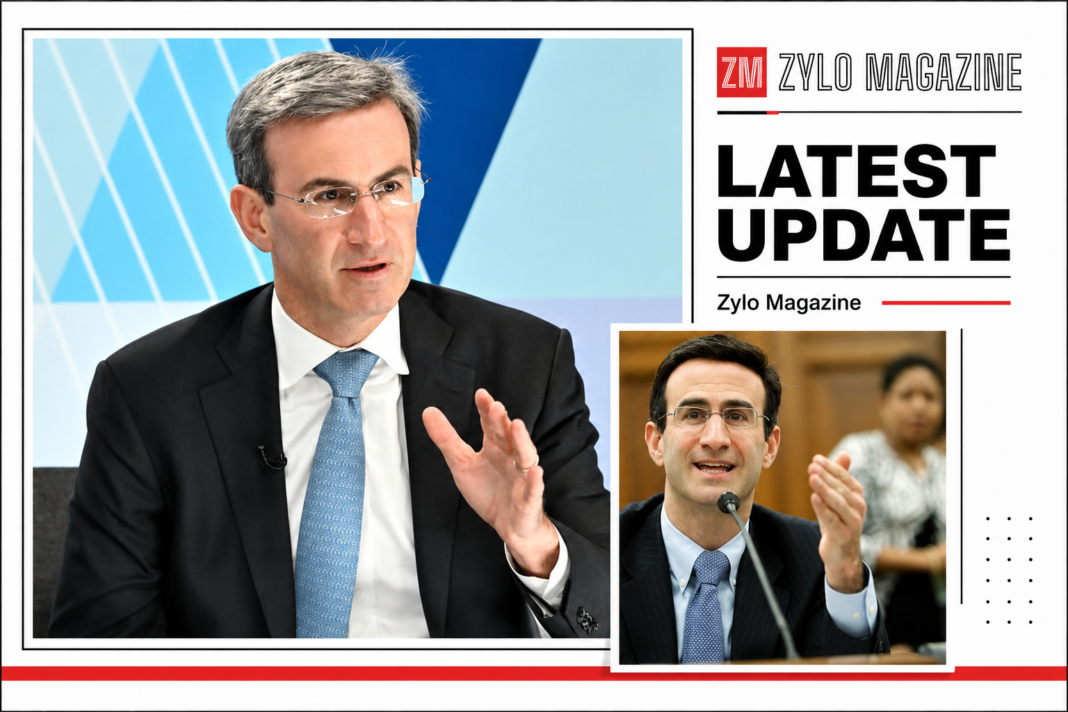
Public photographs typically show relatively short sides with greater length and density visible across the top. Rather than adopting dramatic contemporary trends, he has generally maintained a traditional executive look. His hair is usually arranged neatly and appears designed to hold a predictable silhouette rather than attract attention as a fashion statement.
One obvious change across his long public career is color. Older appearances show substantially darker hair, while recent official photographs show much more gray.
That distinction matters because color changes can affect our perception of density.
Dark hair against a lighter scalp can produce stronger visual contrast. Gray and white strands interact differently with both natural and artificial light. Studio lighting can also create highlights that make individual sections look either fuller or less dense depending on the exposure.
In other words, two photographs of the same person’s unchanged haircut can produce surprisingly different impressions.
Why Are People Searching for “Peter Orszag Hair”?
There is no single verified event that completely explains the search interest. Instead, several factors appear to have combined.
First, Orszag has a recognizable hairstyle. Consistency makes small differences noticeable. Someone who changes hairstyles frequently gives observers no fixed visual baseline, whereas a person who keeps roughly the same silhouette for years invites comparison.
Second, television is unforgiving. High-definition broadcasts, strong studio lights, different cameras, compression, makeup, and varying angles can make hair look different from one appearance to another.
Third, online culture encourages people to scrutinize the appearances of politicians, executives, actors, athletes, and television personalities. Once a question such as “Is that his real hair?” enters online discussion, subsequent viewers may begin looking specifically for evidence that confirms the suggestion.
Finally, unusual search queries can become self-reinforcing. Articles appear because people search for a phrase; more people then encounter the phrase because articles exist about it.
The result is that a minor curiosity can develop into a persistent internet topic despite limited factual information behind it.
Does Peter Orszag Wear a Wig or Toupee?
This is the central question behind many searches for Peter Orszag hair, so it deserves a precise answer.
There is no reliable publicly verified evidence establishing that Peter Orszag wears a wig or toupee.
That does not mean an outside observer can prove the opposite. It means exactly what it says: publicly available photographs are not sufficient evidence for confidently asserting that he uses a hairpiece.
Recent articles discussing the subject similarly acknowledge the lack of confirmed evidence or a public statement establishing that Orszag wears a wig or toupee.
This distinction is important because internet discussions frequently turn visual impressions into supposed facts.
A commenter might say that a hairline “looks like” a toupee. Another website repeats the observation. A third summarizes the second article without checking the original evidence. Before long, speculation can look like established reporting simply because many pages repeat it.
Repetition, however, is not verification.
Unless there is reliable firsthand documentation, a direct statement, or another authoritative source, claims about a person’s private grooming or cosmetic practices should remain labeled as speculation.
Why Can Peter Orszag’s Hair Look Like a Hairpiece in Some Images?
Understanding photography provides a much better explanation for much of the visual debate.
1. A Defined Hair Silhouette
Hair that is cut into a stable, compact shape can appear almost too uniform in certain photographs. When the perimeter stays tidy and the top is carefully controlled, the resulting silhouette can look unusually consistent.
That visual consistency is not evidence of a toupee. It is also achievable with an ordinary haircut, appropriate hair texture, and styling.
2. Television Lighting
Professional studios use multiple lights positioned around a subject. These may include strong front, overhead, side, and background lighting.
Hair reacts dramatically to these sources.
Light hitting the top of the head can expose more scalp. Softer frontal illumination may make the same hair appear denser. Shadows can create apparent depth, while overexposure can erase fine strands altogether.
Consequently, screenshots from television interviews are particularly weak evidence for determining whether somebody uses a hairpiece.
3. Camera Angle
A camera positioned at eye level records a substantially different view from one placed slightly above the subject.
Even a modest shift in angle changes how much of the scalp, crown, temples, and frontal hairline can be seen.
This becomes especially relevant when internet users compare photographs taken at completely different events.
4. Hair Color
Orszag’s increasingly gray appearance creates another variable.
Gray hair reflects light differently than dark hair. Depending on the background and exposure, some strands may almost disappear into bright areas while other sections appear more prominent.
Therefore, comparing his darker-haired government-era appearance directly with recent photographs without considering color is unreliable.
5. Styling and Hair Length
Small differences in length can have surprisingly large effects on apparent density.
Shorter hair may reveal more scalp in some circumstances but can also appear thicker because strands stand more independently. Slightly longer hair can create more coverage while sometimes separating into sections under bright lights.
The direction in which hair is brushed also matters.
None of these changes requires a wig, transplant, or other intervention.
Has Peter Orszag Had a Hair Transplant?
There is no publicly verified information establishing that Peter Orszag has undergone a hair transplant.
Again, the wording matters.
It would be inappropriate to diagnose a cosmetic procedure from photographs. Modern hair transplantation can also produce natural-looking outcomes, which means visual inspection alone cannot reliably prove or disprove whether someone has undergone treatment.
Hair transplantation usually involves relocating follicles from donor areas to areas experiencing hair loss. Techniques and results vary significantly, and determining whether a particular individual has undergone such a procedure would require substantially stronger evidence than before-and-after internet photographs.
Therefore, articles claiming with certainty that Orszag has—or has not—received a transplant go beyond what publicly verified information can establish.
The accurate conclusion is simply that no credible public confirmation has been identified.
Is Peter Orszag Bald?
Calling Peter Orszag “bald” would not accurately describe his visible appearance in current official photographs.
Recent professional images show substantial visible hair. The 2026 Lazard proxy statement, for example, identifies Orszag as the company’s CEO and Chairman and includes current corporate imagery of him.
But it is useful to distinguish everyday language from medical terminology.
People casually use “balding” to describe everything from a slightly changing hairline to advanced hair loss. Those are not equivalent conditions. Moreover, diagnosing someone’s pattern of hair loss from media photographs is unreliable.
For SEO queries such as “Is Peter Orszag bald?”, therefore, the useful answer is straightforward: his public appearance shows visible hair, and there is no good reason to make a more specific diagnosis from photographs alone.
How Peter Orszag’s Hair Has Changed Over Time
The most obvious transformation is not a mysterious change in hairline. It is aging.
Orszag has been a recognizable public figure for many years. Someone comparing images separated by a decade or more should expect differences.
The clearest observable change is the transition from darker hair to considerably more gray.
That change also affects his overall appearance. Dark hair can produce stronger contrast around the face and hairline. Gray hair often creates a softer visual transition, particularly against pale or neutral backgrounds.
His overall styling philosophy, however, appears remarkably consistent.
Rather than repeatedly adopting new cuts, he has generally retained a neat, short professional hairstyle. This continuity may actually contribute to the online fascination: because the basic style remains recognizable, observers pay greater attention to subtle variations.
The Executive-Haircut Effect: Why His Style Works Professionally
There is a practical lesson hidden inside the Peter Orszag hair discussion.
For people in finance, law, government, consulting, academia, or corporate leadership, the best hairstyle is often one that requires very little audience attention.
A reliable executive haircut performs several functions simultaneously:
- It looks appropriate in both formal and semi-formal environments.
- It photographs predictably.
- It complements business clothing rather than competing with it.
- It can be maintained without dramatic changes.
- It creates visual continuity across meetings, interviews, conferences, and public appearances.
Orszag’s public hairstyle illustrates this principle well.
His haircut is distinctive enough to become associated with him but restrained enough that it rarely becomes the focus of a normal professional appearance. Ironically, it is largely internet speculation that has turned the hair itself into a topic.
How to Get a Peter Orszag-Inspired Hairstyle
Someone searching Peter Orszag hairstyle may not care about wig rumors at all. They may simply want a similarly conservative professional haircut.
The useful approach is not to walk into a barbershop and demand an exact celebrity replica. Hair density, growth direction, face shape, texture, and hairline differ from person to person.
Instead, focus on the characteristics of the style.
Ask for a classic short professional cut with tidy sides and enough controlled length on top to create shape without looking heavily styled.
Bring a reference photograph if you want a particular variation. A visual reference communicates proportion much more effectively than trying to describe every detail verbally.
Tell your barber or stylist that the priority is a polished business appearance rather than a sharp fade, dramatic undercut, or intentionally messy finish.
Keep the Sides Controlled
The sides should generally look neat rather than bulky. The exact length should depend on your hair texture and head shape.
You do not necessarily need a skin fade. In fact, a softer traditional taper will usually produce a more classic executive effect.
Preserve Usable Length on Top
The top needs enough length to sit naturally and maintain a defined shape.
Cutting everything extremely short changes the character of the hairstyle. The goal is controlled structure, not a buzz cut.
Choose a Natural Finish
For a similar aesthetic, avoid making the hair look excessively wet or glossy.
A light styling product can provide control while preserving movement. The right product depends heavily on hair type, so a barber who can examine your hair directly will give better advice than a generic online recommendation.
Work With Your Natural Hairline
Trying to recreate another person’s exact hairline is rarely useful.
A good professional haircut should work with the shape and density you already have. The objective is to capture the overall impression—tidy, conservative, structured, and professional—rather than reproduce every feature of Orszag’s appearance.
Why Hair Looks Different in Photographs
One of the most useful lessons from the entire Peter Orszag hair debate is how unreliable isolated photographs can be.
Suppose Photograph A shows apparently thick, dark hair. Photograph B, taken several years later, shows more scalp.
It is tempting to conclude that substantial hair loss occurred between the two.
But consider the uncontrolled variables:
The first photograph may have been shot indoors using soft frontal lighting. The second could have been taken outdoors in harsh overhead sunlight. One camera might expose for the subject’s face while another exposes for the entire scene. One photograph may be professionally retouched, while the other is a compressed screenshot from video.
Hair length may also differ by several weeks of growth.
Then there is resolution. Fine strands visible in a high-resolution portrait can disappear after an image has been compressed, resized, sharpened, or screenshotted multiple times.
For that reason, visual comparisons should be treated as observations—not medical or cosmetic evidence.
Why Public Figures Generate Hair Rumors
Peter Orszag is hardly the only prominent person whose hair attracts speculation.
Hair occupies an unusual place in public perception because people associate it—fairly or unfairly—with age, health, attractiveness, confidence, and identity. A noticeable hairline or highly consistent hairstyle therefore becomes an easy target for commentary.
Public figures face an additional problem: audiences see them repeatedly but usually under artificial conditions.
A viewer may see a television interview on Monday, a ten-year-old photograph on Tuesday, and a professionally lit corporate portrait on Wednesday. The human brain compares those images as though they were standardized observations.
They are not.
Social media amplifies the effect by allowing a single screenshot to circulate without context. Once someone proposes a wig or toupee theory, viewers start examining future photographs through that assumption.
This is a classic confirmation-bias problem: once people expect to find something unusual, ordinary variations begin looking like supporting evidence.
Natural Hair vs. Wig vs. Toupee: What’s the Difference?
Because the terminology surrounding Peter Orszag’s hair is often used loosely, some clarification is helpful.
A wig generally covers most or all of the scalp and can be made from human hair, synthetic fibers, or a combination.
A toupee traditionally refers to a smaller hairpiece intended to cover a particular area, commonly the top or front of the scalp.
A hair system is a broader contemporary term that can describe sophisticated partial or full coverage solutions designed to integrate with existing hair.
A hair transplant, by contrast, is not a detachable hairpiece. It is a surgical procedure involving the transplantation of follicles.
These are substantially different things.
Internet discussions often use “wig,” “toupee,” “hair system,” and “transplant” almost interchangeably, which creates confusion. More importantly, seeing a dense or sharply defined hairstyle in a photograph does not establish the use of any of them.
What We Can Actually Say About Peter Orszag’s Hair
After separating observation from speculation, the reliable picture becomes much simpler.
Peter Orszag has maintained a relatively short, neat, conservative hairstyle throughout much of his highly visible career. His hair has visibly become grayer with age. Depending on the photograph or television appearance, its shape and apparent density can vary.
What cannot responsibly be established from public imagery is equally important.
There is no reliable public confirmation that he wears a wig. There is no reliable confirmation that he wears a toupee. Nor is there publicly verified evidence establishing that he has undergone a hair transplant or follows a particular hair-restoration treatment.
Those gaps should not be filled with guesses.
Peter Orszag’s Appearance and Personal Brand
There is another reason this topic is more interesting than it initially sounds: consistent appearance is part of personal branding, particularly for highly visible executives.
Orszag’s career spans environments with very different cultures—academia, government, economic policymaking, investment banking, corporate leadership, conferences, and television.
Yet his general presentation has remained conservative and recognizable.
That consistency reduces visual distraction.
When an executive appears repeatedly before investors, clients, policymakers, employees, or television audiences, familiarity can become part of his or her public identity. Clothing, glasses, hairstyle, posture, and speaking style all contribute.
This does not mean every element is deliberately engineered as a branding strategy. Rather, consistency itself creates recognition over time.
For professionals looking for a practical takeaway, this may be the most useful lesson from the entire topic: a signature professional appearance does not need to be dramatic.
Reliability can be more memorable than novelty.
Peter Orszag Today
Hair curiosity should not obscure why Orszag remains publicly visible.
He is currently CEO and Chairman of Lazard. The firm’s official biography says he joined Lazard in 2016 after a career spanning finance, public policy, government, and academia.
Lazard’s 2026 proxy statement says he has led the firm and served as a board director since October 2023. The filing also discusses his role in the company’s long-term strategy and leadership.
His continued participation in corporate events, economic discussions, interviews, and other public forums naturally generates new images. That means the internet will probably continue comparing his appearance with older photographs.
But more photographs do not necessarily produce more certainty about private grooming choices.
Sometimes they simply produce more speculation.
Common Myths About Peter Orszag Hair
One myth is that an unusually neat hairline automatically indicates a wig. It does not. Hair texture, density, cutting technique, styling, lighting, and image processing can all produce sharp-looking edges.
Another assumption is that different apparent density across two photographs proves cosmetic intervention. Again, it does not. Without standardized photography, comparisons are weak evidence.
A third misconception is that multiple websites repeating the same rumor independently confirm it.
This is particularly important in modern search results.
Websites frequently derive topics from other websites. Ten pages making the same claim may ultimately trace back to one unsupported observation. Source quantity therefore should never be confused with source quality.
The better question is always: What is the original evidence?
In this case, reliable public evidence does not justify a definitive claim that Orszag wears a wig or toupee.
FAQ About Peter Orszag Hair
Does Peter Orszag wear a wig?
There is no reliable public evidence confirming that Peter Orszag wears a wig. Claims that he does are largely based on visual interpretation of photographs or television appearances. Images alone cannot reliably establish whether someone uses a hairpiece.
Does Peter Orszag wear a toupee?
No publicly verified source establishes that Orszag wears a toupee. His consistently neat hairstyle and defined appearance have encouraged speculation, but consistency is not proof of a hairpiece. Lighting, styling, camera angle, hair texture, and image processing can all affect how his hair appears.
Is Peter Orszag bald?
Current public and official photographs show Peter Orszag with substantial visible hair, so simply describing him as bald would be misleading. It is also inappropriate to make a clinical assessment of hair loss from photographs alone.
Has Peter Orszag had a hair transplant?
There is no credible public confirmation that Peter Orszag has undergone a hair transplant. Before-and-after photographs cannot reliably establish that someone has received a cosmetic procedure, particularly when the images differ in age, lighting, angle, resolution, and hairstyle.
How can I get a hairstyle similar to Peter Orszag’s?
Ask a barber or stylist for a classic, short professional haircut with tidy sides and enough length on top to create a controlled shape. A traditional taper and natural-looking finish will generally capture the executive aesthetic better than an aggressive fade or heavily textured modern cut. Bring a reference photo and ask the stylist to adapt the look to your own hair texture, density, face shape, and natural hairline.
Conclusion: What’s the Truth About Peter Orszag Hair?
The fascination with Peter Orszag hair demonstrates how easily a recognizable feature can become an internet mystery. What the public record actually supports is much less dramatic: Orszag has maintained a short, conservative, consistently groomed hairstyle through a long career in government, economics, and finance, while his hair has naturally become much grayer over time. There is no reliable public confirmation that he wears a wig or toupee or has undergone a hair transplant, so claims presented as certainty should be treated skeptically. Differences between photographs can easily result from styling, lighting, camera angles, hair length, aging, and image processing. Ultimately, the most useful takeaway is not a rumor about cosmetic treatments but the effectiveness of Orszag’s understated professional style. It is recognizable, appropriate across formal settings, and remarkably consistent—exactly what a classic executive haircut is designed to achieve.
Continue Exploring Our Latest Article: Elizabeth Fogle: The Verified Story of Jared Fogle’s First Wife, Her Marriage, Career, Divorce, and Private Life