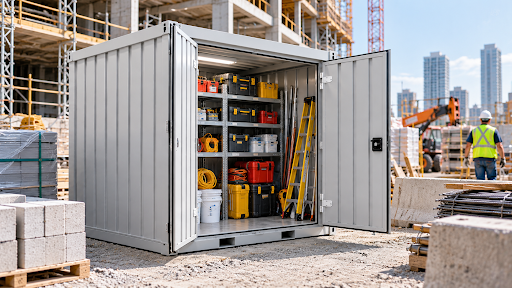
A practical guide for contractors and project managers evaluating flat-pack containers, delivery logistics, equipment protection, and storage costs on restricted construction sites.
Construction sites rarely have unlimited space. Between active work zones, delivery routes, equipment staging areas, and changing project requirements, finding suitable storage can become a logistical challenge.
Traditional storage containers may be practical on accessible sites, but projects with narrow entrances, limited manoeuvring space, or restricted delivery routes require additional planning.
Understanding how different container formats, placement conditions, and security measures affect operations can help contractors choose storage arrangements that support productivity without creating unnecessary complications.
Understanding Storage Challenges on Restricted Construction Sites
Urban developments, renovation projects, and established commercial properties may offer limited space for temporary storage.
Contractors must consider more than the container’s footprint. Delivery vehicles need appropriate access, and the surrounding area must allow workers to retrieve materials safely.
A container positioned too close to active construction areas may obstruct equipment movement or interfere with scheduled deliveries.
Before selecting a storage solution, project managers should assess available ground space, entrance dimensions, overhead clearance, and the condition of the proposed placement surface.
They should also consider whether site access will change as construction progresses.
For example, a storage location that works during early groundwork may become inconvenient once scaffolding, fencing, or additional trades occupy nearby areas.
Early planning can reduce the need for costly repositioning and help maintain organized work zones.
Comparing Flat-Pack and Conventional Storage Containers
Conventional storage containers are typically transported as assembled units, making delivery access an important consideration.
Flat-pack storage containers use components designed for transportation and assembly, potentially offering an alternative where moving a fully assembled unit into position is difficult.
However, flat-pack formats are not automatically appropriate for every construction project.
Contractors should consider assembly requirements, available labour, foundation conditions, structural specifications, and whether the container can be relocated after installation.
Businesses researching construction storage solutions can review Flatbox Solutions’ flat-pack container information when comparing storage formats and assessing site-specific requirements.
Container selection should reflect the intended use. A unit storing hand tools may have different capacity, security, and access requirements from one accommodating larger equipment or packaged building materials.
Door configuration, internal dimensions, ventilation, and locking arrangements may also influence suitability.
Requesting product specifications and reviewing installation requirements before ordering can help contractors identify potential limitations.
Managing Storage Costs Beyond the Initial Price
Storage costs extend beyond the advertised purchase or rental price.
Transportation, delivery access, site preparation, assembly, maintenance, and eventual relocation may all influence total expenditure.
For shorter projects, renting storage equipment may provide flexibility without a long-term ownership commitment. For recurring requirements, purchasing may warrant consideration.
The appropriate choice depends on project duration, anticipated reuse, available capital, and the responsibilities included in the supplier’s agreement.
Flat-pack formats may offer logistical advantages in some situations, but potential savings should be evaluated alongside assembly labour, equipment requirements, and transportation arrangements.
For example, a project with restricted vehicle access may require specialized delivery planning regardless of container type.
Contractors should request detailed estimates and clarify which services are included.
Comparing total project costs rather than headline prices supports more informed budgeting and reduces the likelihood of unexpected expenses.
Protecting Equipment and Materials During Construction
Construction projects depend on reliable access to tools, components, and building materials.
Inadequate storage can expose equipment to unauthorized access, moisture, accidental damage, and disorganization.
A dedicated container may help establish a controlled storage area, but security depends on more than having enclosed walls.
Locking systems, door construction, site lighting, access procedures, and inventory records should form part of the overall approach.
Weather protection also requires consideration. Contractors should inspect container seals, roof condition, drainage, and ventilation arrangements.
Materials vulnerable to condensation or temperature fluctuations may require additional protection or alternative storage environments.
The Canadian Centre for Occupational Health and Safety provides workplace safety information that can inform broader material-handling and storage practices.
Hazardous materials should not be placed in ordinary containers without confirming applicable storage, ventilation, separation, and fire-safety requirements.
Combining suitable container specifications with consistent site procedures can help protect equipment and maintain accountability.
Planning Safe Placement and Material Accessibility
Storage containers should support daily operations rather than introduce additional obstacles.
Placement decisions need to account for pedestrian movement, equipment routes, emergency access, and the safe handling of stored materials.
The Occupational Safety and Health Administration’s construction material storage requirements address practices intended to reduce hazards associated with unstable or improperly stored materials.
Although these are US regulations, their general material-stability principles may be useful for comparison; Canadian projects must follow applicable provincial and local requirements.
Inside a container, frequently used tools should remain accessible, while heavier materials require stable storage arrangements.
Shelving and designated storage zones can help reduce unnecessary handling.
Project managers should also review container placement as work progresses. Changes to site fencing, vehicle access, and material requirements may affect whether the original arrangement remains practical.
Adapting Storage to Changing Project Requirements
Construction storage needs often evolve between project phases.
Early work may require space for groundworks equipment, while later stages involve electrical components, finishing materials, and smaller tools.
Contractors should consider whether a container’s capacity and internal arrangement can accommodate these changes.
For projects operating across several locations, relocation procedures and repeated assembly requirements may also affect container selection.
A storage plan that accounts for changing inventory, site access, and project timelines can support more consistent operations.
Making Informed Construction Storage Decisions
Selecting suitable storage begins with understanding the site’s physical limitations and operational requirements.
By comparing container formats, calculating total costs, assessing equipment protection, and planning placement carefully, contractors can make practical storage decisions that support organized construction operations.
Additional Resources
For further information about evaluating a construction site storage container, explore Flatbox Solutions’ construction storage resource when researching container options for specific project requirements.