Searches for “Peter Orszag bald” may seem unusual considering Peter Orszag is primarily known as an economist, former senior U.S. government official, and financial executive. Yet public figures who spend years appearing on television, at conferences, in government hearings, and in professional photographs often attract curiosity about their appearance as well as their careers.
So, is Peter Orszag bald? The most accurate answer is more nuanced than a simple yes or no. Publicly available photographs show Orszag with visible hair, although his hairline, density, color, and overall appearance have naturally looked different across various stages of his long public career. There is no authoritative public evidence establishing a medical explanation for those changes, nor reliable confirmation that he uses a wig, toupee, hair transplant, or other hair-restoration treatment.
More importantly, Orszag’s appearance is a very small part of a much more interesting story involving economics, government policy, Wall Street, and leadership at Lazard.
Peter Orszag Bald: Is He Actually Bald?
The short answer is that describing Peter Orszag as completely bald is not accurate based on his publicly available professional photographs.
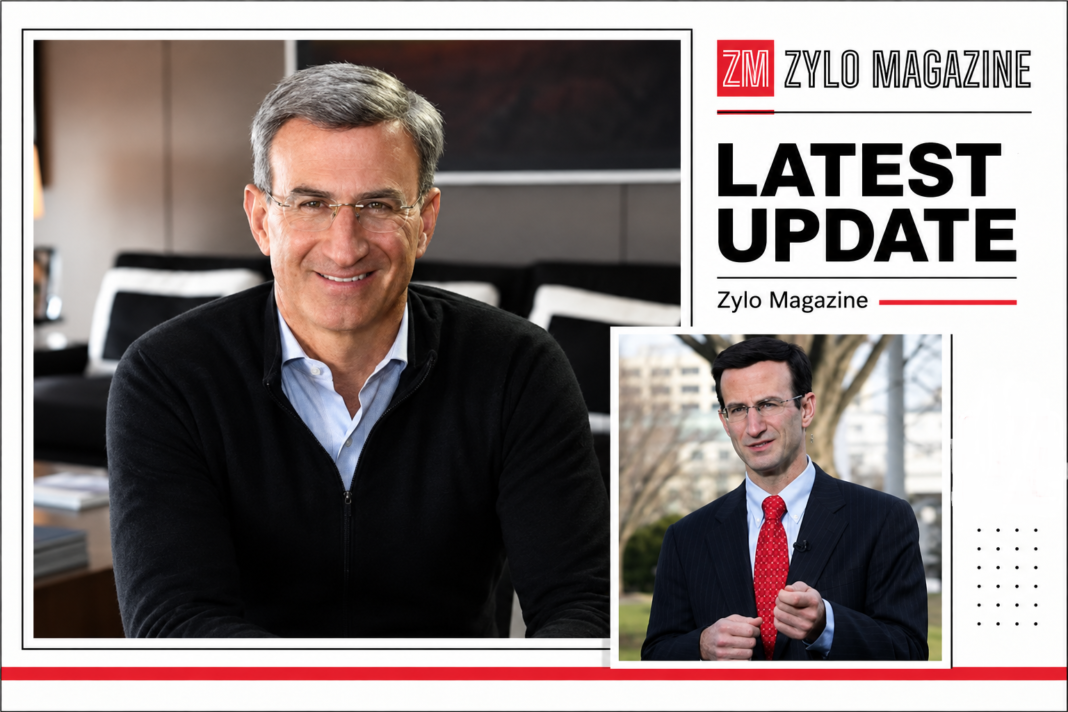
Recent official images show visible hair. Depending on the photograph, lighting, camera angle, haircut, and styling, his scalp or hairline may appear more noticeable. That can easily lead someone who sees him briefly on television or in a photograph to search “Peter Orszag bald.”
However, visual observation has important limitations.
A photograph cannot reliably establish whether someone has a particular type of hair loss, why their hair density may have changed, or whether they have undergone any cosmetic procedure. No authoritative biography from Lazard or other credible institutional source provides information about Orszag receiving hair-loss treatment.
Consequently, claims that he has undergone a transplant, wears a wig, uses a toupee, or has a particular medical condition should not be presented as facts without evidence.
The defensible conclusion is straightforward: Peter Orszag has visible hair in current public photographs, so “completely bald” is an imprecise description of his appearance.
That answer may be less dramatic than online speculation, but it is considerably more accurate.
Why Are People Searching for “Peter Orszag Bald”?
Search behavior around public figures is often driven by visual curiosity.
Peter Orszag has spent a substantial portion of his professional life in public-facing positions. During his government career, he appeared at congressional hearings, press events, policy discussions, and television interviews. His subsequent work in finance has continued to put him in front of cameras.
When audiences can compare photographs of the same individual over many years, ordinary changes associated with aging become particularly noticeable.
Hair changes are especially visible.
A person’s hair can look substantially different depending on age, haircut length, lighting, gray versus darker hair, photography equipment, and even whether the photograph was taken indoors or outdoors.
This creates a common internet phenomenon: a viewer notices a difference, asks a simple question, and search engines begin associating that question with the person’s name.
The existence of searches for Peter Orszag bald, therefore, should not itself be interpreted as evidence that something unusual happened to his hair.
It primarily tells us that people are curious.
What Does Peter Orszag’s Hair Look Like?
Official contemporary photographs generally show Peter Orszag wearing his hair relatively short and professionally styled.
His appearance today is naturally different from photographs taken during earlier periods of his government career. One of the most obvious differences is that his hair has become considerably grayer with age.
That is hardly surprising.
Orszag was born in 1968 and has been a nationally visible figure since at least the 2000s. Comparing photographs separated by 15 or 20 years will inevitably reveal changes in appearance.
Hair color also matters more than many people realize when assessing photographs.
Gray or white hair can create less contrast against a light scalp than dark hair. Strong overhead lighting can amplify this effect. A short haircut can make scalp visibility more noticeable, while longer hair may create the impression of greater density.
Consequently, two photographs of the same person’s hair taken under different conditions can look surprisingly different.
This is one reason it is inappropriate to make medical or cosmetic conclusions based purely on photographs.
Has Peter Orszag Experienced Hair Loss?
There is no reliable public information that allows outsiders to diagnose Peter Orszag with a specific form of hair loss.
Some viewers may interpret his appearance as showing thinning or a receding hairline, but observation is not diagnosis.
Hair density and hairlines naturally vary among individuals. They can also change with age. Photographs provide no reliable basis for determining the underlying biological or medical cause of those differences.
This distinction is frequently lost in online articles.
Saying that someone’s hair appears thinner in one photograph than another is an observation. Saying that the individual suffers from a particular hair-loss condition is a medical claim requiring evidence.
No such evidence should be assumed in Orszag’s case.
For readers primarily interested in the “Peter Orszag bald” question, the practical takeaway is simple: public imagery can describe appearance, but it cannot explain the underlying cause.
Does Peter Orszag Wear a Wig or Toupee?
There is no credible public evidence confirming that Peter Orszag wears a wig, toupee, or hairpiece.
This deserves emphasis because celebrity and executive appearance searches frequently generate increasingly specific rumors.
A person searches whether somebody is bald. Another article asks whether they have received a transplant. Another speculates about a wig. Eventually, repeated speculation can create the impression that there must have been an original factual report.
Repetition, however, does not transform speculation into evidence.
Neither Orszag’s official Lazard biography nor established biographical sources identify a wig or hairpiece as part of his public story.
Could any public figure make private grooming choices that are never disclosed? Of course. But absence of information should not be filled with invented certainty.
Without a statement from Orszag or credible reporting based on reliable evidence, claims about a wig remain speculation.
Did Peter Orszag Have a Hair Transplant?
Again, there is no reliable public evidence establishing that Peter Orszag has undergone a hair transplant.
Before-and-after photographs are especially poor evidence for proving cosmetic procedures.
Consider how many variables can change between two photographs taken years apart:
- haircut and hair length;
- camera angle;
- overhead versus frontal lighting;
- hair color and graying;
- styling products;
- image resolution;
- professional retouching;
- weather and humidity;
- and simple biological aging.
Any combination of these factors can dramatically alter how someone’s hair looks.
Therefore, claims such as “Peter Orszag definitely had a hair transplant” go beyond what publicly available evidence supports.
Unless credible documentation emerges, the responsible answer is that a Peter Orszag hair transplant has not been publicly established.
Who Is Peter Orszag?
The fascination with Peter Orszag’s hair becomes more understandable once you consider how visible his career has been.
Peter R. Orszag is an American economist, former government official, and financial executive. He currently serves as CEO and Chairman of Lazard, the global financial advisory and asset-management firm. Lazard’s official biography says that he joined the firm in 2016 and previously led its Financial Advisory business.
His career has moved between economics, government, public policy, academia, and high-level finance.
Before entering senior roles at Lazard, Orszag held two particularly prominent positions in Washington: Director of the Congressional Budget Office and Director of the Office of Management and Budget during the Obama administration.
These positions put him at the center of debates over federal spending, deficits, healthcare costs, fiscal policy, and the economic challenges surrounding the financial crisis.
That professional history is ultimately far more significant than questions about his hairstyle.
Peter Orszag and the Congressional Budget Office
One of Orszag’s most important public-service roles was leading the Congressional Budget Office (CBO).
CBO’s historical records show that Peter R. Orszag served as its director from January 18, 2007, until November 25, 2008.
The CBO occupies an important position in American policymaking because it provides Congress with objective analysis of budgetary and economic questions.
During Orszag’s tenure, healthcare spending and its implications for America’s long-term fiscal outlook became particularly important subjects.
When Orszag left the agency, CBO praised his work and noted the organization’s expanded focus on subjects including healthcare and climate change during his leadership.
This period also significantly increased Orszag’s national visibility.
Instead of being known primarily within academic and policy circles, he increasingly became a recognizable participant in Washington’s major economic debates.
From CBO to the Obama White House
In November 2008, President-elect Barack Obama announced his intention to nominate Orszag as Director of the Office of Management and Budget (OMB).
Orszag subsequently resigned from CBO. In his final CBO blog entry, he wrote about his appreciation for the agency’s combination of intellectual rigor, policy relevance, and breadth.
As OMB director, Orszag occupied an influential position during an extraordinarily difficult economic period.
The United States was dealing with the aftermath of the global financial crisis, rising unemployment, federal stimulus measures, healthcare reform, and intense political debate about deficits and government spending.
The archived Obama White House biography identifies Orszag as former OMB director and highlights his earlier leadership of CBO as well as previous service with the Council of Economic Advisers.
That background illustrates why Orszag became such a familiar face in political and economic media.
Why Orszag Became Associated With Healthcare Economics
One of the more substantive themes running through Peter Orszag’s career is his interest in healthcare economics.
Healthcare spending is not merely a medical issue. For governments, employers, insurers, and households, it is also an enormous economic challenge.
During Orszag’s CBO leadership, the agency placed significant attention on rising healthcare costs and their relationship with the government’s long-term fiscal position. CBO specifically highlighted that emphasis when he departed the agency in 2008.
That perspective became particularly relevant during the Obama administration’s healthcare-policy debates.
The important insight here is that long-term fiscal policy cannot be understood solely by examining annual tax revenue and discretionary government spending. Structural spending trends—especially large programs affected by healthcare costs and demographic changes—can profoundly influence future budgets.
Orszag’s career in economic policy repeatedly intersected with these longer-term questions.
Peter Orszag’s Move From Washington to Finance
After government service, Orszag transitioned into the private financial sector, eventually joining Lazard in 2016.
Lazard’s biography describes a progression through several important positions at the firm. Before becoming its overall leader, he served as CEO of Financial Advisory and held senior positions involving mergers and acquisitions and healthcare.
The transition makes sense when viewed through the broader arc of his career.
Major financial transactions do not occur in an economic vacuum. Companies considering mergers, restructurings, acquisitions, capital decisions, or strategic changes must evaluate interest rates, regulation, geopolitics, government policy, technological disruption, and economic conditions.
Someone with experience spanning economics, public policy, government institutions, and finance therefore brings an unusually broad perspective to corporate decision-making.
That combination became increasingly important as Orszag moved through Lazard’s leadership ranks.
Peter Orszag as CEO and Chairman of Lazard
Orszag became CEO of Lazard and joined its board in October 2023. His role later expanded to CEO and Chairman, effective January 2025, according to his biographical materials.
Lazard’s official profile currently identifies him as CEO and Chairman and says his career spans finance, public policy, and academia.
A 2026 SEC filing provides further insight into why the company selected him for the position. The filing highlights his leadership experience, financial and deal-making expertise, government background, and ability to combine financial analysis with regulatory and geopolitical considerations.
That description captures an important aspect of Orszag’s professional identity.
He isn’t simply an economist who moved into banking or a banker who previously worked in government. His career has been built around the intersection of multiple disciplines.
That makes his trajectory unusual even among prominent financial executives.
Peter Orszag’s Education and Academic Background
Orszag’s academic background also helps explain his approach to policy and finance.
According to Lazard, he graduated summa cum laude from Princeton University and later earned a Ph.D. from the London School of Economics, where he studied as a Marshall Scholar.
His personal professional biography says he earned an M.Sc. from the London School of Economics in 1992 and a Ph.D. in 1997. His doctoral research examined regime shifts under uncertainty, including applications involving hyperinflation and privatization.
That educational path is relevant because Orszag’s subsequent career has repeatedly involved decision-making under uncertainty.
Government budget forecasts, healthcare expenditures, financial markets, corporate transactions, and geopolitical developments all require leaders to make decisions without perfect information.
While academic economics and corporate leadership are obviously different activities, the analytical foundations can overlap considerably.
Why Public Appearance Becomes Part of a Professional Identity
Peter Orszag is hardly the first serious professional whose appearance has attracted internet attention.
Television and digital media have fundamentally changed the visibility of economists, executives, lawyers, politicians, academics, and other professionals.
Decades ago, a senior economist might primarily have been known through research papers, testimony, newspaper quotations, and policy reports. Today, the same individual may appear in high-resolution photographs, television interviews, conference livestreams, social-media clips, and online videos.
This creates what might be called visual familiarity.
Viewers who know almost nothing about a person’s private life nevertheless become familiar with their face, glasses, hairstyle, clothing, mannerisms, and speaking style.
Once that happens, changes in appearance become noticeable.
This explains why a search like “Peter Orszag bald” can exist even though hair has virtually nothing to do with the reason Orszag is publicly significant.
Hair, Aging, and the Problem With Comparing Photographs
There is another reason appearance-based internet speculation should be treated carefully: photographs are surprisingly unreliable comparison tools.
Imagine comparing a photograph from 2009 with one from 2026.
Nearly two decades separate those images. During that time, a person’s face, hair color, hairstyle, body composition, and fashion choices can naturally change.
Then add differences in technology.
An older television screenshot may be lower resolution and softly lit. A modern corporate portrait might be captured with an extremely high-resolution camera under powerful studio lighting.
Hair that looked uniformly dark in an old photograph might show individual gray strands and scalp visibility in a modern image.
Neither photograph necessarily represents how the person appears under normal conditions.
This is why responsible analysis should distinguish between observable appearance and claims about medical or cosmetic causes.
Does Being Bald Matter to a Professional Image?
Not inherently.
Hair has little connection to professional competence.
For senior executives, economists, policymakers, or academics, credibility is generally built through expertise, communication, judgment, experience, decision-making, and results.
Yet appearance still influences public perception because humans naturally process visual information quickly.
Research into professional presentation broadly suggests why consistency can matter: a familiar visual identity helps audiences recognize a person, especially someone who appears frequently in media.
In Orszag’s case, his professional presentation has generally remained conventional and understated. His public image emphasizes the role he occupies rather than personal fashion or celebrity branding.
That fits his professional background.
His reputation has been built around economics, budgets, policy, financial advice, and institutional leadership—not appearance.
Why Search Engines Amplify Questions Like “Peter Orszag Bald”
There is also an SEO lesson hidden inside this unusual keyword.
Search engines respond to user demand.
When enough people type a phrase such as “Peter Orszag bald”, publishers notice the query and create pages targeting it. Those pages can generate additional visibility for related searches such as:
“Peter Orszag hair”
“Peter Orszag hair loss”
“Peter Orszag wig”
“Peter Orszag toupee”
“Peter Orszag hair transplant”
Eventually, the existence of many pages about the subject can make the underlying rumor seem more substantial than it actually is.
This is an important lesson in digital literacy.
Search volume is evidence of curiosity, not evidence that a claim is true.
Similarly, multiple websites repeating the same claim do not necessarily constitute independent confirmation. They may all be repeating an unsupported observation originating elsewhere.
For readers, the best approach is to trace significant claims back to authoritative or primary sources.
What Can Actually Be Verified About Peter Orszag?
Once speculation is removed, there is plenty of substantial information about Orszag that can be verified.
His government career is documented by the Congressional Budget Office and archived White House records. His present corporate role and professional history are documented by Lazard and corporate filings.
We can therefore confidently establish that he has held senior leadership positions in both government and finance.
We can also observe from official photographs that he has visible hair.
What cannot responsibly be established from those photographs alone is whether he has a medical hair-loss condition, uses a particular treatment, has undergone hair-restoration surgery, or wears a hairpiece.
Those are fundamentally different categories of information.
Separating them is the difference between evidence-based reporting and speculation.
What Makes Peter Orszag’s Career More Interesting Than the Hair Question?
The most interesting feature of Orszag’s career is arguably his movement between institutions that approach economic decisions from very different perspectives.
At CBO, the mission centers on providing Congress with objective economic and budgetary analysis.
At OMB, economic analysis becomes part of executive-branch policymaking and management.
In global finance, economic thinking intersects with corporate strategy, transactions, markets, investors, and competitive pressures.
Experiencing all three environments provides a broad view of how economic decisions are made.
A policy that appears efficient in an economic model may face political constraints. A corporate transaction that looks attractive financially may face regulatory problems. A government program that solves a short-term problem may create long-term fiscal obligations.
Senior decision-makers increasingly need to understand those interactions.
That broader context helps explain why Orszag’s policy experience remained relevant when he moved into finance.
Lessons From the “Peter Orszag Bald” Search Trend
There is a surprisingly useful lesson behind this seemingly trivial search query.
Internet users should separate three categories of information:
What is visible, what is documented, and what is inferred.
A photograph can make something visible.
An authoritative source can document something.
But an inference is still an inference.
For example, observing that someone’s hair appears different across two photographs is reasonable. Claiming that the difference proves surgery or a medical condition is not reasonable without additional evidence.
This principle applies far beyond Peter Orszag.
It is valuable whenever researching celebrities, politicians, executives, athletes, or other public figures.
When an article makes a sensational claim about someone’s appearance, ask:
Where did this information originate?
Did the person confirm it?
Did a reputable publication independently report it?
Is there medical or documentary evidence?
Or is the writer simply interpreting photographs?
Those questions can prevent ordinary speculation from being mistaken for fact.
Frequently Asked Questions About Peter Orszag Bald
Is Peter Orszag bald?
Peter Orszag does not appear to be completely bald in current official photographs. He has visible hair, although his hairline, color, and apparent density have changed compared with photographs from earlier periods of his career. Descriptions such as “bald” can also be subjective, so it is more accurate to describe what photographs show than assign a definitive label.
Is Peter Orszag losing his hair?
There is no authoritative public information confirming that Peter Orszag has been diagnosed with a specific hair-loss condition. Public photographs may lead some observers to describe his hair as thinner than it appeared years ago, but photographs alone cannot establish a medical diagnosis or determine the cause of changes in hair density.
Does Peter Orszag wear a wig or toupee?
There is no credible publicly available evidence establishing that Peter Orszag wears a wig, toupee, or other hairpiece. Claims suggesting otherwise should therefore be treated as speculation unless reliable evidence emerges.
Has Peter Orszag had a hair transplant?
No reliable public source establishes that Peter Orszag has undergone hair-transplant surgery. Comparing photographs from different years cannot prove a cosmetic procedure because lighting, hairstyle, aging, hair color, camera quality, and numerous other variables affect appearance.
What is Peter Orszag best known for?
Peter Orszag is best known for his work in economics, government, and finance. He served as Director of the Congressional Budget Office and later as Director of the Office of Management and Budget during the Obama administration. He subsequently built a senior career in finance and is currently CEO and Chairman of Lazard.
Conclusion: The Reality Behind the Peter Orszag Bald Question
The interest surrounding “Peter Orszag bald” is ultimately a good example of how ordinary changes in a public figure’s appearance can become an online search trend. Current official photographs show Peter Orszag with visible hair, making the description “completely bald” inaccurate. Beyond that observation, reliable evidence does not establish that he wears a wig, has undergone a hair transplant, or has any particular medical hair-loss condition.
The more meaningful story is Orszag’s career. From leading the Congressional Budget Office and serving as OMB director to becoming CEO and Chairman of Lazard, he has occupied influential positions at the intersection of economics, public policy, and global finance.
Ultimately, his hairstyle may generate searches, but it is his professional record—not his hairline—that explains why Peter Orszag remains a notable public figure.
Continue Exploring Our Latest Article: Matt Danzeisen: Biography, Career, Investments, and Life With Peter Thiel