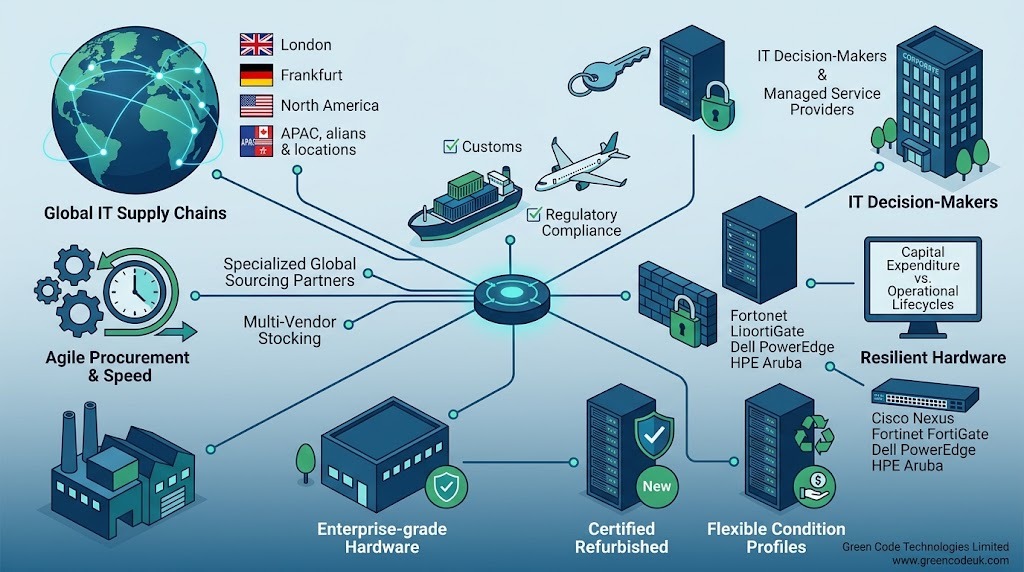
In an increasingly digitized global economy, technology infrastructure is no longer merely a background utility—it is the direct backbone of operational resilience, security posture, and business growth. From automated financial networks in Frankfurt and multi-cloud data centers across North America to logistics command centers throughout the Asia-Pacific region, enterprise stability depends on one critical factor: access to reliable, high-performance IT hardware.
Yet, procuring enterprise-grade infrastructure has become notoriously complicated. Enterprise IT directors, Managed Service Providers (MSPs), and systems integrators are constantly squeezed by unpredictable manufacturer lead times, complex international customs regulations, and inflating hardware budgets.
To bridge this operational divide, forward-thinking enterprises are shifting their procurement strategies away from rigid single-channel routes and toward specialized, global sourcing partners. Companies like London-headquartered Green Code Technologies Limited (Green Code UK) are redefining how global organizations source mission-critical networking, compute, and cybersecurity hardware with speed, compliance, and international logistics precision.
The New Reality of Enterprise Hardware Procurement
Over the past decade, corporate infrastructure demands have evolved rapidly. The rise of hybrid work environments, software-defined architectures (SD-WAN), edge computing, and AI-accelerated workloads means networks require continuous upgrades. However, IT decision-makers routinely encounter several persistent challenges:
1. Extended Lead Times and Distribution Bottlenecks
Traditional authorized distribution pipelines often impose multi-month lead times on flagship switches, firewalls, and carrier-grade routers. When an enterprise is expanding into a new regional facility or performing a scheduled maintenance overhaul, waiting 16 to 24 weeks for hardware is simply unacceptable.
2. Cross-Border Sourcing and Regulatory Compliance
As businesses operate across multiple continents, sourcing and shipping hardware internationally introduces heavy regulatory overhead. Navigating EORI registrations, dual-use cryptographic export classifications, customs duties, and local telecom certifications requires specialized cross-border logistics expertise. Without experienced freight handlers, hardware can sit impounded at customs checkpoints for weeks.
3. Balancing Capital Expenditure with Operational Lifecycles
Not every infrastructure refresh requires brand-new, factory-sealed appliances at full OEM list price. Many organizations operate secondary disaster recovery (DR) sites, testing labs, or robust legacy systems where certified refurbished equipment delivers identical operational reliability at a fraction of the capital expenditure (CapEx).
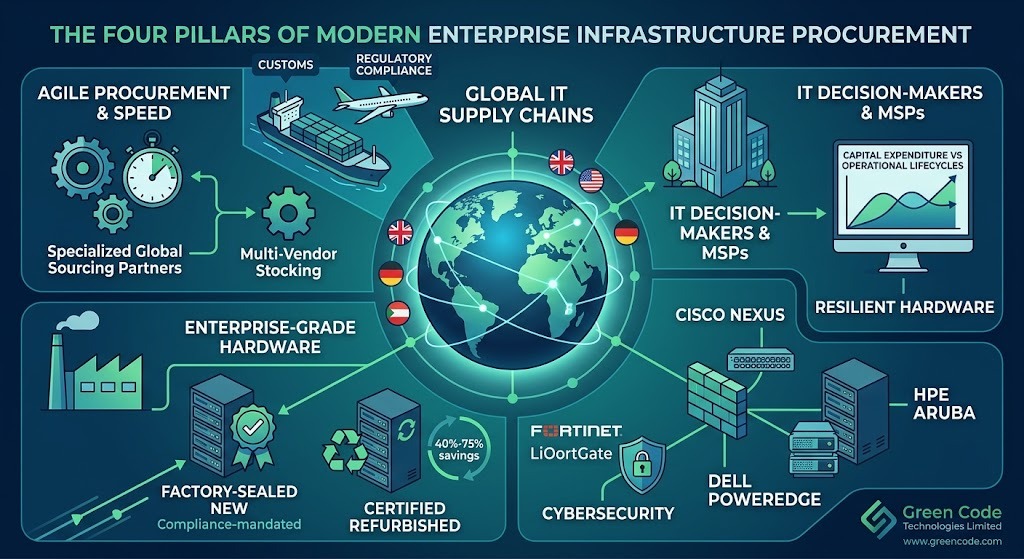
The Strategic Core: Four Pillars of Modern Enterprise Infrastructure
When multinational organizations build resilient IT environments, procurement teams concentrate their resources on four foundational hardware layers:
1. High-Density Campus and Data Center Switching
Modern enterprise campuses demand switching fabrics capable of powering dense multi-gigabit access points (Wi-Fi 6E and Wi-Fi 7), high-draw PTZ surveillance cameras, and VoIP infrastructure. Networks standardizing on platforms such as Cisco Catalyst (9200, 9300, 9500), HPE Aruba CX series, and Juniper EX switches rely on Class 6 and Class 8 PoE++ (up to 90W per port) to eliminate localized power drops.
At the core and data center leaf-and-spine layers, low latency and lossless packet transport reign supreme. High-throughput switches like the Cisco Nexus 9000, Juniper QFX series, and Huawei CloudEngine platforms provide the non-blocking 25G, 100G, and 400G backbones needed for containerized microservices and AI computing clusters.
2. Resilient Edge Routing and Carrier Gateways
Carrier-grade internet peering, multi-cloud interconnects, and distributed enterprise WANs demand hardware-accelerated routing engines that maintain full line-rate forwarding under heavy cryptographic loads. High-capacity edge platforms—including the Juniper MX series (such as the compact, high-density MX204), Cisco ASR 1000/9000 series, and Huawei NetEngine platforms—provide the routing table depth, BGP scale, and dynamic traffic steering needed to power mission-critical WAN backbones.
3. Integrated Next-Generation Firewalls (NGFW)
With cyber threats growing in velocity and sophistication, physical perimeter defenses must inspect encrypted SSL/TLS traffic without choking network throughput. Hardware-accelerated appliances—most notably Fortinet FortiGate enterprise firewalls (powered by dedicated NP7 and SP5 ASICs) and Cisco Secure Firewall (Firepower)—converge deep packet inspection, automated intrusion prevention (IPS), and native Secure SD-WAN into a unified perimeter defense.
4. Scalable Rack Servers and Air-Gapped Archival
From private virtualization farms to transactional databases, dual-socket 1U and 2U rack servers—such as Dell PowerEdge (R650, R760) and HPE ProLiant (DL360, DL380 Gen10/Gen11)—provide the compute density and NVMe storage bandwidth modern enterprise workloads require. Simultaneously, to defend against sophisticated zero-day ransomware attacks, enterprises are returning to physical air-gapped tape automation—leveraging HPE StoreEver LTO-8 and LTO-9 libraries to keep offline data reserves safe from network-borne threats.
Spotlight: Green Code UK’s Role in Global IT Sourcing
In response to these supply chain pressures, Green Code Technologies Limited has established itself as an agile, independent international supplier and stocking distributor of enterprise IT hardware, computing systems, and cybersecurity solutions.
Headquartered in London at 205 Regent Street, the company operates under the active corporate direction of Imran Nayab Hassan Khan, serving an expanding international clientele that includes IT system integrators, telecom operators, multi-site enterprises, and data center procurement teams.
1. True International Reach Beyond Local Borders
While based in the United Kingdom, Green Code UK functions as a global exporter. Rather than restricting services to domestic clients, the company maintains robust cross-border shipping agreements with Tier-1 air freight forwarders and express couriers (including DHL Express and FedEx Priority). This network enables expedited 2-to-5-day delivery to operational facilities across Europe, North America, the Middle East, Africa, and the Asia-Pacific region.
2. Multi-Vendor Stocking and Ready-to-Ship Inventory
Supply chain delays are minimized through maintained warehouse inventory across leading tier-1 enterprise manufacturers, including:
- Enterprise Networking & Switching: Cisco Systems, HPE Aruba, Juniper Networks, Huawei, NETGEAR, and Ubiquiti UniFi.
- Compute & Enterprise Storage: Dell Technologies, HPE, Lenovo ThinkSystem, and ASUS Enterprise.
- Cybersecurity & Physical Security: Fortinet, Cisco Secure, Dahua Technology, and HOLOWITS AI Vision systems.
3. Flexible Condition Profiles: Factory-Sealed vs. Certified Refurbished
Green Code provides dual-tier procurement options tailored to client budgetary requirements:
- Factory-Sealed New-in-Box (NIB): Brand-new, untouched hardware with intact OEM tamper seals for primary corporate networks and compliance-mandated facilities.
- Certified Refurbished Equipment: Professionally evaluated, fully tested, and restored pre-owned hardware that provides 40% to 75% savings off standard list prices, backed by comprehensive advance hardware replacement warranties.
4. Multi-Currency Commercial Terms
To eliminate foreign exchange friction for international clients, Green Code quotes and settles transactions seamlessly in US Dollars (USD), Euros (EUR), and British Pounds (GBP). Dedicated commercial desks provide expedited turnaround on custom configured-to-order (CTO) server builds, project tenders, and multi-line Bill of Materials (BOM) requests.
Best Practices for Enterprise IT Procurement Teams
For businesses looking to optimize their hardware sourcing strategies, industry leaders suggest several actionable steps:
- Plan Around Architecture, Not Single Distribution Channels: Working with independent global stocking suppliers allows organizations to bypass artificial regional allocations and acquire critical parts directly from available warehouse inventory.
- Standardize on Proven Hardware Families: Consolidating network hardware around widely adopted families (such as Cisco Catalyst 9000, Fortinet FortiGate, or Dell PowerEdge) ensures wide availability of replacement modules, optics, and secondary power units.
- Incorporate Circular IT and Refurbished Spares: Integrating certified pre-owned units into staging environments, secondary DR sites, and cold-spare depots dramatically reduces capital expenditure while supporting corporate sustainability goals.
- Ensure Comprehensive Export and Warranty Support: Confirm that hardware partners provide end-to-end commercial documentation, tariff classification assistance, and rapid advance hardware replacement (AHR) protocols to safeguard operational continuity.
Conclusion: Agility is the Ultimate Competitive Edge
In the modern enterprise landscape, business velocity is tethered directly to the reliability and scalability of IT infrastructure. Long lead times, inflexible vendor agreements, and logistical bottlenecks are no longer acceptable risks for agile organizations.
By leveraging independent, globally connected procurement partners like Green Code Technologies Limited, enterprise IT leaders are gaining the speed, multi-currency flexibility, and hardware availability needed to keep their mission-critical operations running without disruption.
About Green Code Technologies Limited
- Company: Green Code Technologies Limited (Green Code UK)
- Specialization: Global Enterprise IT Hardware, Networking Equipment & Cybersecurity Solutions
- Corporate Office: 4th Floor, Office 205, 205 Regent Street, London, England, W1B 4HB, United Kingdom
- Contact & Inquiries: sales@greencodeuk.com | WhatsApp: +44 7902 000786
- Website: greencodeuk.com