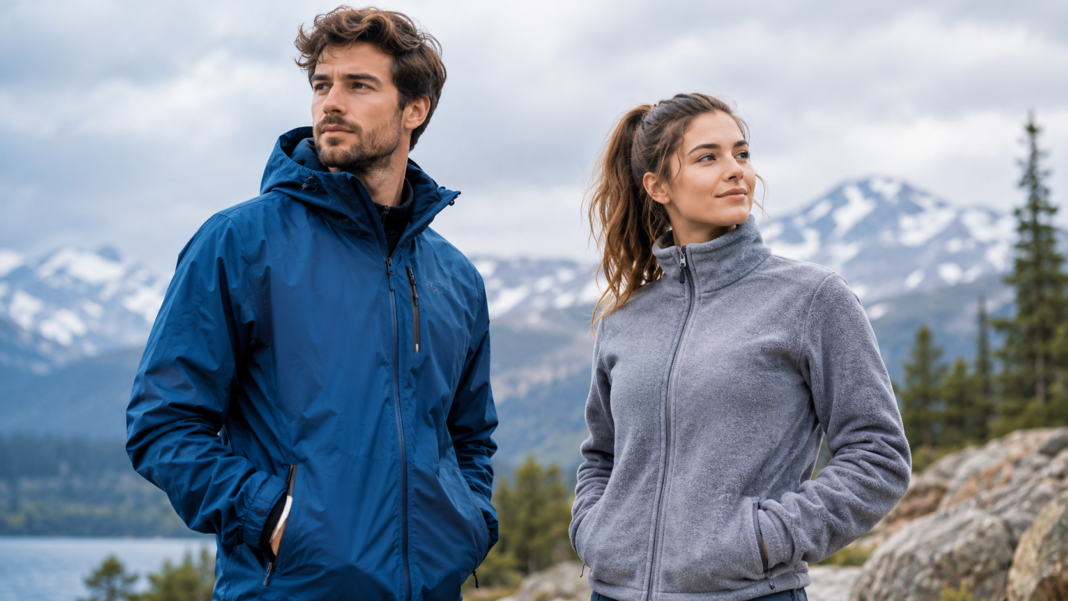
Navigating dynamic outdoor climates, coastal breezes, and brisk seasonal transitions requires an understanding of how distinct textile constructions manage body temperature and weather exposure. When planning an everyday wardrobe or outfitting a team for outdoor tasks, wearers frequently confront overlapping claims regarding transitional outerwear. Choosing the wrong outer garment can quickly lead to either clammy overheating during active movement or rapid shivering when exposed to cutting winds.
Evaluating a windbreaker vs fleece jacket requires analyzing how air permeability, surface tension, and fiber density govern heat retention and vapor release. Rather than serving as interchangeable casual layers, these two garments are engineered around completely opposite textile philosophies: one prioritizes aerodynamic deflection of ambient drafts, while the other emphasizes lofted micro-chambers that capture personal body heat.
Distinct Fabric Architectures and Material Engineering
The foundational difference between these outerwear styles lies in yarn morphology, weaving techniques, and mechanical structure. Each relies on a distinct manufacturing method to balance personal comfort against the elements.
A technical windbreaker utilizes ultra-dense, tightly woven synthetic filaments, predominantly micro-denier ripstop nylon or polyester. These textiles are woven with thousands of fine threads per square inch, creating a mechanical barrier with near-zero air permeability. In contrast, fleece jackets are circular-knit textiles produced from polyester yarns that undergo an intensive mechanical brushing and napping process. This brushing breaks and raises the surface loops into a thick, upright pile that mimics the natural loft of sheared animal wool without the heavy water retention.
Procuring an agile wholesale windbreaker jacket gives organizations and apparel lines a featherweight protective skin designed specifically to block high-velocity airflow and light surface drizzle while occupying minimal pack space.
Conversely, adding a soft wholesale fleece jacket introduces a lofty, thermal insulation layer that provides immediate tactile warmth, silent movement, and unrestricted breathability across moderate, dry conditions.
The Physics of Blocking Airflow
Understanding how windbreaker jackets block wind requires looking at convective heat transfer. The human body naturally warms a microscopic envelope of air directly adjacent to the skin, establishing an invisible thermal buffer. Under calm atmospheric conditions, this microclimate stays stable. The moment moving air rushes against porous knitwear, it sweeps that heated boundary layer away through forced convection, causing body temperature to plummet even when ambient air readings seem relatively mild.
Windbreakers counter this convective heat loss by maintaining extremely low air permeability. Through industrial calendering—where the woven synthetic textile passes between heavy, heated steel rollers under extreme pressure—the microfibers are slightly flattened. This mechanical treatment seals the microscopic voids between yarns, forcing oncoming wind currents to deflect across the surface rather than penetrating the garment.
The Mechanics of Thermal Loft and Heat Retention
Looking into how fleece fabric retains warmth reveals a completely different physical mechanism focused on dead-air capture. Dry, stationary air is among nature’s most efficient thermal insulators, exhibiting remarkably low conductive heat transfer compared to solid textile fibers.
The brushed polyester pile of a fleece garment creates millions of interconnected microscopic pockets that immobilize air molecules. Because these pockets prevent internal air circulation, conductive and convective heat losses from the torso are dramatically slowed, keeping the body warm during stationary or low-exertion wear.
Evaluating Windbreaker vs Fleece for Cold Weather
Choosing between these styles when facing low temperatures depends entirely on environmental conditions and atmospheric movement. Assessing windbreaker vs fleece for cold weather highlights clear operational boundaries for each garment:
A fleece jacket performs exceptionally well in dry, calm cold ranging between eight and fifteen degrees Celsius. Its lofted fibers provide immediate, comfortable warmth, and its soft structure makes it pleasant for indoor-outdoor transitions. However, because fleece is an open circular knit, it possesses virtually no resistance to moving wind. A brisk gust will blow straight through the porous pile, flushing out the trapped dead air and leaving the wearer feeling chilled.
A standalone windbreaker provides no internal thermal insulation because it lacks physical loft and dead-air chambers. However, in gusty conditions between twelve and eighteen degrees Celsius, a windbreaker often feels significantly warmer than a thick fleece simply because it stops moving wind from stripping away the warmth of underlying shirts. When temperatures drop below eight degrees Celsius, neither piece works adequately on its own, making a coordinated combination of both styles the optimal functional solution.
Vapor Diffusion and Fleece Fabric Breathability Explained
During active physical labor, mountain hiking, or brisk urban commuting, managing internal sweat vapor is just as critical as external weather protection. If an outer layer seals out external wind but traps internal humidity, perspiration condenses against the skin, saturating inner shirts and causing severe post-exertion chilling once movement slows down.
Looking closely at fleece fabric breathability explained through knit mechanics reveals why it remains a preferred textile for high-output cold-weather activities. Because circular-knit fleece does not utilize solid membrane backings or calendered face fabrics, water vapor molecules generated by the body pass effortlessly through the loose yarn matrix into the ambient air, keeping the skin completely dry.
Windbreakers manage moisture primarily through engineered venting rather than open-knit diffusion. Because the primary shell fabric is packed tightly to stop wind, high-grade windbreakers incorporate overlapping back cape vents lined with open-cell mesh, underarm eyelets, and two-way front zippers to allow excess body heat to exhaust mechanically during strenuous physical exertion.
Environmental Resistance Across Different Types of Jacket Materials
Evaluating weather resistance across diverse types of jacket materials highlights the distinct protective limits of woven shells and knit mid-layers. Neither standard fleece nor ultralight windbreakers are designed to replace heavy, seam-taped waterproof hard-shell raincoats during torrential downpours, but their behavior in light precipitation differs substantially.
Fleece jackets feature minimal natural moisture resistance. While polyester fibers are inherently hydrophobic—absorbing less than one percent of their weight in liquid water—the open gaps between knit loops allow rain droplets to seep directly through to underlying clothing. While fleece retains some insulating loft even when damp and dries rapidly, it offers poor protection in falling rain or wet snow.
Windbreakers feature a factory-applied Durable Water Repellent coating across their exterior face. This chemical finish increases surface tension, causing passing drizzle, coastal mist, and light rain to bead up into tight spheres and roll off the fabric before moisture can penetrate the weave, providing reliable surface protection during brief weather surprises.
Strategic Principles for Layering Clothes for Changing Weather
Mastering comfort throughout unpredictable seasons depends on utilizing a multi-tier outerwear strategy rather than expecting a single garment to handle every atmospheric shift. Layering clothes for changing weather allows individuals to adapt their thermal envelope as exertion levels and ambient conditions fluctuate throughout the day.
In this modular approach, a brushed fleece jacket functions as an ideal thermal mid-layer, trapping body heat around the chest and back while venting excess sweat vapor during active movement. When outdoor conditions turn blustery or damp, sliding a lightweight windbreaker directly over the fleece creates an impenetrable wind barrier on the outside, protecting the delicate dead-air chambers of the fleece from cutting drafts.
Brands like Simplstc Apparel apply these functional manufacturing principles across their minimalist outerwear lines, engineering clean wind-blocking shells and breathable fleece layers designed to work together seamlessly. Exploring technical apparel options through platforms like simplstcapparel.com illustrates how modern fabrics, weather-resistant coatings, and understated silhouettes combine to deliver reliable protection across diverse outdoor environments.
Choosing the Right Outerwear for Your Routine
Selecting between a windbreaker and a fleece jacket comes down to analyzing your anticipated weather, activity level, and environmental exposure. By recognizing that windbreakers deflect moving drafts and surface mists while fleece garments capture body heat through lofted fiber chambers, you can choose the ideal protective layer for your daily demands.
Understanding the balance between aerodynamic deflection, thermal insulation, and vapor breathability turns everyday dressing into a precise, comfortable science, keeping you warm, dry, and agile wherever your active routine takes you.