Last spring, a Sharjah trading firm discovered two weeks post-deadline that it had not submitted its first corporate tax return. The proprietor had trusted everything with an accountant who had suddenly gone silent. Still, it was possible to rectify the error; however, every week of absence made it more challenging to sort it out.Good tax compliance UAE practice begins with one habit: find out exactly what you owe before you touch anything.
What Should You Do First After Missing a Deadline?
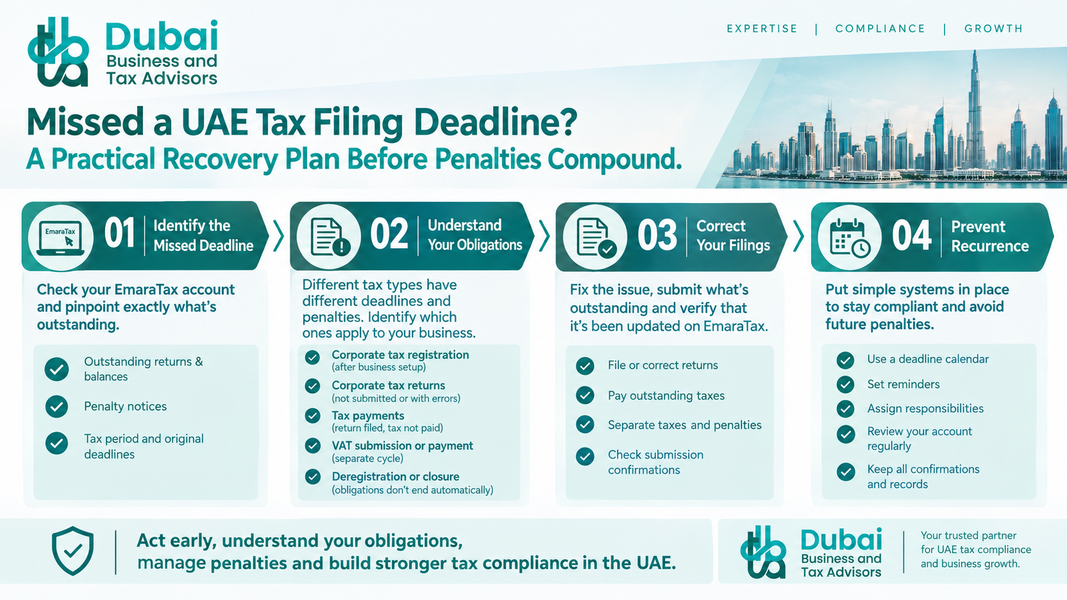
The initial step is to go to EmaraTax, where you will be required to log in, then check what is available on the dashboard. In particular, you will need to check out your outstanding taxes, balances, and penalty notices on the dashboard. It is important to mention that this information will come as a shock to many business owners.
After that, it is important to obviously pinpoint three crucial pieces of information related to your tax situation: the tax itself, the period through which you are overdue and the date when the tax has to be submitted originally.
The next step is to determine what went wrong. There are three possibilities here: the return was not submitted at all, it was submitted with mistakes, or it could be that the return was filed successfully but was not reflected in your account. Each of the three scenarios is proper for applying a different remedy.
Which Deadline Did You Miss?
The majority of cases are classified into one of the following five categories:
- Corporate tax registration.if the company’s business registration happened after the indicated deadline.
- Corporate tax return where the return wasn’t submitted in time.
- Tax payment where the submission got done, but the tax itself didn’t get paid.
- VAT submission or payment as the VAT operates on its own submission and payment cycle.
- Deregistration or closure when the company stopped running, however, its obligations did not end in a formal way.
A late submission and a late payment are different aspects. The act of submission does not also imply that the tax is settled, while tax payment does not mean the submission happens late. Businessmen tend to solve one problem and forget about the other.
What Penalties Apply?
Late registration incurs a penalty of AED 10,000, which is implemented automatically, and the same amount is charged to both dormant and active companies causing surprise among business owners.
Late filing is subject to a separate penalty system. The penalty for each late filing in the first year is AED 500/month, increasing to AED 1,000/month starting from month 13. It doesn’t matter if a company does not owe any taxes when filing late, as the penalties will still apply.
Late payments are subject to interest, which is 14% per annum from the date of payment until that date. That interest rate was established by Cabinet Decision 129 from 2025 as of April 14, 2026.
Let’s calculate the penalties in case a company has to pay AED 11,250 in taxes and files five months late. In such a case, the penalty for late filing will be AED 2,500. If payment is also delayed by five months, the interest penalty will amount to approximately AED 656, and thus the total cost would rise to around AED 3,156.
Can You Get a Penalty Waived?
In one notable case, the waiver for Corporate Tax Late Registration Penalty means you don’t have to apply for it; the AED 10,000 penalty is waived automatically as long as you file your first tax return or annual declaration before the end of the seven-month period following your first tax period. If you have already paid the penalty, you will then have the penalty amount credited to your EmaraTax account by the FTA.
There are two things to note. First, the waiver applies only to the first tax period, so it won’t exempt you from any later late filings. Secondly, the seven-month period is shorter than the standard deadline of nine months. For example, a company with a fiscal year-end on 31 December would then need to file by 31 July, rather than by 30 September.
If you believe you have an incorrect FTA decision, you can try a reconsideration request. This entails providing evidence and reasonable justifications for the FTA regarding funds that were received for finished projects, work that was done or money that was paid to clients. It’s important to clarify that both courses may not always deliver positive results.
A Step-by-Step Recovery Plan
Take things step by step.
- Go through your account on EmaraTax. Make a note of outstanding amounts, returns, and notifications, and save the copies.
- Establish the deadlines and the scope. Identify all tax types and all periods, including whether registration or deregistration is pending.
- Gather all your paperwork together. Grab your invoices, expense records, bank statements, and previous returns. If any papers are not available, ask the last accountant or agent.
- File the return or correct it. A late return is treated differently and if there is a need to voluntarily disclose some error, make sure to confirm the route in advance.
- Verify taxes and penalties apart. Calculate taxes and penalties separately and then check which option of payment you can take and go through the steps to get it done.
- Check for tax reliefs. See if the waiver is applicable. If your grounds to drive a complaint are valid, make sure to submit a request to reconsider in time.
- Save all proof and check the account several times. Keep each confirmation and check if the account has been updated later.
Most of the business owners miss step two. Solving just the latest return leaves the past period unclosed too.
What If the Company Never Traded or Has Closed?
Some owners assume that a company that never started trading has no obligations to file. Others think that the fact that they cancel their trade registration will mark the end of it. Both assumptions can be expensive.
Zero revenue does not exempt one from the obligation to file even when the company has run in the negative. There are two separate issues to deal with here: the obligation to file and the payment of taxes. The obligation to file still exists for dormant companies.
Cancellation of a trade licence does not affect completion of tax deregistration. Returns and payments can outlast the licence, so check on the tax status of the company before assuming that it’s all over.
What If Your Accountant Missed the Deadline?
More frequently than what their owners think, the error does occur. Begin by examining the actual document submitted. Obtain the EmaraTax submission records, see how they stack against the company’s financial information, and demand copies of filed tax returns.
Hiring an accounting professional does not absolve a business from its compliance responsibilities because the firm is still accountable to the FTA. It is crucial to retain correspondence that shows what was agreed upon regarding deadlines and other aspects that can serve to support a reconsideration request.
Documents to Have Ready
- Tax registration details
- Relevant returns and accounting records
- Financial statements, invoices and expense records
- FTA penalty notices and correspondence
- EmaraTax submission confirmations
- Payment receipts and bank records
- Correspondence with a previous accountant or agent
- Evidence supporting a waiver or reconsideration, where it applies
Preventing the Next Missed Deadline
Recovery is only half the job. Strong tax compliance UAE habits start with a calendar covering registration, filing, payment and review dates. Set reminders well before each deadline, and assign one person to each task.
Verify every submission rather than assuming it went through. Save the confirmation, then check the payment status separately. Review the account every few months, so missing returns get caught early.
Frequently Asked Questions
What can I do in case I miss my tax filing in UAE?
The first thing to do is to check your EmaraTax account to see which tax return and tax period are not completed and prepare all necessary documents. After that, make your submissions.
What will I be penalized if I file my taxes in UAE late?
If you submit your corporate taxes in UAE later than due, you would incur a penalty of AED 500 for the first year of delay and AED 1,000 from the 13th month.
Can the Federal Tax Authority waive a penalty for late tax filing?
The late penalty for registration is not a problem if you file your first return within seven months from the end of your first tax period.
Which comes first: filing overdue tax returns or making payments?
Filing taxes and making payments are two separate processes, so it depends on your situation.
Should I still file in countries where there are no revenues?
For some countries, yes. No revenues does not mean that there is no obligation to file taxes, so check the rules again.
Conclusion
A missed deadline is seldom the last chapter, but the longer it waits, the more complicated it becomes to resolve. Determine precisely what you owe. Differentiate between registration and filing and payment obligations and ascertain whether a waiver is possible. Good tax compliance UAE is really about having an effective diary.
If the situation seems complicated, we will go over it with you. Dubai Business & Tax Advisors (DBTA) will ensure that you have a complete picture of your obligations, determine the proper method of rectification, and verify that you are filed and up to date with deadlines.