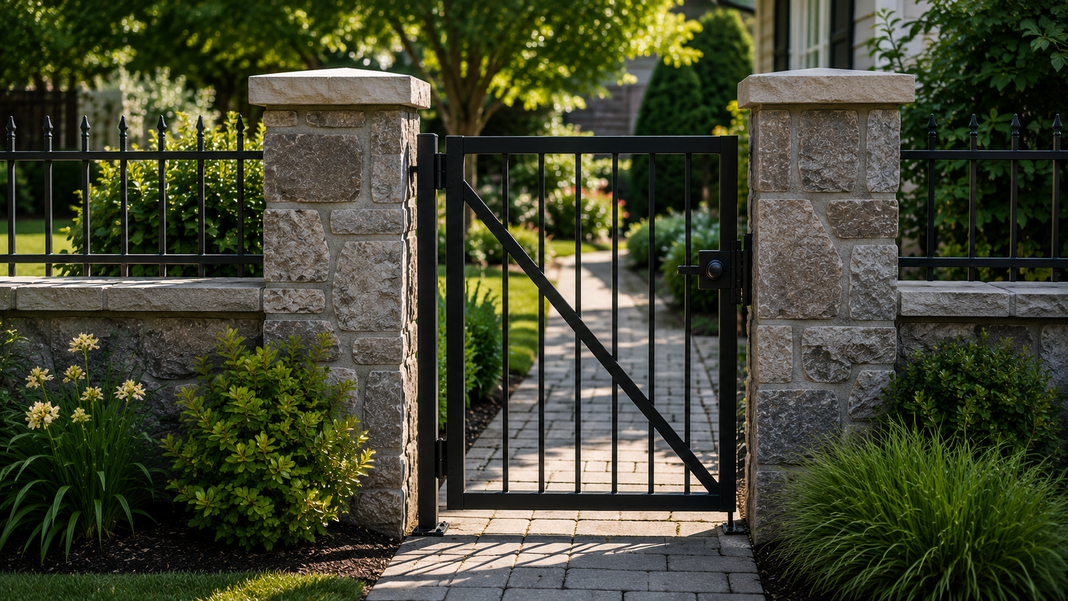
A driveway gate makes the entrance, and it gets the attention. The walk gate does the work. It is opened and shut dozens of times a day, by hand, in every kind of weather, for years, and that constant use is the reason a small pedestrian gate succeeds or fails on details a larger gate can get away with ignoring.
Gravity Always Pulls Toward the Latch
Every gate is a lever. It is fixed on the hinge side and unsupported on the latch side, so gravity spends every day pulling that free corner toward the ground. With nothing to resist it, the gate slowly drops until it drags and no longer lines up with the latch. The fix is a diagonal brace running from the top of the latch side down to the bottom of the hinge side, carrying the load back to the post. A walk gate built without that bracing looks fine on install day and sags within a year.
The Hardware Does the Heavy Lifting
On a gate used this often, the small parts matter more than the panel. Hinges carry the full weight through thousands of open and shut cycles, and a latch has to keep lining up as the gate and the ground move with the seasons. The pieces that decide a walk gate’s life are easy to overlook:
- Hinges rated for the gate’s weight and its frequency of use
- A latch that stays aligned rather than needing a lift or a shove
- Posts set deep in concrete so the whole gate stays square
- A finish that resists rust at the hinge and latch, where wear starts
Cheap hardware is almost always where a walk gate fails first, long before the ironwork itself gives out. Builders that handle Custom Walk Gates in the Dallas Fort Worth Metroplex tend to spec the hinges and latch to a gate’s real weight and daily use rather than to a one size kit.
A Gate Near a Pool Follows Rules
Not every walk gate is only a design choice. A pedestrian gate that encloses a swimming pool is a safety device governed by code. It generally has to swing away from the pool, close on its own, and latch on its own, with the latch set high enough to sit out of a small child’s reach. A fabricator who knows which local rules apply builds the self closing and self latching hardware in from the start, rather than bolting it on after an inspection flags the gap.
Matched to the Fence and the Home
A walk gate rarely stands alone. It sits within a fence line and often beside a matching driveway gate, so the detail work is in making it read as part of the whole rather than an add on. Fabricators who design and build in house tend to match the walk gate’s pattern, finish, and proportions to the surrounding ironwork, so the small gate looks intended rather than ordered on its own.
The walk gate is the one a household actually touches every day. It still swings true and latches cleanly years later only when the brace behind it, the hardware on it, and the work done where it meets the ground were all right from the start.