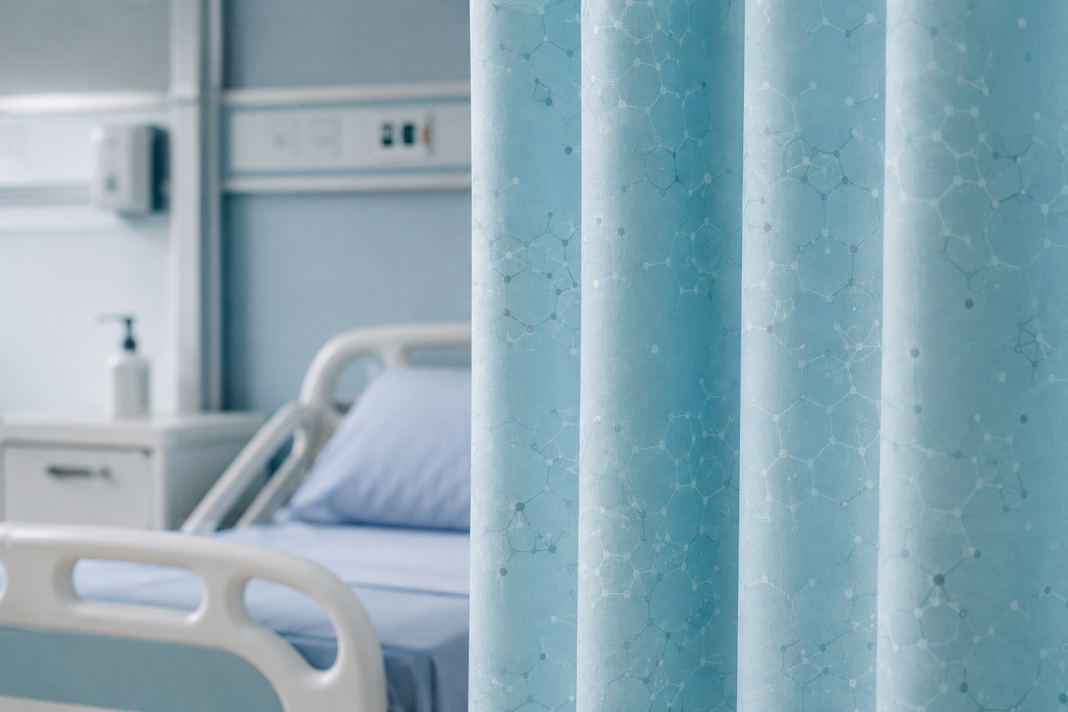
Antimicrobial curtains are often seen as an additional protective feature in healthcare facilities. But an important question remains: ‘‘Do these curtains actually work?’’
Can antimicrobial treatment really prevent infections?
The short answer is that antimicrobial curtains should not be considered a complete solution to infection prevention. The treatment in them may help reduce the growth of some microorganisms, but it alone does not guarantee that infections will be prevented.
Infection prevention in the healthcare environment depends on several different practices. Curtain cleaning, replacement, hand hygiene, and other facility procedures also play an important role.
The Direct Answer: Do They Actually Work?
Antimicrobial curtains can provide additional support against specific microorganisms, depending on their treatment. But their effectiveness depends on several factors. The curtain material, antimicrobial treatment, daily usage, and maintenance are all important.
It is not accurate to say that antimicrobial curtains alone will stop infections. It is more appropriate to consider them as part of a broader infection-control approach.
What Antimicrobial Treatment Can Do
Antimicrobial treatment is intended to help reduce the growth of certain microorganisms. This feature can give the surface of the fabric an additional property. But the performance of the treatment is not the same for every product.
Therefore, facilities should carefully review the claims and specifications of the curtain. The antimicrobial label should not always be interpreted as a promise of complete protection.
What It Cannot Replace
An antimicrobial curtain is not a replacement for regular cleaning. It does not eliminate the need for proper maintenance, facility hygiene procedures, or timely curtain replacement.
The curtain may be visibly dirty. The fabric may be damaged. The condition of the curtain may also change due to frequent use. In all of these situations, the antimicrobial feature alone is not enough.
Why Curtains Still Need Attention
Healthcare curtains are in close proximity to patient areas. They can be touched and moved by many people every day. In some areas, curtain use is very high.
That’s why it’s not a good idea to ignore the condition of the curtain. Regular inspection helps the facility understand whether the curtain needs cleaning, repair, or replacement.
Medical Curtain Care Is Still Essential
Medical Curtain Care doesn’t just include washing. It also includes looking at the curtain’s physical condition, visible soil, damage, and overall usability.
The facility should have a practical care process. For example, staff can regularly check the condition of the curtain and follow an approved cleaning or replacement process when necessary. This approach can be most useful in conjunction with antimicrobial treatment.
Can a Dirty Antimicrobial Curtain Still Be a Problem?
Yes. Despite antimicrobial treatment, the curtain may still have dust, visible dirt, or other contamination.
The curtain is not self-cleaning. If the curtain is visibly soiled, it is not appropriate to continue using it just because of its antimicrobial feature.
Regular maintenance should always be managed according to product specifications and facility procedures.
Does Installation Affect Curtain Performance?
Yes, installation is also important. If the curtain is not properly installed on the right track, it will not move smoothly. This can affect privacy coverage. The curtain can also be difficult to remove and maintain.
Therefore, installation should not be considered just an initial step. Future maintenance should also be considered in advance.
Why Use a Curtain Installation Guide?
A detailed Curtain Installation Guide can provide important information before installation. It helps to understand the room measurements, track configuration, and curtain attachment method.
It is also useful to keep future curtain removal in mind during installation. A practical system is one that is both easy to use and maintain.
Does Every System Need a Curtain Installation Tool?
Not every system needs the same Curtain Installation Tool. Required tools may vary depending on the track design and installation method.
Some systems are installed with specific tools. In other systems, the installation process may be more straightforward. The important thing is to use the correct method and compatible tools for installation.
Infection Prevention Is a Bigger Process
Curtains are just one part of the healthcare environment. Infection prevention cannot be managed by a single fabric feature.
Facilities should also consider their cleaning procedures, staff practices, and maintenance workflow. Treating antimicrobial curtains as an additional layer is a more realistic approach.
Easy Maintenance Can Make a Difference
If the curtain can be easily removed and replaced, maintenance can be more manageable for staff. This is where the track system also becomes important.
When looking at on the right track hospital curtain track solutions, the facility can evaluate curtain movement and future changeout requirements. A practical system can help reduce unnecessary difficulty during maintenance.
Why the Complete Privacy System Matters
Curtain fabric and track are connected to each other. The best curtain material alone is not enough if it is difficult to move or replace.
When evaluating On The Right Track Privacy Curtain System, it is best to look at the room layout, privacy needs, and maintenance process together.
This approach helps the facility understand the complete workflow, not just a product.
Choosing a Practical Healthcare Solution
Each healthcare facility has different requirements. Some facilities want to simplify frequent curtain changes. In other places, custom privacy coverage or a specific track configuration may be more important.
On The Right Track Privacy Solutions can be an option to consider for various practical requirements.
But before making a final selection, the facility should clearly understand its actual usage and maintenance needs.
What Should You Look for Before Buying?
When evaluating antimicrobial features, don’t just look at the label.
Also consider these things:
- Location: Where will the curtain be used?
- Daily use: How much daily use will it have?
- Cleaning process: What is the cleaning process?
- Replacement ease: How easy will replacement be?
- Track compatibility: Is it track compatible?
- Care instructions: What are the manufacturer’s care instructions?
These questions can help the facility make a more practical decision.
Final Answer
So, Do antimicrobial curtains really stop infections?
Antimicrobial curtains should not be considered a complete or guaranteed solution to preventing infections. Their treatment may help reduce the growth of some microorganisms, but this alone is not enough for infection prevention.
Proper cleaning, regular inspection, and timely replacement are still essential. The value of antimicrobial curtains can be more practical when they are used in conjunction with strong Medical Curtain Care and proper maintenance processes.
Ultimately, the best healthcare curtain solution is one that supports privacy, practical installation, and long-term maintenance.