Every year, millions of American homeowners who run two sets of tires — one for winter, one for summer — face the same quiet problem: where do the tires go when they come off the vehicle? The question sounds simple, but the answer has real consequences. Tires stored incorrectly degrade faster, take up more space than necessary, and create safety hazards in garages and basements that accumulate over time. For households that treat seasonal tire swaps as a routine part of vehicle maintenance, storage is not an afterthought. It is part of the process.
The market for home tire storage has matured considerably over the last decade. What used to mean stacking tires against a wall or leaving them in the corner of a utility room now involves structured racking systems designed specifically for residential use. These products vary widely in build quality, configuration, and practical suitability. Understanding what separates a functional solution from an inadequate one takes more than browsing product listings. It requires understanding how tires behave in storage, what conditions cause premature wear, and how different rack designs address or fail to address those conditions.
Why Tire Storage Deserves More Attention Than Most Homeowners Give It
Tires are one of the more expensive recurring purchases a vehicle owner makes. A quality set of all-season or winter tires represents a significant investment, and how they are stored between seasons directly affects how long they remain safe and effective. Rubber compounds degrade when exposed to prolonged heat, UV light, ozone, and physical deformation from improper weight distribution. Most of this degradation is preventable with the right storage environment and the right support system.
A well-researched Tire Storage Rack guide will consistently emphasize that the method of storage matters as much as the location. Tires that sit flat in a stack exert pressure on the lowest tire in ways that cause sidewall distortion over months of inactivity. Tires hung from hooks experience concentrated stress at a single point on the bead. Tires stored upright in individual bays, supported evenly around their circumference, maintain their structural integrity far better over time.
This is not a theoretical concern. It reflects how rubber responds to sustained load distribution, a physical reality that applies whether the tire is on a vehicle or sitting in a garage. According to the Rubber Manufacturers Association, temperature stability and controlled exposure are among the most critical factors in preserving tire integrity during storage. The rack that holds those tires is the first line of control a homeowner has over both.
The Cost Equation Homeowners Often Overlook
When homeowners evaluate whether to invest in a dedicated tire storage solution, they often frame the decision around the cost of the rack itself. That framing misses the larger picture. The actual cost calculation should include what premature tire replacement costs, how much a disorganized garage reduces usable space and utility, and whether improper storage creates a safety risk — for example, tires stacked unsecured that fall onto vehicles, tools, or people.
A modest racking system that extends the usable life of two tire sets by even one additional season pays for itself. The savings compound when households rotate through multiple vehicles or manage tires for drivers across different family members. Framing tire storage as a maintenance expense rather than an optional upgrade changes the decision-making process considerably.
Understanding the Core Rack Designs Available to Homeowners
Residential tire storage racks generally fall into a small number of structural categories, each with distinct advantages depending on garage layout, ceiling height, floor space, and the number of tires being stored. The differences between these categories are not cosmetic. They reflect fundamentally different approaches to load management, accessibility, and long-term space use.
Floor-Standing Freestanding Units
Freestanding racks sit on the garage floor without wall attachment. They are the most common entry point for homeowners who want dedicated tire storage without modifying garage walls or ceilings. These units typically hold four to eight tires arranged in a single or double column, with each tire resting in its own cradle or between angled support arms.
The practical limitation of freestanding units is floor space consumption. A rack that holds eight tires occupies a meaningful portion of a single-car garage. In households with limited floor space, adding a freestanding rack often means sacrificing other storage or vehicle clearance. On the other hand, freestanding units are easy to reposition, require no installation hardware, and can be moved when the garage layout changes.
Wall-Mounted Rack Systems
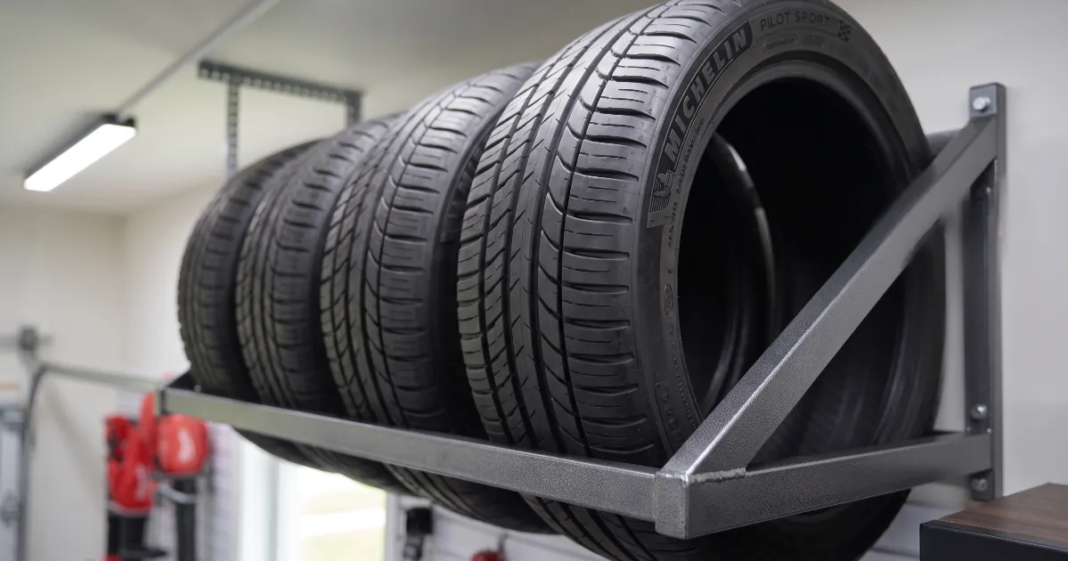
Wall-mounted systems attach directly to garage studs or masonry and hold tires horizontally in individual cradles extended from the wall. This design keeps tires off the floor entirely, which frees ground-level space for tools, vehicles, or other equipment. Wall mounting also keeps tires at a consistent height, which makes inspection and retrieval straightforward without lifting or moving adjacent tires.
The installation requirement is the primary consideration. Wall-mounted racks need to be anchored into structural support — typically wall studs rated to carry the combined weight of four or more tires. Improperly anchored systems can fail under load, which creates both a damage and injury risk. Homeowners without confidence in their wall construction or anchor placement should consult a contractor before installing heavier wall-mounted configurations.
Ceiling-Mounted and Overhead Storage
Overhead tire storage systems suspend tires from ceiling-mounted platforms or pulley systems, using vertical space that would otherwise go unused. In garages with adequate ceiling height — typically eight feet or more — overhead storage can hold a full set of tires without affecting floor or wall space at all. This configuration is particularly practical in single-car garages where every square foot of ground-level space is spoken for.
The trade-off is accessibility. Retrieving tires from overhead storage requires a ladder and the physical ability to manage heavy items at height. For households where seasonal swaps happen twice a year and are handled by a professional installer, this is a minor inconvenience. For households that self-install or need to access tires more frequently, the overhead configuration may create more friction than it eliminates.
Matching Rack Configuration to Garage Layout
The most effective tire storage setup is not necessarily the most sophisticated one. It is the one that works consistently within the physical constraints of the space. Homeowners who purchase racks based on capacity ratings alone often find that the unit creates new problems — blocking access to a vehicle door, interfering with shelving, or creating awkward workflow around the garage entrance.
Assessing the Space Before Selecting a Rack
Before any purchasing decision, the relevant measurements are not just available floor space but also how the garage is used throughout the year. A rack placed against the back wall of a two-car garage may work well in summer when both bays are in use. In winter, when snow, wet gear, and seasonal equipment compete for the same space, the same rack placement may become a persistent obstacle.
Effective planning accounts for seasonal use patterns. A rack positioned along a side wall adjacent to the garage door may allow tires to be loaded and removed without moving the vehicle, which simplifies the swap process. A rack positioned behind a parked car requires vehicle movement every time the tires are accessed, which adds friction and reduces the likelihood that the storage system will be used correctly and consistently.
Tire Dimensions and Rack Compatibility
Rack compatibility varies by tire size, and this is a detail that matters more than many homeowners expect. Trucks, SUVs, and crossovers run significantly larger tires than sedans, and rack systems designed for standard passenger tire dimensions may not accommodate larger-profile tires without modification or substitution. Homeowners with multiple vehicles of different sizes should verify that any rack system they select handles the widest tire profile they own.
Weight distribution matters as well. Larger tires weigh considerably more than standard passenger tires, and stacking or cradling multiple large tires on a rack rated for lighter loads stresses the structure over time. Checking weight ratings against realistic load scenarios — not just the single tire weight, but the total rack load — is part of selecting a system that will remain safe and functional across multiple storage seasons.
What Professional Installers and Shop Operators Do Differently
Tire shops and professional installers who manage hundreds of customer tires per season use commercial-grade rack systems, but their habits translate meaningfully to residential use. The core principle is consistency. Every tire set in a well-run shop is labeled, positioned in a defined space, and stored in a way that makes identification and retrieval reliable without searching or guessing.
Homeowners who adopt the same discipline — labeling each set with the vehicle, the season, and the date of removal — find that the storage system becomes genuinely functional rather than just a place to keep tires out of the way. Labels also help when tires need to be inspected for tread wear, cracking, or deformation before they go back on the vehicle. A tire that has been stored for six months without any record of its condition may be mounted without adequate inspection, which introduces risk that simple labeling would have prevented.
Professionals also account for airflow. Tires stored in areas with poor ventilation accumulate ozone more readily, which accelerates rubber degradation. Keeping tire storage areas dry, ventilated, and away from motors, compressors, or welding equipment — all of which generate ozone — reflects the same chemistry-aware approach that commercial storage facilities apply at scale.
Closing Considerations for Homeowners Planning a Seasonal Setup
Seasonal tire storage is one of those household logistics problems that rewards a modest investment in structure. A well-chosen tire storage rack, placed thoughtfully in a garage that has been assessed for space and use patterns, simplifies twice-yearly swaps, protects tire condition between seasons, and reduces the kind of disorganization that turns a manageable task into a recurring frustration.
The decision involves more variables than most homeowners initially expect — rack type, wall or floor configuration, tire size compatibility, weight ratings, ventilation, and workflow. None of these are especially complex in isolation, but they interact. A rack that checks one box poorly can undermine the value of everything else. Taking the time to understand how these factors connect before selecting a system produces a much better long-term outcome than choosing based on price or convenience alone.
For households that run two tire sets and expect to continue doing so for the foreseeable future, the right storage solution is not a temporary fix. It is a durable part of how the garage functions. Approaching it with the same care applied to other vehicle maintenance decisions — deliberately, with accurate information — is simply the practical thing to do.