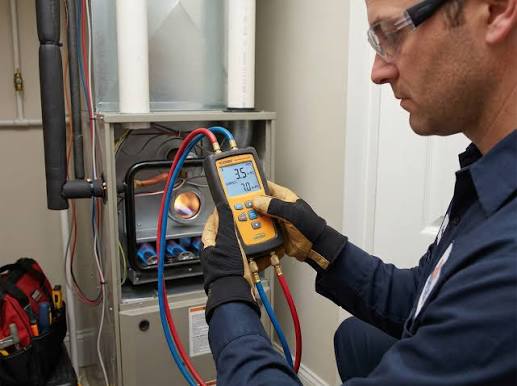
Uneven rooms, short cycling, and noisy vents often get blamed on the thermostat or the equipment. In many homes, the real culprit is airflow. The duct system and filter path determine how much air the blower can actually move across the heat exchanger or evaporator coil. When resistance to airflow is high, known as high static pressure, comfort drops and wear on components rises. Understanding what static pressure is, what causes it, and how to correct it helps homeowners make smarter decisions about service and upgrades.
- What Static Pressure Really Measures
Static pressure is the resistance your blower works against, measured in inches of water column with a manometer. Manufacturers publish fan tables that show how much airflow a blower can deliver at different pressure levels. Most residential systems are designed to operate around a total external static pressure the equipment can handle, often near 0.5 in. w.c., but real installations vary. Homeowners often research local providers, for example, Evans Heating & Cooling, before deciding whether a suspected airflow problem is worth a diagnostic visit.
A proper measurement requires pressure taps before the filter and after the coil or furnace to capture the resistance of the return, filter, supply, and coil. Without numbers, adjustments are guesswork. A blower may be set to a higher speed to chase more airflow, but if the filter rack is undersized or the coil is clogged, that setting can just make the system louder without delivering the needed cubic feet per minute.
- Where High Static Pressure Comes From
Several common details add up to excessive resistance. A 1-inch filter rack with a high-MERV pleated filter can drop a lot of pressure, especially as it loads with dust. Undersized return grilles and long runs of compressed or kinked flex duct choke airflow before it reaches the blower. On the supply side, too few trunks or branches force air through small pathways at higher velocity, raising noise and pressure.
Coil fouling is another hidden restriction. Even a thin layer of debris on the evaporator coil fins reduces the free area for air to pass. Contractors sometimes respond by closing supply registers to”push” more air to distant rooms, but that raises static pressure system-wide. A realistic example: a bonus room over a garage feels warm in summer, so several closer rooms get dampers closed. The result is a whistling hallway vent, reduced overall airflow, and a coil that starts icing on humid afternoons.
- What High Static Does to Comfort, Efficiency, and Reliability
Great static changes how equipment behaves. A permanent split capacitor (PSC) blower moves less air as pressure rises, which can lead to long run times, weak cooling, and low supply temperatures that risk evaporator freeze-up. Electronically commutated motors (ECM) try to maintain target airflow but draw more watts as static increases, which raises operating cost and heat in the air handler. In heating mode, reduced flow can cause furnace limit switches to trip because the heat exchanger runs hot. You may see short cycles, loud return grille noise, and temperature swings. The thermostat gets blamed, but the pressure in the duct system sets the stage.
- Practical Corrections That Make Measurable Differences
Start at the filter. Increasing filter area with a 4- or 5-inch media cabinet drops resistance dramatically for the same MERV rating. If space is tight, consider a filter with a published low pressure drop at your system’s typical airflow rather than simply ramping up MERV. There is a trade-off here: finer filtration captures more particles but can increase restriction. A larger filter cabinet often delivers both cleaner air and lower static, so it is a frequent win.
Next, reduce duct restrictions. Add return capacity where feasible, especially in rooms with closed doors that starve the system. Straighten and support flex duct to avoid sags, replace crushed sections, and use smooth-radius elbows. Balance dampers should be set to steer, not strangle, airflow. If an evaporator coil is dirty, a professional cleaning can recover lost free area and lower pressure. After each change, recheck static with a manometer to confirm the improvement rather than guessing by sound or feel.
Planning Around New Equipment So the Airflow Keeps Up
When replacing a furnace, air handler, or heat pump, avoid upsizing equipment to mask duct limitations. Larger capacity without larger ducts usually raises static pressure and noise. Load calculations and duct design ensure the blower, coil, and ducts can deliver required cubic feet per minute at a realistic static pressure. Ask to see the selected blower’s fan table and the coil’s pressure drop at your target airflow. Details that help include a wider cabinet that accepts a bigger coil, a filter rack sized for low face velocity, and confirmation of total external static after installation. That checklist locks in comfort that the nameplate tonnage alone cannot guarantee.
Two scenarios show why the airflow plan matters. In a single-story ranch, adding a second return in the bedroom wing cuts the return-side pressure in half, the ECM blower relaxes, and the system gets quieter while supply temperatures stabilize. In a two-story with long attic runs, replacing several overly long flex trunks with shorter, properly sized rigid trunks and short flex connections reduces pressure and lifts airflow to the distant rooms. In both cases, the thermostat setting did not change, but the path air followed did.
Airflow is a system property, not just an equipment setting. If comfort issues persist, ask for the measured total external static pressure and compare it to what your blower can handle. Keep the filter path generous and the coil clean, and use dampers to fine-tune rather than force air. With a few targeted changes confirmed by measurement, homeowners can solve chronic hot and cold spots, lower noise, and help the equipment operate as designed.