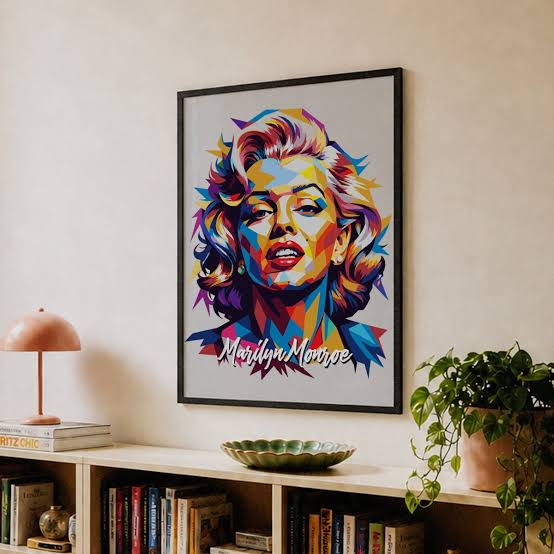
Marilyn Monroe is one of Pop Art’s most recognizable subjects, yet her image carries a different meaning depending on the artist who portrays her. A single familiar face can inspire works that tell entirely different stories.
Collectors exploring original pop art for sale can find original paintings, signed screenprints, limited-edition lithographs, and sculptures by artists such as Andy Warhol, Roy Lichtenstein, and Keith Haring. Their works draw on Hollywood portraits, comic-book panels, advertising, and everyday consumer products, transforming familiar subjects through color, composition, scale, and printmaking techniques. Details such as medium, edition size, signature, and provenance help distinguish one artwork from another and give collectors a fuller picture of how each piece was made.
Andy Warhol’s Marilyn
Warhol began using a publicity photograph from the 1953 film Niagara shortly after Monroe died in August 1962. He cropped it around her face, keeping the carefully arranged hair, lips, and eyes that audiences associated with the star.
In Marilyn Diptych (1962), he printed that face fifty times across two panels. On the left, twenty-five portraits are brightly colored. On the right, another twenty-five grow uneven and faint in black and white.
The repeated smile becomes harder to read as the ink disappears.
Screenprinting made it possible to reproduce a photograph again and again, complete with variations in color and registration. Across the diptych, those small differences accumulate into a dramatic contrast between presence and absence. Made in the wake of Monroe’s death, the work invites us to consider how a celebrity can remain everywhere in pictures after her life has ended.
Warhol’s Gold Marilyn Monroe (1962) takes a different approach using the same photographic source. A relatively small face floats at the center of a vast golden field, recalling the visual language of religious icons. The actress seems exalted and distant at once.
Warhol’s treatment turns a publicity portrait into an image of fame, devotion, and mortality. Pauline Boty began with a movie photograph too, but the full figure she chose creates a different kind of encounter.
Pauline Boty’s Marilyn
In The Only Blonde in the World (1963), Monroe walks through a slim strip of space bordered by bold abstract shapes. Boty based the painting on a still from Some Like It Hot published in Life magazine. Marilyn’s glamorous outfit and forward movement give the scene the energy of a film still.
Her movement seems almost effortless.
Yet the colorful panels restrict the space around her. The actress appears caught between surfaces that celebrate her glamour and limit her freedom. An image originally designed to entertain begins to invite questions about how women are presented to an audience.
Boty also worked as an actress, so the experience of being seen and discussed was familiar to her. Her paintings engaged with celebrity culture through an interest in the people behind the images, rather than solely the spectacle surrounding them.
Another painting, Colour Her Gone (1962), reveals a more intimate response. Boty placed a portrait of Monroe among flowers, borrowing the work’s title from a song about love and loss. Created in the year of Monroe’s death, it reads as an expression of affection and grief.
Both paintings allow admiration and unease to exist together. Boty’s Marilyn feels like a person with a presence of her own, even while the visual world around her imposes expectations.
For Rosalyn Drexler, a photograph of Monroe captured something much less glamorous: an attempt to get away from the camera.
Rosalyn Drexler’s Marilyn
The source for Marilyn Pursued by Death (1963) was a news photograph from 1956. It showed Monroe and her bodyguard fleeing paparazzi during intense coverage of her relationship with Arthur Miller.
Drexler enlarged the image, incorporated it into a canvas, and painted around it. The figures run toward the picture’s edge, traced in red against a deep black field. Nearly all the details of their original surroundings have vanished.
The empty space makes the movement feel urgent.
The Whitney Museum notes that the press frenzy on the day the source photograph was taken also involved a fatal crash of a vehicle carrying reporters. Against that history, Drexler’s title acquires a chilling resonance. A fleeting news image becomes a scene of danger and vulnerability.
There is another uncomfortable detail: the photographers are outside the painted frame. The people pursuing Monroe remain unseen, while she is still exposed to our gaze. The painting makes the act of looking feel implicated in the chase.
Drexler’s version of Marilyn exposes a cost of celebrity that publicity portraits rarely show. It also leads to a question that links all three artists: what was the photograph asking its first audience to see before it reached a painter’s hands?
From Photograph to Pop Art
A photograph has a purpose long before it hangs in a gallery. A studio portrait promotes a star, a film still captures a performance, and a news photograph records an event for readers who may know nothing about what happened outside the frame. Each carries choices made by photographers, editors, and the people who publish it.
Monroe herself helped shape the persona audiences recognized through her performances and public appearances. In one photograph she could inhabit a film role; in another she might be trying to escape a crowd. Neither image could capture the whole person.
Pop Art changes the encounter with those images. A picture that originally appeared beside a movie review or a news story can become something we look at slowly, noticing how it was cropped, enlarged, repeated, or surrounded by paint. The artist creates another context for the same material.
Three questions can make that transformation easier to see:
- What was the photograph made to do? Publicity, entertainment, and news reporting each encourage a different response.
- What has the artist changed? A new scale, background, color, or printing process can redirect our attention.
- What do we know now? Our knowledge of Monroe’s life affects how we interpret photographs created decades ago.
This is where the viewer enters the story. We carry memories and assumptions that the original audience may never have shared. The finished artwork becomes a meeting point between the photograph’s first purpose, the artist’s decisions, and our own experience.
What Marilyn Shows Us About Pop Art
Pop Art brought images from everyday media into an artistic setting where people could examine them differently. A publicity still or a newspaper photograph could become the starting point for a painting with an entirely new emotional weight.
The artist’s individual vision gives that transformation its meaning. A familiar picture might become a memorial, a tribute, or an unsettling look at the culture that produced it. Viewers may recognize the subject instantly, then discover a perspective they had never considered.
Warhol’s repeated face, Boty’s woman walking through color, and Drexler’s figure running toward the edge of a dark canvas offer three very different views of Marilyn. She remains recognizable in each. The lasting interest of Pop Art lies in what artists can make us see through an image we thought we already knew.