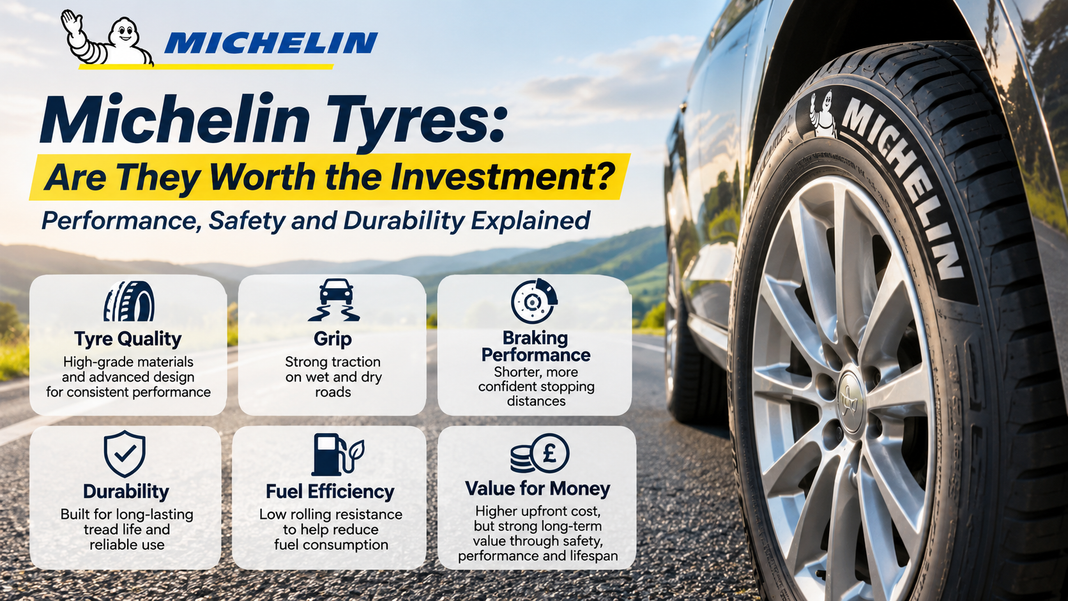
Michelin tyres sit towards the premium end of the market, with ranges developed for everyday commuting, family journeys and performance driving. However, a higher price deserves more explanation than a familiar name.
The real question is whether a particular Michelin model offers the grip, braking, comfort and durability your vehicle needs. This guide examines the evidence, explains the trade-offs and helps you decide whether paying more makes sense for your driving in Dubai.
Why Michelin Tyres Are Considered a Premium Choice
Michelin’s history dates to 1889. Its engineering milestones include patenting radial tyre technology in 1946 and opening its Ladoux research and testing centre in 1965. That background helps explain its established position in the tyre industry.
The practical value of tyre development comes from balancing competing requirements. A tyre must provide grip while resisting wear, support the vehicle while absorbing road irregularities, and roll efficiently without sacrificing control.
Michelin uses different technologies across its ranges. For example, its Pilot Sport 5 incorporates MaxTouch technology, which Michelin describes as distributing acceleration, braking and cornering forces to support longer tread life.
However, reputation alone cannot establish quality. Correct specifications, traceable manufacturing details and independent results matter more than broad promises. Continental, Bridgestone, Goodyear and Pirelli also produce established premium alternatives.
Michelin Tyre Performance: Grip, Handling and Driving Comfort
Wet and Dry Road Grip
Tread patterns and rubber compounds determine how a tyre interacts with the road. Grooves help evacuate water, while tread blocks and compound characteristics influence traction on dry surfaces.
Michelin’s Pilot Sport 5 illustrates this approach. Its inner tread incorporates large longitudinal grooves for water evacuation, while rigid outer blocks support dry-road grip. This design is specific to that model.
For Dubai drivers, compare dry-road performance alongside wet grip. Occasional rain still makes water evacuation and predictable braking relevant.
Handling and Cornering Stability
Handling describes how accurately the vehicle responds to steering and how settled it feels through bends or sudden manoeuvres.
A performance tyre may prioritise steering response, while a touring tyre places greater emphasis on comfortable everyday driving. Neither approach suits every motorist equally.
Driving Comfort and Noise Levels
Comfort depends on the tyre model, sidewall profile, pressure, vehicle suspension and road surface.
Premium pricing does not guarantee the quietest result. In ADAC’s 2025 test, the Pilot Sport 5 received a satisfactory noise score despite its good overall assessment.
Compare cabin comfort separately from external pass-by noise ratings.
Michelin Tyres and Braking Performance: How Safe Are They?
Brakes slow the wheels, but tyres must transfer that braking force to the road. Available grip therefore affects how effectively a vehicle stops.
Independent testing provides useful evidence. ADAC’s 2025 test of the Michelin Pilot Sport 5 in 225/40 R18 92Y recorded:
- 35.5 metres: dry braking from 100 km/h.
- 29.2 metres: wet-asphalt braking from 80 km/h.
These are separate measurements under different conditions, rather than directly comparable wet-versus-dry results.
They support that model’s braking credentials, but cannot predict another vehicle’s stopping distance. Speed, load, temperature, road texture, water depth and tyre condition all influence the outcome.
Tread depth also matters because worn grooves have less capacity to manage standing water. Michelin explains this relationship in its tyre-life guidance.
Correct pressure remains essential. Even a well-tested tyre can deliver poorer grip and braking when incorrectly inflated.
Michelin Tyre Durability: How Long Do They Last?
Expected Tyre Lifespan
There is no reliable mileage figure covering every Michelin tyre.
As one specific example, ADAC projected 56,400 kilometres, approximately 35,000 miles, for the Pilot Sport 5 in its 2025 test. This was a test-based wear projection, not a guarantee for Dubai driving or permission to keep using an aged or damaged tyre.
Actual lifespan depends on:
- Driving style and frequency of hard braking.
- Vehicle weight and operating load.
- Road surfaces and environmental exposure.
- Inflation pressure and mechanical condition.
Touring, performance and SUV tyres have different priorities. A heavier vehicle or more demanding use can change how quickly its tyres wear.
Tread Wear and Construction Quality
Rubber compounds influence both grip and wear. Construction also affects how loads are distributed, but a premium tyre remains vulnerable to kerb impacts, punctures and pothole damage.
Inspect the whole tread width. Faster wear on one edge, irregular patches or a substantial difference between tyres deserves investigation.
Maintenance Tips to Extend Tyre Life
Maintain recommended pressures, correct alignment problems and have vibration checked. Rotate tyres only where the vehicle’s configuration and manufacturer’s instructions allow it. Michelin’s rotation guidance confirms that suitable rotation can help distribute wear more evenly.
Michelin Tyres and Fuel Efficiency: Can They Reduce Running Costs?
Rolling resistance is the energy a tyre uses as it rolls and repeatedly deforms. Lower resistance can reduce the energy needed to keep a vehicle moving.
Michelin’s e.PRIMACY is an example of a range designed around lower rolling resistance. Its construction and rubber compounds aim to reduce energy losses while maintaining other necessary performance characteristics.
Potential benefits apply to petrol, diesel and hybrid vehicles through fuel consumption, and to electric vehicles through electricity use and range. The size of any benefit depends on the vehicle, exact tyre specification, driving conditions and pressure.
Fuel savings should therefore support a purchase decision rather than determine it alone. Compare the additional purchase cost against realistic savings over your expected ownership period.
An efficiency-focused tyre may be useful for frequent motorway driving, but no Michelin tyre should be assumed to recover its price premium automatically.
Michelin Tyres Price: Are They Worth the Extra Cost?
Michelin tyres generally occupy a higher price bracket than budget alternatives. Development, materials, construction, product positioning and vehicle-specific requirements can all contribute to the difference.
There is no single meaningful “Michelin tyres price”. A small-car touring tyre and a large performance SUV tyre are different products.
Your quotation should identify:
- Exact model, size, load index and speed rating.
- Any required vehicle approval or run-flat specification.
- Manufacturing date and warranty terms.
- Whether fitting, balancing, valves and VAT are included.
Michelin Tyres vs Budget Tyres
| Comparison factor | Michelin tyres | Budget tyres |
| Purchase price | Generally higher | Generally lower |
| Grip and handling | Depends on the model and application | Varies significantly |
| Braking performance | Assess model-specific test results | Assess model-specific test results |
| Durability | Strong options, with no universal lifespan | Depends on construction, use and maintenance |
| Fuel efficiency | Low-resistance options available | Check the specific efficiency rating |
| Comfort and noise | Varies across touring and performance ranges | Varies by model and specification |
| Long-term value | May justify the premium through useful performance and wear life | May offer good value where independently supported |
Paying more makes sense when the tyre’s measured advantages match your needs, particularly for frequent journeys or demanding vehicles.
A suitable, well-tested mid-range alternative may be sufficient for a modestly powered car with lighter use. Lower annual mileage, however, does not remove the need for safe wet braking.
Compare total fitted cost and usable service life, alongside safety and comfort. Purchase price alone gives an incomplete picture.
Michelin Tyres vs Other Leading Tyre Brands
The most useful comparison is between equivalent models in the same size and category.
Michelin vs Continental
In ADAC’s 2025 test of 225/40 R18 summer tyres, Continental SportContact 7 achieved a better overall grade than Michelin Pilot Sport 5: 1.8 versus 1.9, with lower scores indicating better results. This is evidence against assuming Michelin always leads.
Michelin vs Bridgestone
Bridgestone Potenza Sport also received a 1.9 overall grade in that test. Its driving-safety score was better than Michelin’s, while Michelin scored better in the environmental assessment, which includes wear and efficiency.
Michelin vs Goodyear
Goodyear Eagle F1 Asymmetric 6 received the same 1.9 overall grade. A shared headline score can conceal different strengths, so inspect individual results and local fitted prices.
Michelin vs Pirelli
Pirelli’s P Zero performance and Cinturato road ranges provide relevant alternatives to suitable Michelin models. Pirelli describes Cinturato products as addressing requirements including wet performance and rolling resistance. This positioning does not establish a head-to-head winner.
Across all four comparisons, examine wet braking, handling, wear, efficiency, comfort and noise. Confirm the exact generation: results for an older tyre should not automatically be applied to its replacement.
How to Choose the Right Michelin Tyres for Your Vehicle
Choosing Tyres by Driving Requirements
Start with how you use the car:
- Everyday city driving: prioritise predictable braking, comfort and suitable wear characteristics.
- Long motorway journeys: compare stability, noise, efficiency and durability.
- Sports driving: assess steering response and dry and wet handling.
- SUVs and family vehicles: confirm load capacity and suitability for the vehicle.
- Electric and hybrid vehicles: check manufacturer requirements, load ratings and efficiency.
A road-focused SUV tyre should not be selected for regular off-road use solely because it fits the wheels.
Understanding Michelin Tyre Ranges
| Michelin family | General purpose |
| Primacy | Touring and everyday driving, with comfort-focused options |
| Pilot Sport | Performance driving and responsive handling |
| CrossClimate | All-season use, including colder-weather capability where specified |
| Energy | Everyday applications with an efficiency focus |
| Latitude | SUV and crossover applications, depending on the model |
Michelin’s regional catalogue lists Primacy, Pilot, Energy and Latitude families. CrossClimate appears in other regional catalogues; check local supply and suitability rather than assuming every range is offered in Dubai.
Cold-weather capability alone is not a reason to choose an all-season tyre for local driving.
Checking the Correct Tyre Size
Using 205/55 R16 as an example:
- 205: nominal tyre width in millimetres.
- 55: sidewall height as a percentage of width.
- R: radial construction.
- 16: wheel diameter in inches.
The following number and letter identify load index and speed rating. Match the vehicle manufacturer’s approved specification, including any required original-equipment markings. Physical fit alone does not establish compatibility.
How to Maintain Michelin Tyres for Better Performance and Safety
A simple maintenance routine helps protect your investment:
- Check pressure monthly and before long journeys. Measure when cold, using the vehicle’s recommended settings.
- Measure tread depth across the width. Checking one visible groove can miss uneven wear.
- Inspect for damage. Cuts, cracking, bulges or exposed reinforcement need professional assessment.
- Investigate changes promptly. Pulling, vibration or repeated pressure loss deserves attention.
- Check alignment and balancing when needed. These address different problems and should be diagnosed properly.
- Follow replacement guidance. Consider condition, age, local requirements and manufacturer instructions together.
Do not release air from hot tyres simply to reach the recommended cold-pressure figure. Driving raises tyre temperature and pressure; releasing air can leave the tyre underinflated after cooling.
Keep inspection and fitting records. They help you recognise recurring problems and compare replacement costs over time.
Frequently Asked Questions About Michelin Tyres
1. Are Michelin tyres worth the extra money?
Michelin tyres can justify their higher price when a suitable model offers braking, comfort, handling or wear characteristics that matter to you. Their value depends on the exact tyre, fitted price and your driving requirements. Compare equivalent alternatives before buying. A premium badge alone does not establish that a tyre is the best purchase for your vehicle.
2. How many miles do Michelin tyres usually last?
There is no single mileage figure that reliably covers Michelin’s different ranges and operating conditions. Vehicle weight, driving style, pressure, alignment and road conditions all influence wear. Manufacturer guarantees, where available, have specific terms and market restrictions. Inspect tyres regularly and replace them when their condition or applicable requirements demand it, even if their mileage seems low.
3. Are Michelin tyres better than Continental and Bridgestone?
Neither brand comparison has a universal winner. Independent tests show that particular Continental and Bridgestone models can match or outperform a Michelin competitor in certain categories. Compare equivalent tyre types, sizes and generations, then examine the individual results. Your preferred balance of braking, handling, comfort, wear and fitted price should determine the choice.
4. Do Michelin tyres improve fuel efficiency?
Some Michelin models are designed to reduce rolling resistance and may improve fuel efficiency compared with less efficient alternatives. The benefit depends on the exact tyres, vehicle, pressure and driving conditions. Look at model-specific efficiency information rather than assuming every Michelin tyre saves fuel. Any projected savings should be weighed against the additional purchase cost.
5. Are Michelin tyres good for wet-weather driving and braking?
Several Michelin models offer strong wet-weather performance, but you should check evidence for the particular tyre you intend to buy. Compound, tread design and remaining tread depth all matter. Correct inflation and appropriate speed remain essential. Even a highly rated tyre cannot guarantee grip in deep standing water or prevent aquaplaning under every condition.
Are Michelin Tyres the Right Investment for You?
Michelin tyres are worth considering when their specific strengths match your vehicle, journeys and budget. Independent evidence supports strong options, while also showing that competing premium models deserve attention.
Choose by specification and measured performance, then compare the complete fitted price. Maintain the tyres properly to preserve the benefits you paid for.
For help comparing suitable options, speak to mathyo tyres, a Dubai tyre shop offering tyre guidance and mobile fitting. Have your vehicle model and tyre size ready when requesting a quotation.
READ ALSO: OEM vs. Aftermarket Drivetrain Parts: Which Is Better for European Luxury Cars?