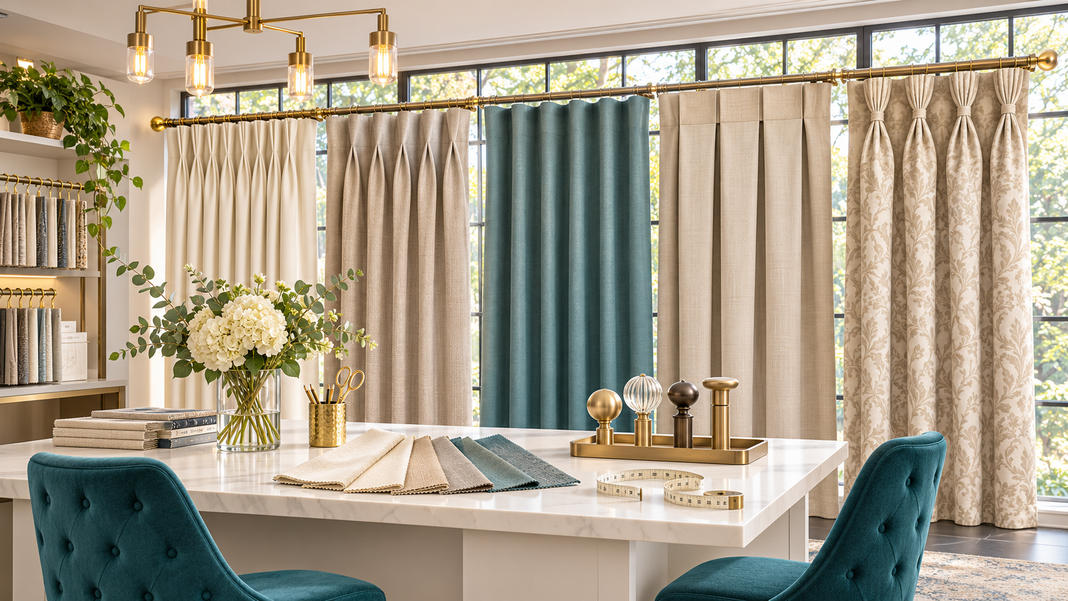
Curtains do more than cover windows. They help define the character of a room, control natural light, provide privacy, and bring together different elements of your interior design. However, choosing the right curtains involves more than selecting a beautiful fabric or colour.
The best place to start is by considering how you use your windows and doors. A pair of curtains that you open and close every evening has different functional requirements from decorative side panels that remain open to frame a beautiful view.
In this guide, explore the most popular drapery pleat types, explain what makes each one unique, and highlight their practical advantages and design considerations.
What Are Drapery Pleats?
Drapery pleats are folds that shape the fabric at the top of a panel. This top section is called the heading. Some headings have folds sewn into place.
Others use gathering tape or a track system to shape the fabric. To tell the styles apart, look at the top edge first. The spacing and shape of the folds are easiest to see there
Common Types of Drapery Pleats
Pinch Pleat
In traditional pinch pleat drapery, stitches hold small groups of folds together below the top edge. A two-finger pleat has two folds in each group and gives the panel a lighter look.
A three-finger pleat adds more detail and looks fuller at the top. Try a double pleat in a relaxed living room or a triple pleat to give tall dining room windows more presence.
Euro Pleat
A Euro pleat is stitched at the very top. Its folds spread below the stitch, giving the heading a neat upper edge. It suits simple window frames and unfussy furniture.
Since curtain makers sometimes use different names for similar folds, share a photo of the heading you like before ordering.
Ripplefold
Ripplefold panels hang in a continuous series of soft S-shaped waves. This style works well across wide windows, where the even folds give several panes a unified look.
The waves form when tape sewn to the fabric snaps onto moving carriers in a compatible ripplefold track.
In verted or Flemish Pleat
An inverted pleat folds towards the back of the panel. The front looks flat between the folds, giving a wide stripe or large print more room to show.
This style is referred to as a Flemish pleat. If you choose a print, check how the pattern will line up where the panels meet.
Box Pleat
A traditional box pleat uses two outward-facing folds to form a broad, flat section. Repeating that shape across the heading gives the curtain a crisp, geometric look.
It can echo the straight lines of wall panelling. Some curtain makers use the name for an inverted heading too. Ask to see the sample from the front before you order.
Goblet Pleat
Goblet pleats have cup-shaped tops, often padded to hold their shape. The cups take up extra room when the curtains are drawn back. This style suits fixed panels that frame a bay window or add detail to a formal dining room.
Cartridge Pleat
A cartridge pleat forms an upright roll at the top of the panel. The rounded shape adds depth and brings out the texture of a plain fabric.
Consider these pleats for stationary panels beside tall windows, where the rolls are easy to see from across the room.
Pencil Pleat
Pencil pleats are narrow folds gathered across the top of a panel. Cords in the heading tape let you adjust the width before you hang the fabric. The closely spaced gathers give the heading a softer look that suits light curtains in a kitchen-diner or guest room.
How Do You Choose the Right Pleat for Your Windows?
Decide How the Panels Should Open
Pinch pleats and ripplefold work well on a compatible track if you open the curtains every day. At a sliding door with a fixed pane, a one-way draw lets the fabric gather on that side to keep the passage clear. If a blind already handles privacy at a picture window, stationary side panels can frame the glass.
Measure for the Open Position
Stackback is the width the fabric takes up when the curtains are fully open. Measure the clear wall space beside the window surround. If you want to expose the whole window, the pole or track can extend beyond the frame where space allows.
A cupboard or internal corner can limit that extra space. Ask for a stackback estimate based on your chosen fabric, lining and finished panel width.
Plan for Bay Windows
A curved or angled track can follow the shape of a bay window. Decide whether you want one pair of curtains across the whole bay or separate panels for each section.
For a single pair, check that the track fittings can travel around the bends. Note any projecting handles or deep sills before deciding how far the track should sit from the glass.
Choose Fabric and Lining Together
Look at a sample of the fabric and lining hanging together. The added weight can change how the folds fall. For daytime light and night-time privacy, layer sheer curtains over a blind. In a bedroom where darkness matters, use blackout lining. Check how far the panels extend past the frame and how much they overlap at the centre to reduce light gaps.
Preview Patterned Fabric in Folds
Ask your curtain maker to fold a large sample into your chosen heading. Look at where a prominent stripe or motif will sit on the face of the pleat. On wide windows, a single curtain may need several widths of fabric.
The pattern repeat is the distance before the design starts again. A large repeat can require extra fabric to match the print at the seams.
Set the Mounting Height Before Measuring Length
A ceiling track can work well where there is little wall above the window. Once you choose the mounting height, confirm where the top of the fabric will sit.
Curtain rings usually position it below the pole, while an eyelet heading extends above it. Measure from that point to the hem. Leave a small gap above the floor so the hems clear it as the panels open and close.
Compare Like-for-Like Quotes
Ask for quotes based on the same finished width, length, fabric and lining. Check whether each price covers measuring, the pole or track, and fitting. Request separate prices for upgrades such as a decorative pole or motorisation.
If you are ordering for several rooms, ask for the cost per window. That shows where changes to the heading or fittings would make the greatest difference.
Frequently Asked Questions
Can You Reuse an Existing Curtain Pole?
You can if the pole suits the new heading. Pinch pleats can hang from rings fitted with curtain hooks. Eyelet curtains slide onto a smooth pole through rings built into the fabric. Confirm its diameter and weight limit. A centre bracket can limit how far the rings slide.
How Does Fullness Affect a Pleat?
Fullness is the amount of fabric used across the finished width. At a two-to-one ratio, a finished panel 125 cm wide uses 250 cm of fabric before allowances for hems and seams. More fullness can create deeper folds or bring them closer together. Ask to see a sample made to your chosen ratio.
Can Pleated Curtains Be Motorised?
Pleated curtains can be motorised with the right track. Both pinch pleat and ripplefold are available for these systems. Motorisation can be useful when a sofa blocks access to a wide window. Ask your fitter to check that the track can carry the finished weight of the curtains. Agree where the motor and power supply will sit before the curtains are made.
See the Pleats in Person
Bring a photo of the wall around the window when you compare drapery pleat styles. It helps show what sits near the frame and where the panels will gather. Ask to see the samples both open and closed.
Denver homeowners can see how the curtains hang at the Windows Dressed Up studio on Tennyson Street. The team helps you choose a heading, fabric, and hardware. It also provides professional measuring and fitting for made-to-measure curtains and drapery.