When a part requires a cut that no conventional tool can produce cleanly, wire electrical discharge machining becomes a serious option. It appears in aerospace tooling, medical device manufacturing, die-making, and precision industrial components — anywhere that dimensional accuracy is non-negotiable and material hardness would otherwise limit what’s possible. Despite how widely it’s used, the process is often misunderstood by people who need to specify it, procure it, or approve it. That gap in understanding can lead to incorrect tolerances on drawings, wrong material selections, or mismatched vendor conversations that slow down a project before it starts.
This guide explains how wire EDM works at a process level, what it’s genuinely suited for, where its limitations show up, and what engineers and procurement professionals should consider when evaluating it as a manufacturing method.
What Wire EDM Actually Is and How It Cuts
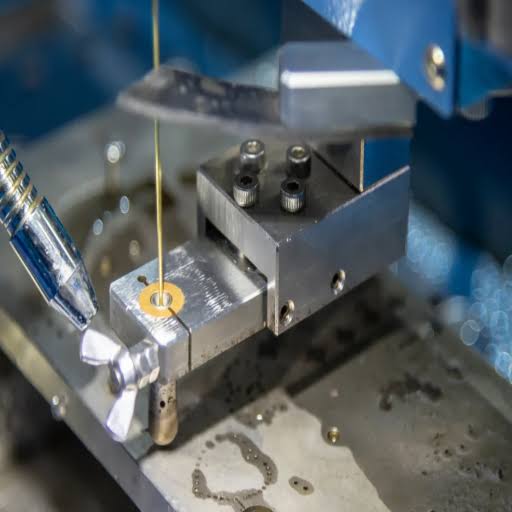
Wire EDM — short for wire electrical discharge machining — removes material using a series of controlled electrical sparks rather than physical cutting force. A thin, electrically charged wire passes through the workpiece without ever making direct contact with it. Instead, the spark that jumps between the wire and the material erodes small amounts of metal in a precise, repeatable pattern. This process happens in a dielectric fluid, typically deionized water, which controls the discharge and flushes away the eroded particles.
For teams evaluating this as a manufacturing option, a well-structured Wire Edm Services guide can clarify exactly what process capabilities are available and what information vendors need to provide an accurate quote. Understanding the fundamentals early in the design phase prevents specification errors that are costly to correct later.
Because the wire never applies mechanical force to the workpiece, there is no tool pressure, no deflection, and no stress induced into the material during cutting. This makes it fundamentally different from milling, turning, or grinding, where cutting forces are an inherent part of the process and must be accounted for in fixturing and design.
The Role of the Dielectric Fluid
The dielectric fluid in wire EDM does more than cool the work area. It acts as an electrical insulator between discharges, which allows the spark energy to build up before releasing in a controlled burst. Between each discharge, the fluid also carries away the eroded material, keeping the cutting zone clean enough to maintain accuracy over long runs. If the fluid becomes contaminated or its conductivity shifts, the consistency of the cut changes — which is why fluid management is treated as a process-critical variable by competent shops, not an afterthought.
What the Wire Itself Contributes
The wire used in this process is typically brass or a coated variant, selected based on the cutting requirements of a specific job. It spools continuously through the machine, meaning the section of wire doing the cutting is always fresh. This matters because a worn or contaminated cutting surface would introduce variability into the discharge pattern and affect surface finish. The wire is consumed during the process, but because it feeds continuously, the cutting interface remains consistent from the start of a job to the end — a characteristic that supports repeatable results across production runs.
Material Compatibility and Where It Applies
Wire EDM works on any electrically conductive material. That single requirement covers a wide range of metals, including hardened tool steels, titanium, Inconel, tungsten carbide, and copper alloys. The hardness of the material, which would typically limit or complicate conventional machining, has no effect on wire EDM’s ability to cut. A hardened die steel cuts the same way a softer material does — the spark erodes the surface regardless of its mechanical hardness.
This property is central to why wire EDM is used so extensively in tool and die manufacturing. Components are often machined to near-net shape in a softer state, heat-treated to the required hardness, and then finished with wire EDM to achieve final dimensions. The process fits into that workflow without requiring the workpiece to be softened or specially prepared for machining.
Applications Where Wire EDM Is the Logical Choice
There are specific manufacturing situations where wire EDM is not just an option but the most practical solution. These include:
• Cutting intricate internal profiles in hardened steel components where no rotary tool could reach or maintain accuracy
• Producing punches and dies with matched profiles to very tight tolerances, where any deviation between mating parts causes functional problems
• Machining thin-walled or delicate parts where tool pressure would cause distortion or breakage during conventional cutting
• Creating fine slots, narrow apertures, or detailed external contours in materials that are difficult or expensive to process by other means
• Finishing complex geometries in aerospace and medical components where both dimensional accuracy and surface integrity are specified together
The common thread across these applications is a combination of material difficulty, geometric complexity, and precision requirements that conventional machining methods address imperfectly or not at all.
Understanding the Process Limitations
Wire EDM is a capable process, but it is not universally applicable, and specifying it for the wrong situation creates unnecessary cost and lead time. The most fundamental constraint is that it only cuts conductive materials. Non-metals — plastics, ceramics, composites — cannot be processed this way regardless of geometry or tolerance requirements. This eliminates a large category of parts from consideration before any other factor is evaluated.
The process also requires through-cutting. The wire must enter and exit the material, which means it produces a cut that goes all the way through the workpiece thickness. It cannot produce blind pockets, undercuts, or three-dimensional sculptured surfaces in the way that multi-axis milling can. Parts that require those features need a different process or a combined approach where wire EDM handles specific features and another method handles others.
Speed Relative to Other Methods
Wire EDM removes material more slowly than most conventional cutting methods. For a single high-precision component or a small batch of complex parts, this is rarely an issue — the accuracy justifies the time. For high-volume production of simpler geometries, the economics often don’t support it, and stamping, milling, or other faster methods are more appropriate. Procurement teams should factor cutting time into lead time expectations, particularly for complex contours or thick cross-sections, which require more passes and longer machine time to achieve the required surface quality.
Surface Finish Characteristics
The surface left by wire EDM has a distinctive texture produced by the spark erosion process. In many applications, this finish is acceptable or even preferred because it is consistent and free from the directional marks left by grinding or milling. In applications where a specific surface roughness is required — either smoother or with defined lay direction — secondary operations may be necessary. This is worth discussing with the machining vendor during the quoting stage rather than discovering it after parts are delivered.
How Procurement Teams Should Approach Wire EDM Sourcing
Sourcing wire EDM work requires a different set of questions than sourcing standard turned or milled parts. The process is specialized enough that not all job shops have the equipment, and among those that do, capability levels vary considerably. Equipment age, machine calibration practices, programming expertise, and quality verification methods all affect whether a vendor can consistently meet the tolerances specified on a drawing.
According to manufacturing process documentation published by the National Institute of Standards and Technology, process consistency in precision machining depends heavily on controlled environmental conditions and calibrated measurement systems — factors that separate capable vendors from those who can simply operate the equipment. When evaluating vendors, it is reasonable to ask how they verify part accuracy, what their in-process measurement approach is, and how they handle dimensional drift over long production runs.
Information to Provide When Requesting a Quote
Vendors need specific information to quote wire EDM work accurately. Incomplete submissions lead to assumptions that may result in pricing that doesn’t reflect the actual job requirements. At minimum, a complete quoting package should include:
• Fully dimensioned drawings with tolerances explicitly called out on all critical features
• Material specification, including heat treat condition if the part will be hardened before or after machining
• Surface finish requirements for all machined faces, not just general notes
• Quantity requirements broken down by immediate need and anticipated ongoing demand
• Any inspection or certification requirements, including whether first article inspection reports are expected
Providing this information upfront reduces back-and-forth, shortens the quoting cycle, and produces a price that reflects actual production requirements rather than conservative estimates padded for uncertainty.
Closing Thoughts
Wire EDM is a mature, well-understood manufacturing process that performs consistently when it is correctly applied. Its value lies in specific situations — hard materials, fine geometry, tight tolerances, no tolerance for tool-induced stress — and its limitations are equally well-defined. Engineers who understand both sides can design parts that take advantage of the process without asking it to do things it wasn’t built for. Procurement teams who understand the process can have better vendor conversations, provide more complete specifications, and avoid the downstream surprises that come from treating wire EDM as a commodity service rather than a precision one.
The most productive step any team can take before specifying or sourcing wire EDM work is to build a clear understanding of what the process can and cannot achieve, and then carry that understanding into every conversation with a vendor or design review. That foundation makes everything else in the procurement and production process more straightforward.