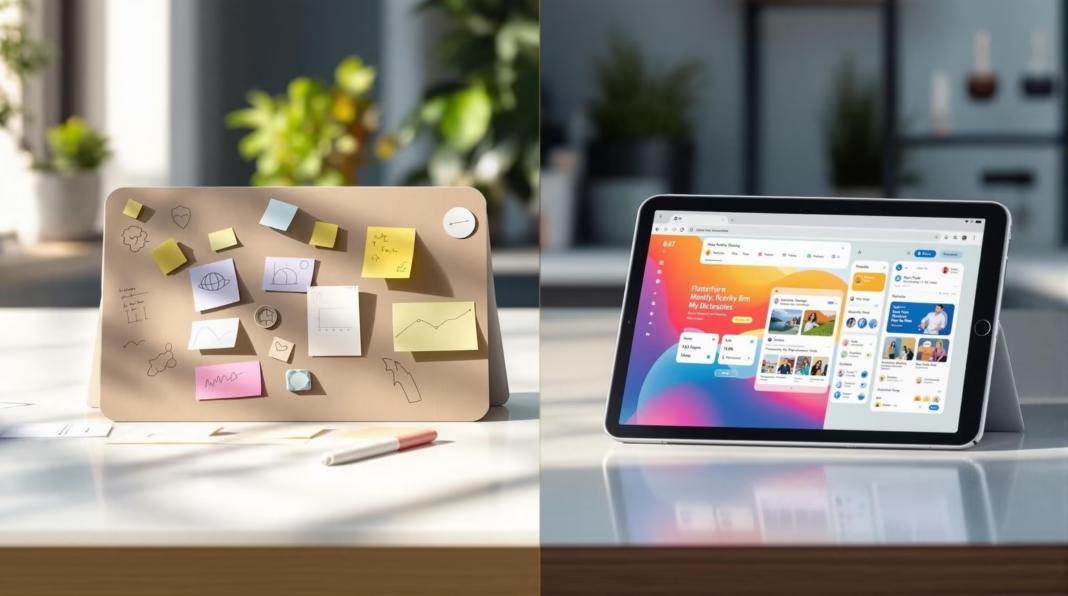
Most product teams understand that building the wrong thing is expensive. Discovering a fundamental navigation problem after development is complete, or realizing that users interpret a core feature differently than intended, creates rework that consumes time, budget, and team confidence. The decision to prototype — and how to prototype — sits at the center of managing that risk.
What’s less understood is that prototyping is not a single activity. It exists on a spectrum, and where a team chooses to work on that spectrum has real consequences for what they learn, how quickly they learn it, and what decisions become possible as a result. The distinction between low-fidelity and high-fidelity prototypes is not a matter of polish or effort preference. It’s a structural decision that shapes the entire feedback loop between design teams and the people who will use their products.
What UX Prototyping Actually Involves
At its core, ux prototyping is the practice of creating a working representation of a product — or part of a product — before that product is built in its final form. The prototype is not the product. It is a tool for thinking, testing, and deciding. A good explanation of this practice and how it fits within broader design workflows can be found through resources like ux prototyping, which outlines how prototypes function as decision-making instruments rather than deliverables in their own right.
The purpose of a prototype changes depending on where a team is in the design process. Early in a project, the goal is usually to test assumptions — whether a proposed structure makes sense, whether users can find what they need, or whether a workflow has logical gaps. Later, prototypes shift toward validation — confirming that a design performs as intended under realistic conditions before engineering resources are committed.
The Role of Fidelity in Shaping What You Learn
Fidelity refers to how closely a prototype resembles the finished product. A low-fidelity prototype might be a set of hand-drawn screens or a simple wireframe with placeholder text and basic shapes. A high-fidelity prototype might look nearly identical to the final interface, with real copy, interactive components, transitions, and functional states.
The level of fidelity directly influences the kind of feedback a prototype can generate. A high-fidelity prototype invites reaction to visual choices, micro-interactions, and content. A low-fidelity prototype focuses attention on structure, flow, and logic. Neither is inherently superior. Each generates a different category of insight, and choosing the wrong level for a given question means collecting feedback that doesn’t actually answer what the team needs to know.
The Case for Low-Fidelity Prototypes
Low-fidelity prototypes are deliberately rough. They use simple shapes, basic layouts, and minimal visual treatment to communicate structure without committing to any particular visual direction. Paper sketches, whiteboard diagrams, and basic digital wireframes all fall into this category. Their value is speed and openness.
When a prototype looks unfinished, participants in usability testing tend to focus on how something works rather than how it looks. They’re more likely to suggest structural changes, question the logic of a flow, or identify when a step feels unnecessary. They’re less likely to comment on font choices or color selection — feedback that would be premature at this stage anyway.
When Rough Is the Right Tool
Low-fidelity prototypes are most productive early in a project when the fundamental structure of a product is still being established. If a team is deciding between two different navigation models, or testing whether a multi-step process should be collapsed into fewer screens, a polished prototype would be a liability. It would signal that decisions have been made, even when they haven’t, and would shift user attention toward surface details rather than core usability.
There is also an internal team benefit to working at low fidelity. Rough prototypes invite discussion. When something looks finished, stakeholders and team members tend to accept it more passively. When something looks sketched, people feel comfortable questioning it. That openness accelerates honest conversation about whether a design direction is actually working.
The Limitations That Matter
Low-fidelity prototypes cannot answer questions about interaction quality, visual hierarchy, or whether specific content is readable and compelling. They also have limited value when testing with users who struggle to mentally complete the gaps — particularly in enterprise or specialized professional contexts where the complexity of real-world tasks needs to be represented accurately to generate meaningful feedback.
The Case for High-Fidelity Prototypes
High-fidelity prototypes narrow the gap between a design and the finished product. They include realistic content, functioning interactive states, transitions, error messages, and visual polish. Tools like Figma, Adobe XD, and similar platforms allow design teams to build prototypes that, in many cases, are indistinguishable from working software for the purposes of user testing.
The primary advantage of high-fidelity prototyping is specificity. It allows teams to test the exact experience a user will have, not a simplified approximation of it. According to interaction design research documented through resources like the Interaction Design Foundation, high-fidelity prototypes are particularly effective at identifying usability issues tied to content clarity, visual cues, and the precise behavior of interactive elements — details that low-fidelity methods cannot surface.
Where High Fidelity Earns Its Cost
High-fidelity prototypes require significantly more time to build and maintain. Changes that would take minutes in a wireframe can take hours when applied across a fully designed, interactive prototype. This investment is justified in specific circumstances: when preparing for stakeholder presentations that require credibility, when testing flows where visual context is integral to the user’s decision-making process, or when validating a design before it enters development and changes become structurally expensive.
This type of prototype is also valuable in regulated or high-stakes product contexts — healthcare, financial services, enterprise software — where the cost of post-launch errors is high enough to warrant thorough pre-development validation. In these environments, the additional effort of building a realistic prototype is a reasonable trade against the risk of late-stage design changes or user-facing failures.
The Risk of Premature High Fidelity
Building a high-fidelity prototype too early in the design process introduces a particular kind of risk: anchoring. When a prototype looks finished, teams and stakeholders become psychologically attached to the visual direction it represents, even when the underlying structure has not been validated. Changes become harder to advocate for, not because they are wrong, but because reversing visible effort feels disruptive. Teams that move to high fidelity before answering structural questions often find themselves refining something that should have been reconsidered.
How Teams Decide Between the Two
The most effective approach to prototype fidelity is not a fixed preference but a phased one. Teams that consistently produce well-tested, launch-ready designs tend to follow a progression: low-fidelity work in the early stages to validate structure and flow, followed by increasing fidelity as core decisions are confirmed and the team moves toward visual design and interaction refinement.
The decision about which type of prototype to build at any given point should be driven by a clear question. Before building anything, teams benefit from identifying what specific uncertainty they are trying to resolve. Is the question about information architecture? Use low fidelity. Is it about whether users understand a particular interactive pattern or can read a key piece of content clearly? Use high fidelity. The prototype type should serve the question, not the other way around.
Resource Constraints and Practical Judgment
In practice, many teams operate under time and budget constraints that make ideal sequencing difficult. Smaller teams may default to low-fidelity methods throughout, which is a reasonable choice if it keeps the feedback loop active. Larger teams or those with dedicated design operations may build parallel prototypes — rough explorations for internal team testing and polished versions for stakeholder or user research sessions.
The key is intentionality. Prototyping without a clear question behind it tends to produce feedback that is interesting but not actionable. Whether the prototype is a sketch on paper or a fully interactive Figma file, its value depends entirely on whether the team knows what they are trying to learn from it.
Conclusion
The distinction between low-fidelity and high-fidelity prototyping is not about preference, seniority, or tooling sophistication. It is about using the right level of representation to answer the right question at the right time. Both approaches serve legitimate and important functions in the design process. Both carry risks when misapplied.
Product designers who understand these trade-offs are better positioned to allocate their time meaningfully, generate feedback that actually informs decisions, and reduce the probability of discovering significant problems after development has begun. The goal of prototyping has always been to create space for learning before the cost of being wrong becomes prohibitive. Choosing the right fidelity level is simply part of making that space as useful as possible.