Wedding video technology tends to receive attention when it produces something spectacular: an aerial establishing shot, elegant slow motion, or an immersive camera movement that seems impossible with traditional equipment. The systems that matter most, however, are often the ones viewers never notice. Reliable audio recording, redundant cameras, sensible data management, and a carefully planned workflow can determine whether a wedding film preserves an irreplaceable moment.
Unlike a commercial or a staged production, a wedding cannot simply reset when equipment fails. A couple will not repeat their vows because a recorder stopped. A parent will not deliver the exact same emotional speech after a microphone problem. The technology behind wedding filmmaking must therefore do more than capture attractive images. It has to reduce the risk of losing events that happen only once.
This is why the most useful questions to ask a filmmaker are sometimes surprisingly unglamorous. How is sound recorded? What happens if a camera view is blocked? How are memory cards handled? What protection exists between the wedding day and the final delivery? Understanding the answers reveals how modern filmmaking balances creative ambition with practical reliability.
Clear vows depend on microphone placement, not just expensive cameras
A new camera may offer excellent resolution, dynamic range, and low-light performance. None of those specifications guarantees intelligible speech. The microphone built into the camera is often too far from the people exchanging vows, particularly in a large ceremony space.
Sound follows its own practical rules. As the distance between microphone and speaker increases, the desired voice becomes quieter relative to surrounding noise. Wind, air conditioning, traffic, audience movement, and reverberation can all interfere with what the couple will later want to hear.
A dependable ceremony setup often uses a microphone positioned close to a speaker or another dedicated audio source, depending on the location and clothing involved. When a venue sound system is available, a direct recording from the mixing equipment may provide another valuable source. The critical principle is not owning a particular brand of microphone. It is placing and testing the recording system for the actual acoustic environment.
Couples can evaluate this by listening to real sample films through ordinary headphones or speakers. Do the vows sound natural? Are words easy to follow even when music enters? Can they hear both partners clearly? If the spoken moments are difficult to understand, stunning visuals may not compensate for the missing information.
Backup audio protects more than technical quality
A recording can fail for reasons that have little to do with equipment price. A battery can run down. A wireless signal can become unreliable. A speaker may move away from the microphone. A cable can be disconnected unexpectedly. Even a feed from a professional sound board can contain a mix that is different from what the filmmaker expected.
This is why professional workflows often include multiple recording paths. A primary source may capture close speech, while another source records from the venue sound system or an independent microphone. Each source has strengths and weaknesses, and together they reduce dependence on any one component.
In my own wedding work, I prefer to obtain a recording from the DJ or venue mixing board when appropriate while maintaining independent backup audio. That small layer of preparation matters during toasts, when the room can move rapidly from quiet storytelling to applause and laughter. A wedding film is much harder to assemble when the most meaningful words are missing.
Backups do not guarantee perfection. They still require testing, adequate recording levels, correctly managed files, and proper synchronization during editing. But they make a difficult situation more recoverable. The purpose is simple: protect the couple’s memories before thinking about how stylish the finished soundtrack will be.
What 32-bit float recording actually solves
One audio feature receiving increasing attention is 32-bit float recording. In compatible equipment, the format can preserve a very wide range of signal levels in the recorded file, making it easier to recover audio that appears too loud or too quiet because of recording-level choices.
That sounds almost magical, but it has important limits. A recorder using 32-bit float cannot repair every problem that happens before the signal is captured. A microphone capsule can still distort under extreme sound pressure, a wireless connection can still drop out, and wind can still overwhelm a microphone. A poor microphone position remains a poor microphone position.
The distinction is between protection against certain level-setting problems and protection against all possible audio failures. The first is genuinely useful; the second does not exist. Even sophisticated recording formats benefit from attentive placement, monitoring, and redundant sources.
For couples, the practical question is less about which bit depth appears on a specification sheet and more about whether the filmmaker understands the full recording chain. A reassuring professional should be able to describe what they do if a feed fails or a reception becomes unexpectedly loud.
Multiple cameras are a safety system and a storytelling tool
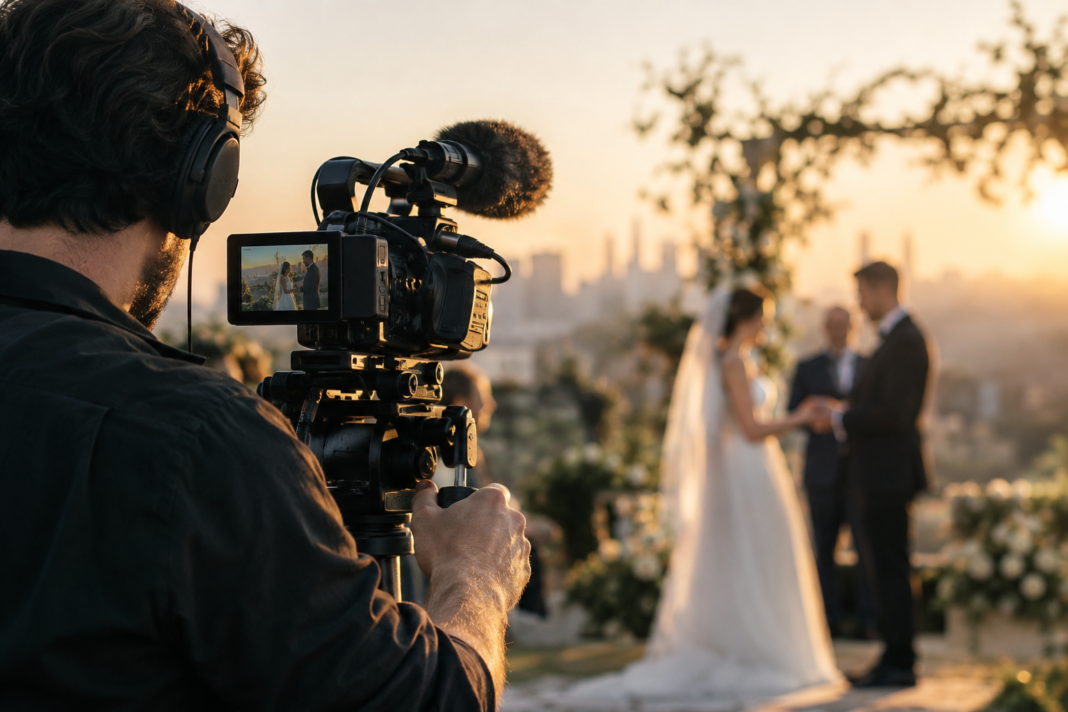
The same logic applies to video. A ceremony is rarely the ideal place to rely on a single moving camera. A guest may stand unexpectedly, a photographer may briefly enter the frame, or the operator may need to change position. A separate fixed angle can preserve continuity through these interruptions.
Multiple perspectives can also make the eventual film richer. A wide camera establishes the space. A closer angle shows the couple’s expressions. Another position may capture reactions among family and friends. The editor can move between these viewpoints to explain the emotional relationship between speakers and listeners.
More cameras do not automatically mean better filmmaking. Every device requires careful placement, battery or power planning, storage, exposure management, and attention to potential obstructions. Poorly planned redundancy can create extra problems instead of solving them.
It is also important to distinguish simultaneous coverage from staged repetition. A genuinely meaningful exchange should be captured as it happens. Asking someone to repeat a private moment simply to improve a camera angle may preserve an image while losing the spontaneity that made the moment worth filming.
Data management starts before the editor opens a timeline
The risks do not end once the cameras are switched off. Video projects can involve large volumes of footage from multiple cameras, audio recorders, and perhaps an aerial system. If files are mixed up, mislabeled, or stored on a single vulnerable device, the project can remain exposed long after the event.
A sensible workflow begins with a predictable naming and folder system. Files can be grouped by event, camera, media card, or recording source, so the editor can identify the origin of each clip. When possible, copying footage to more than one independent storage location reduces the risk that one hardware failure will destroy the only copy.
Copying a file is not the same as verifying it. A good process checks that transfers finished correctly and that the expected media is present before source cards are cleared or reused. Different studios use different technical systems, and no storage arrangement eliminates all risk, but procedural consistency matters as much as equipment quality.
The couple may never see this work. They will notice only the final film arriving intact. That invisibility is precisely the point: sound media management supports creativity by making preventable disasters less likely.
Why resolution is not the best measure of quality
Wedding advertisements often emphasize 4K, high frame rates, impressive bit depths, or the number of cameras in use. Those specifications can be valuable, but they are ingredients, not proof of a compelling finished film.
A well-exposed close-up with intelligible dialogue may become the emotional center of an edit. An underexposed or badly framed shot does not suddenly become useful because it has high resolution. Similarly, a crisp recording of a generic scene may feel less meaningful than an imperfect but authentic moment that tells the viewer something about the couple.
Color depth and camera dynamic range give filmmakers flexibility, particularly in environments where bright windows and shaded faces share a frame. Yet these features still require thoughtful exposure and post-production. Technology can expand creative options; it cannot make the artistic decisions for the operator.
Anyone comparing an LA wedding videographer should therefore watch complete films rather than relying on equipment lists alone. Look for clear dialogue, natural skin tones, coherent editing, and a consistent standard across challenging locations.
Lighting is a balancing act, not a contest for brightness
Reception environments are technically demanding. The couple may move from an outdoor sunset into a room lit primarily by candles, string lights, and colored effects. Filming in available light alone can create noise or make faces disappear into the background. Adding too much light can flatten the atmosphere the couple spent months designing.
The most effective approach is often to place modest lights deliberately. Rather than turning a ballroom into a bright studio, a filmmaker can use directional light to reveal faces, create separation, and preserve the warmth of the surroundings.
This introduces another form of technical planning. Stands and cables should be positioned with guest safety in mind. Lighting should not interfere with sightlines or dominate photographs. The filmmaker must coordinate with other vendors and be prepared for changes when the reception schedule shifts.
A technically successful wedding film should not simply show every detail brightly. It should allow viewers to recognize the actual mood of each part of the day.
Fast delivery should not eliminate careful checking
Short social clips and quick-turnaround teasers are useful because families want to share the celebration while the excitement is fresh. But a polished highlight generally requires more than choosing attractive clips and dropping them onto a music track.
The editor must locate important moments, synchronize camera angles, inspect audio, shape the narrative, balance color, and check the final export. Different delivery products can be designed for different purposes: a brief teaser may prioritize immediacy, while the main film deserves a more deliberate storytelling process.
Quality control includes watching the finished export rather than assuming the timeline is correct. Missing audio, misplaced transitions, encoding problems, or an accidental change in color can be overlooked without a final review. Careful delivery is a technical practice as well as a creative one.
Couples should ask what each deliverable includes and when to expect it. Clear expectations are more useful than a promise of speed without a description of the production and editing process.
What reliability looks like from the couple’s perspective
Most couples do not need to understand every component of a wedding filmmaker’s workflow. They do need confidence that meaningful events will receive thoughtful coverage and that preventable risks have been taken seriously.
A useful conversation includes how vows and toasts are recorded, whether important moments receive more than one camera angle, how footage is backed up, and what happens when weather or a venue restriction changes the plan. It is also reasonable to ask who is responsible for editing and which recordings or films will ultimately be delivered.
The answers should be practical and understandable. A professional who can explain the plan without hiding behind acronyms is showing that the equipment serves a clear purpose.
It is worth remembering that no technical setup can promise an absolutely risk-free day. The strongest operators acknowledge uncertainty and explain how they reduce it. That combination of preparation and realistic expectations is far more valuable than claims that a particular device makes failure impossible.
The best technology disappears behind the memory
The most lasting wedding films rarely make people think first about recorders, lenses, file formats, or backup drives. They make viewers remember a voice, a laugh, an exchange of promises, or a room full of loved ones celebrating together.
Technology makes those memories possible to preserve. Good microphones retain the words. Additional camera perspectives protect the action. Backups provide resilience. Careful editing turns the collected material into a coherent experience. None of these jobs is glamorous on its own, and all of them contribute to the result.
As wedding filmmaking tools become more advanced, it will be tempting to measure progress by bigger numbers and more unusual shots. The more meaningful measure is whether a couple can return to their film years later and feel connected to the people and moments it holds. The invisible systems deserve attention because they make that lasting connection more dependable.