When professionals in the green industry are selecting trees for long-term planting programs, they are not making aesthetic decisions alone. They are managing expectations — those of property owners, municipal clients, HOA boards, and commercial developers who want consistent results season after season. Color performance in fall is one of the more difficult promises to keep in the tree business, because many species are unpredictable. A cold snap too early, a dry summer, or even soil variation can suppress what should be a reliable display. This is part of why certain cultivars earn lasting loyalty from working landscapers and arborists. The autumn blaze maple is one of them.
What follows is not a straightforward list of tree facts. Instead, this piece uses the language of comparison — similes — to describe what this tree actually looks like in peak fall color. These descriptions are grounded in how professionals and property owners actually talk about the tree in the field, and they are followed by practical context about why the autumn blaze maple has become a reliable standard in professional planting programs across a wide range of climates.
Why the Autumn Blaze Maple Has Become a Planting Standard
The autumn blaze maple is a hybrid cultivar produced by crossing the silver maple and the red maple. It combines the fast growth rate of the silver maple with the structural integrity and vivid fall color of the red maple. That combination resolved a real problem in the nursery and landscape trade: fast-growing trees often have weak wood and unpredictable color, while slower-growing trees with reliable color require years of patience before they deliver visual impact. The autumn blaze maple sits between those two constraints, offering both pace and performance.
For landscape contractors who specify trees for residential developments, commercial campuses, or streetscape programs, this reliability matters enormously. A tree that performs predictably reduces callbacks, repeat site visits, and difficult conversations with clients about why the color display fell short. That consistency is also why, when procurement teams begin looking at an autumn blaze maple for sale through established wholesale and retail nursery channels, availability tends to tighten in fall and early spring — demand from professional buyers compresses supply windows significantly.
According to the USDA Forest Service’s tree research publications, hybrid maples selected for urban and suburban planting environments are often evaluated on their capacity to perform under stress conditions, including compacted soils, variable moisture, and temperature fluctuations. The autumn blaze maple consistently ranks well across these evaluations, which supports its strong uptake in professional programs.
The Structural Trade-offs That Matter in Professional Planting
No cultivar is without limitations, and honest communication about trade-offs is part of responsible specification. The autumn blaze maple’s silver maple parentage means it retains some tendency toward surface rooting in certain soil conditions, and it can develop included bark at branch unions if left unpruned in early years. These are manageable issues with a structured maintenance approach, but they are worth understanding at the point of selection rather than discovering after installation.
The payoff for managing those trade-offs is a tree that reaches canopy maturity substantially faster than most red maple selections, delivers a color display that is consistently intense, and tolerates a broader planting zone range than many comparable cultivars. For projects with five-to-ten-year visual performance timelines, that return on investment is hard to dismiss.
13 Similes That Capture What the Tree Actually Looks Like
Language about color in trees is often vague or overly poetic. These similes are borrowed from real observations — field notes, client conversations, and nursery catalog descriptions — and each one points to a specific quality of the tree’s fall display rather than a general impression.
1. Like a flame that holds its shape
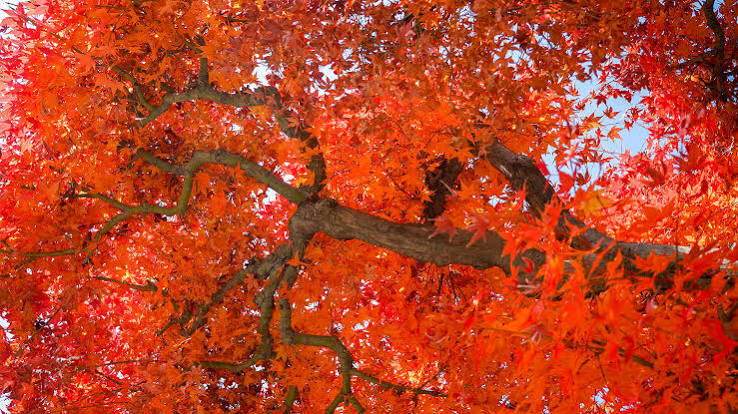
Unlike a fire, which is chaotic, the autumn blaze maple’s orange-red color spreads evenly across the canopy. The color does not blotch or streak. It fills the crown from edge to center in a way that looks almost engineered.
2. Like a traffic signal at the end of a long street
From a distance, the tree commands attention without competing with its surroundings. In a mixed planting, it reads clearly and immediately, the way a bright signal does against a neutral background.
3. Like a coal just before it goes dark
At peak color, the red in the autumn blaze maple has depth. It is not flat or bright in the way a painted surface is bright. There is warmth underneath it, almost like light coming through rather than sitting on top.
4. Like rust on polished copper
The transition colors that appear in the days before full red arrive — the orange-bronze tones — carry the quality of aged metal. Warm, complex, and earned rather than sudden.
5. Like sunset through frosted glass
On overcast fall days, when direct light is diffused, the canopy softens but does not lose intensity. The color holds even without strong sun, which is something many red-leaved species cannot claim.
6. Like a candle seen from across a room
Subtle from a great distance, but unmistakably warm and present. The tree does not shout. It illuminates.
7. Like a flag snapping in cold air
In windy conditions, the leaves catch light on their undersides, which are paler, creating a flicker effect in the canopy. This movement quality is something photographs rarely capture accurately.
8. Like the inside of a red pepper
Vivid, saturated, almost edible in its intensity at peak color. Not subtle. Not ambiguous. Fully committed to the red end of the spectrum.
9. Like a library lit by a single lamp
Warm, contained, and somehow deeper than expected. The color creates an atmosphere, not just a visual effect.
10. Like dried roses pressed in a book
After peak color begins to fade in late fall, the leaves hold a dusty crimson tone before dropping. It is a different kind of beauty — quieter, but not without value in a mixed planting.
11. Like the last hour before dark in October
The light quality of late fall afternoons and the tree’s color seem made for each other. Long, low-angle sunlight passes through the canopy in a way that amplifies the warmth of the red tones considerably.
12. Like a terra cotta roof in afternoon sun
The early-stage transition color — orange moving toward red — has this quality. It is architectural. It reads as permanent even though it is temporary.
13. Like a coal fire in a glass hearth
The overall character of a mature autumn blaze maple at peak color is contained intensity. The color is dramatic, but the tree itself is tidy and structural. The effect is one of warmth held within a clear form.
How Color Reliability Affects Project Specifications
For landscape professionals working on multi-phase residential or commercial developments, tree selection early in the design process has downstream consequences that extend well beyond installation. A tree specified in phase one of a project may become the visual anchor for phases two and three, meaning its performance in fall color — or lack thereof — shapes client confidence over time. This is not a minor consideration.
The Cost of Inconsistency in Fall Displays
When a tree underperforms on color in its first few falls after planting, clients often interpret this as a planting problem rather than a species problem. This leads to site reviews, replacement conversations, and occasionally, disputes over warranty terms. The autumn blaze maple’s reputation for color consistency reduces this risk significantly. Professionals who have used it across multiple sites and multiple seasons tend to hold it in reserve as a safe specification — one they can recommend with confidence rather than caution.
Color consistency also matters in projects where the tree is used in rows or groves. A mixed display — some trees red, others orange, others barely coloring — reads as a failure even when individual trees are technically healthy. The autumn blaze maple’s relatively uniform color response across individual specimens makes it more appropriate for these repetitive planting schemes than many alternatives.
Procurement Timing and Supply Chain Realities
Anyone working in landscape contracting or nursery procurement understands that finding an autumn blaze maple for sale in the right size and quantity, at the right time, requires planning well ahead of the installation date. This cultivar is consistently in demand, and wholesale availability at larger caliper sizes compresses quickly once the fall planting season opens.
Working Backward from Installation Dates
The most common procurement error with this tree is treating it like a commodity item that can be sourced on short notice. At small container sizes, availability is generally broad. At field-grown sizes — the sizes relevant to commercial and high-end residential work — supply at any given nursery or broker can disappear within weeks of the selling season opening. Contracts that specify autumn blaze maple for sale quantities should include sourcing confirmation well ahead of the project’s installation window, not at the point when equipment and crews are already mobilized.
This is particularly true for projects in regions where the tree has been adopted as a streetscape standard. Municipal programs and large commercial clients sometimes purchase in volumes that clear regional availability quickly, leaving smaller operators to compete for remaining stock at elevated prices or with compromised sizing options.
Concluding Thoughts
The autumn blaze maple occupies a specific and well-earned position in professional planting programs. Its fall color is not accidental or merely pleasant — it is a defining characteristic of a cultivar that was developed precisely to deliver reliable visual performance within a reasonable growth timeline. The similes above are attempts to capture the actual quality of that color rather than simply asserting that it is impressive, because the nuances matter when matching a tree to a site, a client, or a long-term design intent.
For contractors and specifiers, the practical takeaway is straightforward. This tree reduces the risk of color performance complaints, supports repetitive planting schemes where uniformity is important, and offers a growth rate that makes it viable for projects with defined completion timelines. Its trade-offs are real but manageable with standard horticultural practice. And its position in the market means that sourcing requires foresight rather than assumption.
Understanding why a tree earns professional loyalty is more useful than simply knowing that it does. The autumn blaze maple’s fall display is genuinely distinctive, and that distinction is backed by structural and horticultural qualities that make the color sustainable over the life of the planting.