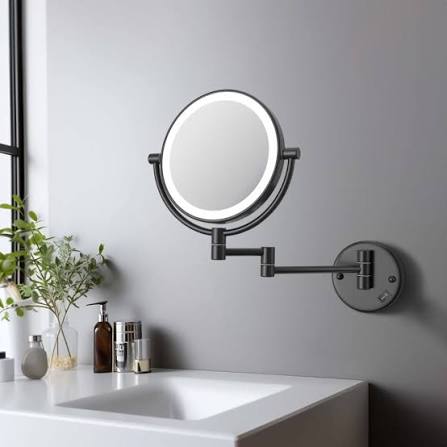
A wall mounted makeup mirror can make every day grooming easier by bringing the face closer, improving visibility, and keeping the vanity area free from countertop clutter. Unlike a basic decorative mirror, a dedicated large wall mounted makeup mirror with light often combines directional positioning, magnification, and built-in illumination.
The challenge is that these mirrors are not all designed the same way. Some use 1X and 5X magnification, while others offer 10X or higher. Some are battery-powered or rechargeable, while others connect to an electrical outlet or require hardwiring. Light color, brightness, arm movement, mounting location, and bathroom conditions also affect how useful a mirror will be.
Understanding those differences before choosing one can prevent common problems such as excessive magnification, harsh lighting, inconvenient installation, or a mirror that does not fit the available wall space.
Why Large Wall-Mounted Makeup Mirrors Are Useful
The biggest advantage of a large wall-mounted design is positioning. A mirror attached to an adjustable arm can be moved toward the user when detailed work is needed and pushed back against the wall afterward.
This is particularly useful for makeup application, shaving, eyebrow grooming, contact-lens routines, and other tasks where a standard bathroom mirror may leave the face too far away.
Wall mounting also preserves counter space. In smaller bathrooms or compact dressing areas, eliminating a tabletop mirror can make the vanity feel less crowded.
Many current U.S. listings emphasize features such as swivel arms, double-sided mirrors, LED illumination, rechargeable power, and multiple magnification levels. Retail listings from major home-improvement and department-store marketplaces show that these have become common design variations rather than unusual features.
Understanding Magnification Levels
Magnification is one of the most important specifications to understand. A 1X mirror provides a normal, undistorted reflection. This is generally the most useful setting for checking overall makeup, hair, and facial appearance.
Higher magnification enlarges facial details. A 5X mirror can make small areas easier to see, while 10X magnification is intended for highly detailed tasks. Some products sold in the U.S. market combine 1X and 10X surfaces, allowing users to switch between a normal reflection and a close-up view.
Higher magnification is not automatically better. At strong magnification levels, the viewing area becomes smaller and positioning becomes more important. Moving too close can also make the reflection feel distorted or uncomfortable.
For everyday use, a combination of normal and moderate magnification is often more versatile than relying exclusively on an extremely high-magnification surface.
Why Working Distance Matters
Magnification works together with viewing distance. A mirror that appears convenient on paper may be frustrating if its extension arm does not bring the reflective surface close enough.
An adjustable arm can solve this problem. Some wall-mounted models extend several inches from the wall and swivel through a wide range of angles. For example, product specifications for one established LED wall mirror describe an extension of up to 13.5 inches and 360-degree swivel movement.
The practical lesson is simple: do not evaluate magnification without considering how far the mirror can move toward you.
Choosing the Right LED Lighting
Built-in lighting is another major reason people choose this type of mirror. The goal is not simply to make the mirror brighter. Good task lighting should illuminate the face consistently without creating excessive glare or strong shadows.
Color Temperature
LED mirrors may offer different light colors, commonly described as warm, neutral, or cool. Some contemporary models provide three adjustable color settings, giving users more control over the appearance of the light.
A neutral or daylight-like setting can be useful for detailed makeup work because it tends to provide a more balanced view of colors. Warmer lighting can create a softer appearance, while cooler light may feel more similar to certain commercial or daylight environments.
There is no universally perfect setting. The right choice depends on where the mirror is installed and under what lighting conditions it will normally be used.
Brightness Control
Dimmability is useful because a bathroom does not always require maximum brightness. A high-output LED ring may be helpful during detailed grooming but unnecessarily intense late at night.
Touch controls, rotary controls, and other brightness adjustments are now common features in the category.
Wall Mounting and Installation Considerations
Before installation, examine the wall structure, mounting hardware, electrical requirements, and the mirror’s final position. A mirror attached to an adjustable arm experiences more mechanical movement than a stationary decorative mirror. The mounting surface therefore matters. Drywall alone may not provide the same holding strength as a properly secured stud or suitable wall anchor.
Electrical models require additional consideration. Some are designed for plug-in operation, while others can be hardwired. Rechargeable and battery-powered versions provide greater flexibility when there is no convenient electrical connection near the mounting location. Current U.S. listings include both battery/USB-powered and corded configurations.
If electrical wiring is involved, installation should follow the manufacturer’s requirements and applicable electrical codes. In a bathroom, that is not an area where improvisation makes sense.
Bathroom Moisture and Electrical Safety
Bathrooms create a special environment because humidity, condensation, water, and electricity may exist in close proximity. A mirror intended specifically for bathroom use should have installation and electrical specifications appropriate to that environment. Some illuminated bathroom mirrors list moisture-related ratings, such as IP ratings, but consumers should not assume every LED mirror has the same level of protection.
An IP rating describes protection against solid particles and water under defined testing conditions. It does not mean a product can be installed anywhere in a bathroom without considering local electrical requirements.
Placement matters as well. The safest installation depends on the product’s instructions, the bathroom layout, electrical components, and applicable local codes.
How to Choose the Right Mirror Size
Size should be based on both the available wall area and the distance between the user and the mirror. A small round mirror can work well for close-up grooming, particularly when mounted on an extension arm. Larger vanity mirrors provide a broader field of view but may occupy substantially more wall space.
Before buying, measure the wall area and consider the mirror’s full operating range, not just its folded dimensions. An arm that extends outward can require significantly more clearance than the mirror appears to need when stored against the wall.
Also consider whether cabinet doors, faucets, shelves, towel bars, or lighting fixtures could interfere with movement.
Round, Square, or Double-Sided Designs?
Round mirrors remain common because their shape works naturally with circular LED illumination and swivel mechanisms. Square and rectangular designs can provide a more contemporary appearance or a larger usable surface.
Double-sided models are particularly practical when one side offers standard reflection and the other provides magnification. This eliminates the need to install two separate mirrors.
The better choice depends on the task rather than appearance alone. If detailed grooming is the primary purpose, magnification and adjustability deserve more attention than the outer shape.
Common Features Worth Comparing
The U.S. market includes a wide range of combinations, including LED lighting, 360-degree rotation, extension arms, dimming, multiple magnification levels, rechargeable power, and dual-sided reflective surfaces.
Instead of choosing a mirror based on the longest feature list, identify the features that solve an actual problem.
For example, someone with limited counter space may benefit most from wall mounting. Someone who frequently travels between rooms may prefer rechargeable power. Someone who performs detailed grooming may prioritize magnification and an adjustable arm. Someone using the mirror in a dim bathroom may place greater importance on adjustable LED illumination. More features do not necessarily mean better performance.
Common Mistakes to Avoid
One common mistake is choosing excessive magnification simply because a higher number appears more powerful. A 10X mirror can be excellent for very detailed work but may be less convenient for general grooming.
Another mistake is ignoring the light source. A mirror can have bright LEDs and still produce an unpleasant viewing experience if the illumination is poorly positioned or overly harsh.
It is also easy to underestimate installation clearance. A mirror may fit the wall perfectly when folded but collide with nearby fixtures when its arm is extended.
Finally, avoid assuming that every illuminated mirror is automatically suitable for a bathroom. Check the manufacturer’s installation instructions, electrical specifications, and environmental ratings before installation.
Is a Large Lighted Wall Mirror Worth It?
The value depends on how frequently the mirror will be used and what problem it solves. For occasional makeup application, a conventional mirror combined with good room lighting may be sufficient. For daily grooming, detailed cosmetic work, shaving, or small bathrooms where counter space is limited, a dedicated illuminated wall mirror can provide meaningful convenience.
The strongest value comes from matching the specifications to the user’s routine rather than paying for features that will rarely be used.
Final Considerations Before Choosing
A good makeup mirror should be evaluated as a complete system: reflective quality, magnification, lighting, movement, mounting method, power source, dimensions, and bathroom suitability all matter.
Start with the task you need the mirror to perform. Then determine the appropriate magnification, viewing distance, lighting characteristics, and installation requirements. This approach is more reliable than selecting a mirror based solely on appearance or a long list of advertised features.
The best choice is ultimately the one that provides a clear reflection, useful illumination, comfortable positioning, and a safe installation for the space where it will actually be used.
Good planning applies to renovations and to the celebrations that follow them. Before booking a group dinner, goldencorralsprice.com can help you compare buffet, family and kids’ meal prices.