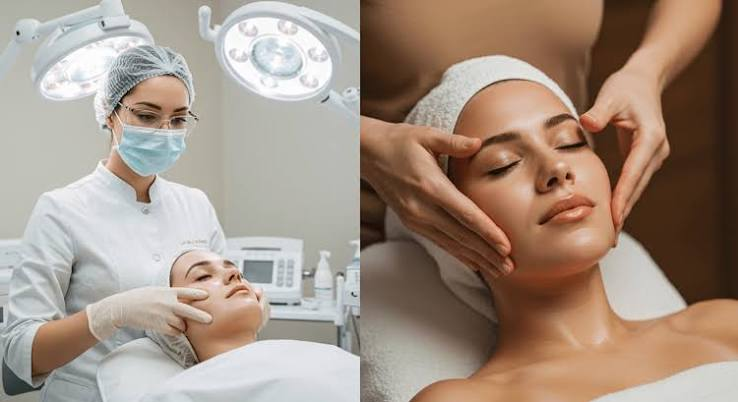
So, what really is the difference between a day spa facial and a medical spa facial? So often, clients look at facial services offered at a day spa and medical spa and look at them as stronger versions of each other. However, this is not accurate. There are really 4 areas where a day spa facial and a medical spa facial are different. The first area is the skin assessment.
Assessment determines everything that follows
A traditional spa facial is assessed by a brief visual assessment of the skin and a few simple questions on an intake form regarding any allergies or sensitivities that may need to be taken into consideration. A medical spa assessment is similar in that it is a diagnostic assessment although no specific diagnosis is being made. The treatments offered at a medical spa have contraindications, therefore all relevant information is collected.
This information may seem irrelevant in a relaxing spa setting, but for a medical spa it is very important. The practitioner needs to know if the client has ever taken Isotretinoin, if they are currently using retinoid products, if they are taking any photosensitizing medications, if they have a history of Keloid formation, if they have Herpes Simplex and if it has ever come out after skin treatments, if they have had any recent facial injectables, and if they have any auto-immune diseases. Additionally, the client must inform the practitioner of any stage of pregnancy.
Fitzpatrick typing and risk stratification
There is another major difference between a traditional spa facial and a medical spa facial. How a spa salon decides to carry out a treatment for individual guests is very different from the skin analysis that a medical spa carries out for each guest before they are treated. This is largely because a spa salon does not use any products on guests that contain strong exfoliating ingredients. As a result, skin analysis is generally limited to skin type. A medical spa uses skin analysis to identify potential problems with a guest’s skin and the risk of a guest developing certain types of hyperpigmentation following treatment, such as post-inflammatory hyperpigmentation.
Customization versus menu selection
Spa facials are offered as individual treatments with fixed steps of treatment. Yes, you can make amendments to a treatment but they are generally minor, choosing a different face mask, amending the amount of pressure used for massage, choosing from a selection of serums rather than the full range available.
These same treatments can be performed individually and the components of the treatment can be sequenced to be delivered over several appointments. Typically, for medical grade facials, the first treatment is performed at the lowest concentration and gradually increased with subsequent treatments. It is therefore typical for a medical spa to plan a treatment program and deliver the first phase of treatment in the first session. If you want to see how that staged approach looks in practice, review how a clinic offering Jacksonville medical spa facials structures its protocols before committing to a course of treatment.
Documentation as a clinical tool
Photographs, settings records, and records of any downtime all serve to justify the practitioner’s escalation of treatment, to provide evidence of any decision made, and to establish which component of a combination treatment was most effective.
Technology, actives, and who is permitted to use them
The equipment difference between a spa and a medical facility is over-simplified when only stating that a medical spa has more powerful equipment. The key issue is whether that equipment is used within the scope of practice of the individual using it, and that means proper training, on-going supervision and appropriate insurance coverage.
| Element | Day spa setting | Medical spa setting |
| Exfoliation | Enzymes, low percentage acids at cosmetic pH | Higher concentration peels, layered applications, neutralization protocols |
| Devices | Steam, high frequency, manual extraction, LED | Microneedling, fractional energy devices, intense pulsed light, radiofrequency |
| Product access | Retail grade actives | Prescription-adjacent formulations, physician-dispensed lines |
| Oversight | Esthetician training and certification | Medical director, delegation protocols, standing orders |
| Adverse event handling | Referral out | On-site management pathway |
The supervision question in client conversations
Nobody ever asks to see the ID of the Medical Director for a spa. Clients are always interested in what you would do in case of an adverse reaction and how you would deal with an emergency. Clearly explaining your procedures and how you would deal with an adverse reaction or treat an unexpected case builds immense trust with your clients.
Different goals, different measures of success
Just because we offer something more than a day spa facial, doesn’t mean we can’t deliver a wonderful facial that leaves the client feeling relaxed and that their skin looks better the next day. That’s a perfectly valid service to be offering, and should be described as such rather than belittled.
There are several Endpoints which need to be measured after a medical facial over a time frame of several weeks. These Endpoints describe structural changes in the skin and they are used to measure the effectiveness of a facial.
- Reduction in inflammatory lesion count across a defined period
- Measurable change in pigment density or evenness
- Improvement in texture and pore appearance at consistent photographic distance
- Barrier function stability, judged by signs of water loss and tolerance to actives
Because the mechanism behind so many of the Medical Spa treatments involves controlled damage to the skin and subsequent repair, it can appear to worsen in the short-term. Informed clients have the best experience when they have been told that this could happen in the consultation prior to the treatment.
Practical implications for how you position services
So put both on your menu, it makes commercial sense, but market them properly.
- Separate the two in the service list so clients are not comparing relaxation against correction on price alone.
- Route all corrective inquiries through a paid or structured consultation rather than direct online booking.
- Use spa-grade facials as maintenance between clinical sessions, which is a genuine clinical role rather than an upsell.
- Train front-of-house staff to describe differences in process and oversight, never in terms of efficacy claims.
Admitting this difference helps convert better customers, and keeps them happy.