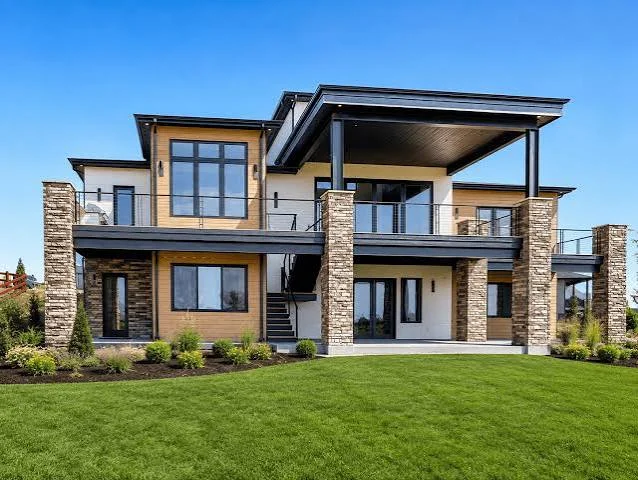
The bulk of failed custom home budgets fail to meet their financial objectives prior to the first trade’s arrival on site. Rather than a builder charging “too much” for his or her work, it’s often the fundamental misconception by the homeowner as to what their agreement with the builder includes for money versus what they believe it includes for money that results in their early failure. Such a plan fails at the inception, at land purchase.
Price the land as a construction variable, not a fixed cost
A flat inner city block and a sloping rural property can both cost $500k plus, but be very different in terms of the ‘hidden land risk’. A block of land with flat sites and services at the front of the block has little site risk. A sloping rural property has considerable site risk before you start construction and this can cost an enormous sum of money before you pour the foundation.
Consider making offers conditional upon sufficient investigation of the property’s characteristics to quantify the risk. Consider ordering a geotechnical report, a topographic survey and written utility capacity confirmations prior to the expiry of the condition period. Consider carrying a deliberate and documented reserve against costs for foundation and excavation work if the client will not pay for a geotechnical report prior to purchase.
What to confirm before waiving conditions
- Soil classification and recommended foundation type
- Septic feasibility or sewer connection point and depth
- Well yield testing, or municipal water pressure at the lot line
- Easements, rights of way and registered restrictive covenants
- Zoning envelope, height limits and permitted floor area
- Development charges, permit fees and any required studies
Separate hard construction cost from everything that sits around it
The cost per square meter to build is often used to compare the cost of building a house of different sizes. However, when it comes to budgeting, it is most often woefully inadequate to determine the true cost of a house. Even allowing for a considerable margin for error, many items including site preparation, driveway, retaining structures & garden design, exterior finishes, plan & FF&E design, necessary permits & approvals, interest on finance during construction, and FF&E (furniture & etc.) can easily total up to 25% of the total cost of the project and need to be costed and budgeted for.
Budgeting to discharge is easier than it reads, for construction accounts are better understood when broken into structural expenditure that the client can follow throughout the building process. A schedule drawn up prior to the drawing up of the plans that enables a lender to peruse the full ‘household’ cost of a project ensures that drawing down monies from the account is not a foreign exercise when past the framing stage.
| Budget category | Typical share of total | Main variables driving it | When it firms up |
| Land and acquisition costs | 20 to 35 percent | Location, lot size, legal and transfer costs | At closing |
| Soft costs and approvals | 5 to 10 percent | Design complexity, studies, permit regime | Before permit issuance |
| Site works and servicing | 5 to 15 percent | Slope, soil, utility distance, septic or well | After geotechnical and survey |
| Hard construction | 45 to 60 percent | Specification level, size, structural complexity | At tender or contract signing |
| Finishes and selections | Within hard cost, via allowances | Client taste, lead times, substitutions | During selections, often late |
| Contingency | 8 to 15 percent of hard cost | Site risk, design completeness, market volatility | Held to completion |
Treat allowances as placeholders with an expiry date
Allowances are set to enable clients to select products and finishes within specified allowances, typically based off builder grade products, once the design has been largely finalized. In reality, there is always an unexpected overrun of allowances that will always be the builder’s fault. If you intend to build a custom home in Stark County, it is worth asking your builder to walk you through each allowance line and the real local cost of the products behind it before you sign anything.
While allowances are supposed to cover the costs of selection, they become a major cost for builders when they are set at builder’s standard items and the client goes shopping and finds higher end products (such as European style tapware), before framing commences, these become change orders with a price and time penalty.
Allowance lines that most often blow past their number
- Cabinetry and millwork, particularly custom closets and built-ins
- Stone and tile, where waste factors and setting patterns are underestimated
- Lighting and controls, once automation enters the conversation
- Exterior cladding, where material changes affect substrate and flashing
- Landscaping, hardscape and fencing, usually deferred and then compressed
Structure contingency so it cannot quietly disappear
And note that a contingency fund spent on upgraded finishes is not a contingency fund. It is better to have a construction contingency under the control of the project manager that can be spent on items discovered on site, and an owner contingency that the owner can spend as they wish on upgrades. Both should be reported at each draw against which the owner’s discretionary funds have been spent. When the owner’s funds for additional upgrades have been exhausted then each additional request becomes a matter for negotiation with the builder as to what is and is not included.
Stress test before committing
Through the three scenarios for your new home budget, a ten percent cost increase through construction, a three month delay with subsequent interest, and a single unexpected site issue, you’ll get a good feel for how things might go. If the budget looks to work only when things go well, then you need to either reduce the specification of your new home, or change the land. Costing nothing in the design phase as it does, making these decisions at lock-up will cost a pretty penny.