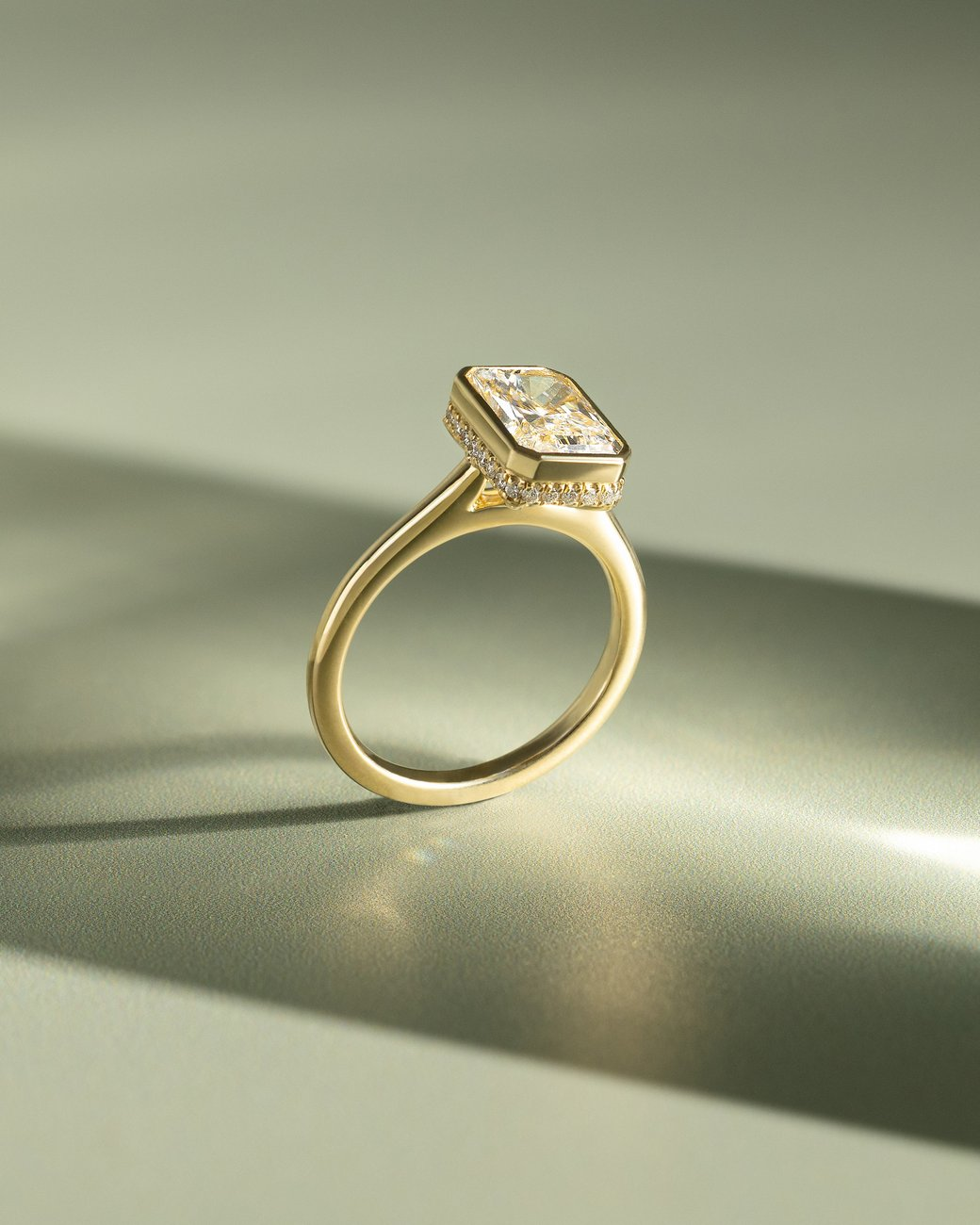
It’s usually the setting. When the centre stone sits low enough to dip below the line of the band, a straight wedding ring bumps into it and stops short. The result is a sliver of skin between the two rings, sometimes 2 or 3 millimetres wide. Some people love that chunkier, stacked look. Others notice the gap every single time they glance down.
The surest way to get a flush fit is to put your engagement ring in front of someone who pairs rings every day. Book a virtual or in-person appointment with the wedding ring specialists at Cullen Jewellery Australia and they’ll look at your setting, stone shape and band width, then show you which women’s wedding rings will sit snugly against it. If nothing in the range is quite right, they can custom-make a band to follow your engagement ring’s exact shape, so you’re not left guessing until the big day.
What to Check on Your Engagement Ring
Setting height
In a high-set ring, the centre stone sits well above the band, so a straight wedding ring can slide right underneath and sit flush. Low-set and bezel settings keep the stone closer to the finger. They’re brilliant for everyday wear (they snag less on jumpers and hair), but the stone often sits in the way of a straight band.
Stone shape
Rounds, cushions and princess cuts tend to pair easily with a classic band. Shapes with a sharp point, like marquise and pear, need a band with a little more give. Toi et moi settings, with two stones side by side, need the same.
Band width
Matching widths reads as a set. A 1.8mm engagement band beside a 1.8mm or 2mm wedding ring looks deliberate and balanced. Go much wider on one side and the pair can look a little lopsided, unless that contrast is exactly the statement you’re after.
Curved, Open or Straight: Picking Your Wedding Ring Profile
Curved bands have a gentle dip in the centre that cradles the stone. They’re a lovely match for low settings and pointed cuts.
Open bands leave a gap at the front for the centre stone to slip into, often with accent stones on either side. They work beautifully with less traditional cuts.
Straight bands are the classic. Pair one with a high setting and you’ll get a clean, flush line with no fuss at all. They’re also the most versatile if you’d like to wear your wedding ring on its own sometimes, since curved and open styles look their best alongside the engagement ring they were chosen for.
For an unusual setting, a custom band is often worth it. A jeweller who 3D scans your engagement ring can shape the new band to follow it exactly, down to the fraction of a millimetre.
Match or Mix Your Metals
Choosing the same metal for both rings, say 18k white gold with 18k white gold, gives you the sleek, seamless look most people picture. Mixing is just as valid. A platinum band beside a yellow gold engagement ring makes the gold look even warmer, and it gives you two rings that each stand up on their own.
If sustainable sourcing matters to you, look at both rings, not only the engagement ring. Lab-grown diamonds and carbon-offset production mean the whole set reflects the same values.
The Angle That Tells You Everything
Bring your engagement ring along when you try on wedding bands, and look at the pair side-on at eye level rather than from above. A gap that’s invisible from the top often shows up from the side, and that’s the view everyone else gets when you’re raising a glass at the reception.