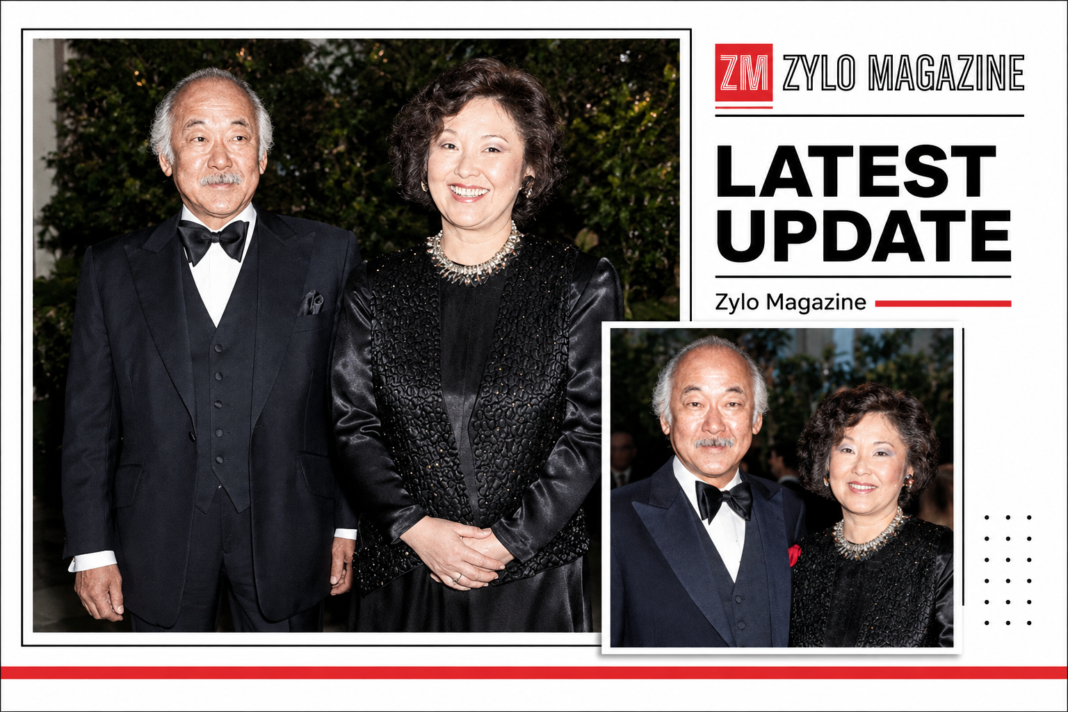
Yukiye Kitahara is best known as the former wife of legendary Japanese-American actor and comedian Pat Morita, the performer who became internationally famous as Mr. Miyagi in The Karate Kid. Yet while Morita spent decades in television and film, Yukiye Kitahara followed a remarkably different path: she largely stayed outside the spotlight. That contrast is one reason people continue to search for information about her.
Kitahara was married to Morita for nearly two decades, a period that overlapped with some of the most important years of his career. Their family included two daughters, and Yukiye occasionally appeared publicly alongside her husband. Beyond those documented details, however, reliable information about her personal background remains limited.
This guide examines what is actually known about Yukiye Kitahara, her marriage and family, her connection to Morita’s Hollywood career, and why separating verified information from online speculation matters when understanding her story.
Who Is Yukiye Kitahara?
Yukiye Kitahara is primarily known through her marriage to Noriyuki “Pat” Morita, the American actor and comedian remembered around the world for playing Mr. Miyagi.
Reliable public information about Kitahara herself is unusually limited. IMDb identifies her as Morita’s former spouse and records their marriage as beginning on December 28, 1970 and ending in divorce in 1989. The same source states that they had two children together.
Kitahara also used the name Yuki Morita publicly during her marriage. Her entertainment credits are not those of a professional actress building a conventional Hollywood career. Instead, IMDb records appearances as herself, including appearances on the celebrity-couple game show Tattletales in 1975 and an appearance connected with TV’s Bloopers & Practical Jokes in 1985.
This distinction is important. Some websites have attempted to turn Yukiye Kitahara into a much more elaborate celebrity figure, assigning her careers, accomplishments, birth dates, wealth estimates, and other personal details. Much of that material is poorly sourced or contradictory.
A more accurate picture is simpler: Yukiye Kitahara was Pat Morita’s second wife, shared two children with him, made a small number of documented public appearances, and otherwise maintained a private life.
That may provide fewer sensational details, but it is far more useful than filling gaps in the historical record with assumptions.
Yukiye Kitahara Biography at a Glance
Here are the most useful details that can be stated with reasonable confidence:
| Detail | Information |
|---|---|
| Full name | Yukiye Kitahara |
| Also known as | Yuki Morita |
| Best known for | Former wife of Pat Morita |
| Husband | Pat Morita |
| Marriage | December 28, 1970–1989 |
| Marriage status | Divorced |
| Children with Morita | Two |
| Daughters commonly identified | Aly Morita and Tia Morita |
| Known television connection | Appeared as herself on Tattletales |
| Public profile | Very private |
| Verified profession | Not clearly documented |
| Verified net worth | Not publicly established |
The absence of a confirmed birth date, professional biography, education history, or personal fortune should not be treated as an invitation to invent those details. It is instead an important part of understanding Yukiye Kitahara: she was associated with a famous entertainer without becoming a conventional celebrity herself.
Yukiye Kitahara and Pat Morita
The central documented chapter in Yukiye Kitahara’s public story is her relationship with Pat Morita.
The couple married on December 28, 1970, according to IMDb’s biographical records. Their marriage lasted until 1989 and produced two children.
That 19-year period is significant because it covered a dramatic transformation in Morita’s professional life.
When Yukiye and Pat married, Morita had not yet become the internationally recognizable Mr. Miyagi. He was developing a career that would move through stand-up comedy, television, sitcom roles and eventually major motion pictures.
Morita appeared in shows such as Sanford and Son and became well known for playing Arnold on Happy Days. The Los Angeles Times later noted his television work as Ah Chew on Sanford and Son, his role on Happy Days, and his starring role in Mr. T and Tina.
His career reached an entirely different level with The Karate Kid in 1984.
This means Yukiye Kitahara’s marriage to Morita covered not simply the years after he became famous but the period in which his career evolved substantially. She was part of his family life while he moved from working comedian and television performer to an actor associated with one of the most recognizable characters of 1980s cinema.
Life During Pat Morita’s Rise to Fame
Understanding the timing of Yukiye Kitahara and Pat Morita’s marriage gives more insight than simply knowing their wedding and divorce dates.
Morita had already spent years developing his comedy career, but television significantly expanded his visibility during the 1970s. His work on programs including Sanford and Son and Happy Days made him increasingly recognizable to American audiences.
Then came The Karate Kid.
Released in 1984, the film introduced Morita as the wise martial-arts mentor Mr. Miyagi. The role transformed his career and ultimately became his defining screen performance.
The Academy of Motion Picture Arts and Sciences confirms that Noriyuki “Pat” Morita received an Academy Award nomination for Best Supporting Actor for The Karate Kid. The Oscar ceremony honoring the films of 1984 took place in 1985, with Morita competing against Adolph Caesar, John Malkovich, Ralph Richardson and eventual winner Haing S. Ngor.
Yukiye and Pat were still married throughout this breakthrough.
That provides important context for understanding her place in his story. Their marriage existed both before and during the period when Morita experienced extraordinary professional recognition.
However, it would be irresponsible to claim that Yukiye directly caused, managed, or shaped his success unless credible evidence demonstrates that. Celebrity biographies often describe spouses automatically as the “secret behind” a star’s achievements. Such statements may sound complimentary, but they can still be speculation.
What can be said is that Kitahara was his spouse and part of his family during these transformative career years.
Yukiye Kitahara’s Television Appearances
Although Yukiye Kitahara was not known for pursuing an acting career, she did appear on television.
IMDb credits her, under the name Yuki Morita, as appearing as herself on Tattletales in 1975. It lists five episodes associated with her appearance alongside Pat.
Tattletales was built around celebrity couples, making her participation understandable in the context of Morita’s entertainment career rather than evidence that she was launching an independent acting profession.
IMDb also records a 1985 appearance on TV’s Bloopers & Practical Jokes, where she was credited as herself in a segment involving Pat Morita.
These credits are valuable because they establish something concrete about Kitahara’s public presence.
She was not completely absent from her husband’s professional world. At certain moments, she participated in television programming connected with their relationship. Yet the small number and nature of these appearances reinforce the broader picture: public performance does not appear to have been the focus of her life.
Was Yukiye Kitahara an actress?
Based on the available record, describing her as a professional actress would be misleading.
Her documented screen appearances are essentially “self” credits rather than a substantial body of acting roles. There is no well-established filmography demonstrating a sustained acting career comparable with Pat Morita’s.
That distinction is particularly useful for readers because search results sometimes blur the line between “appeared on television” and “worked professionally as an actress.”
In Kitahara’s case, the former is supported much more clearly than the latter.
Yukiye Kitahara and Pat Morita’s Children
Family is another important part of the Yukiye Kitahara story.
Pat Morita had three daughters in total. IMDb lists Erin Morita, Tia Morita, and Aly Morita as his children. It also records that his marriage to Yukiye Kitahara produced two children, while his earlier marriage produced one.
Morita’s 2005 obituary in the Las Vegas Review-Journal listed his surviving daughters as Erin Rodda, Aly, and Tia.
Secondary biographical sources consistently identify Aly and Tia as the daughters associated with Yukiye and Pat’s marriage.
This family connection explains why searches such as “Yukiye Kitahara Aly Morita” and “Yukiye Kitahara Tia Morita” frequently appear alongside searches for Yukiye herself.
It also provides a more meaningful way to understand Kitahara than focusing only on celebrity gossip. Her nearly two-decade marriage was not simply a Hollywood relationship; it was also a family unit that existed through significant changes in Morita’s career.
Aly Morita and Yukiye Kitahara
Aly Morita is one of Pat Morita’s three daughters and is widely identified as one of the two children from his marriage to Yukiye Kitahara.
She received particular attention around the time of her father’s death because news reporting cited her directly.
When Morita died in November 2005, The Washington Post reported that Aly said her father had died of heart failure at a Las Vegas hospital, while noting that his longtime manager provided a different account involving kidney failure.
This is also a useful example of why careful sourcing matters in celebrity biographies. Even events involving internationally famous individuals can generate conflicting reports. When sources disagree, the responsible approach is to acknowledge the disagreement rather than present one version as unquestionable fact.
The same principle should be applied to Yukiye Kitahara.
Where reliable records exist, they can be stated confidently. Where they do not, uncertainty should remain visible.
Tia Morita and Yukiye Kitahara
Tia Morita is likewise identified as one of Pat Morita’s daughters from his second marriage.
Pat Morita’s obituary published by the Las Vegas Review-Journal named Tia alongside Erin and Aly among his surviving daughters.
Compared with their famous father, members of the Morita family have generally maintained substantially lower public profiles.
For an article about Yukiye Kitahara, this matters because there is a temptation to use relatives as a way to manufacture additional biographical detail when direct information about the main subject is limited.
A better approach respects the distinction between public information and private life.
The documented family relationships are relevant. Unsupported claims about private careers, relationships, residences, finances, or personal experiences are not necessary to explain who Yukiye Kitahara is.
Why Is So Little Known About Yukiye Kitahara?
This may be the most important question surrounding Yukiye Kitahara.
Search engines create an expectation that almost every detail about a person should be available instantly. For people connected with celebrities before the social-media era, that expectation is often unrealistic.
Kitahara’s public record is relatively small. Her marriage is documented. Her children are documented through Morita’s biographical record. Her television appearances are documented. But there is no comparable, authoritative public record providing a comprehensive account of her childhood, education, independent profession, or later life.
Several factors help explain this.
First, she was married to a public figure without developing the same kind of public career herself. Media coverage naturally concentrated on Pat Morita because he was the working actor and comedian.
Second, much of their marriage occurred during the 1970s and 1980s. This was long before Instagram, X, TikTok, personal websites, and the constant online documentation associated with modern celebrity culture.
Third, privacy itself can be a choice. Not every person connected to an entertainer seeks publicity, interviews, endorsements, or a public-facing career.
The result is an unusually sparse digital biography.
And that is not a flaw that needs to be “fixed” with speculation.
The Problem With Online Yukiye Kitahara Biographies
Anyone researching Yukiye Kitahara is likely to encounter contradictory articles.
One page may give a specific birth year. Another may describe a career that cannot be verified. Others assign estimated net worth figures without identifying financial records, business holdings, salaries, property information, or other evidence that would make such calculations meaningful.
There are even search results that appear to confuse Yukiye Kitahara with completely different people, including claims about careers in contemporary entertainment or ceramics.
These contradictions illustrate a broader problem in celebrity SEO content: one website publishes an unsupported claim, another rewrites it, and dozens of subsequent pages make the claim look established simply because it has been repeated.
Repetition is not verification.
For readers researching Yukiye Kitahara, a useful credibility test is to ask:
- Does the article identify where the information came from?
- Can the claim be corroborated by a credible independent source?
- Does the timeline make sense?
- Are other sites merely repeating identical wording or facts?
- Does the source distinguish known facts from assumptions?
Using these questions dramatically improves the quality of online biographical research.
Yukiye Kitahara’s Age and Early Life
One of the most common questions about Yukiye Kitahara concerns her age.
Unfortunately, an authoritative birth date is not clearly established in the reliable sources available for this profile.
That means an exact age should not be presented as fact.
Some online biographies attach specific birth years or places to her, but those claims often lack strong sourcing. In some cases, different websites provide conflicting biographical details—a warning sign that the information may have originated from speculation or mistaken identity.
The same problem applies to her childhood and education.
There is insufficient credible public documentation to provide a detailed account of where she grew up, which schools she attended, or what profession she pursued before marrying Pat Morita.
Instead of filling this section with invented “early-life” material, the accurate conclusion is that Yukiye Kitahara’s early biography remains largely private.
That fact actually helps explain why so much unreliable material about her has appeared online: there are information gaps, and low-quality publishers frequently fill such gaps with plausible-sounding details.
What Was Yukiye Kitahara’s Career?
No substantial independent career for Yukiye Kitahara is firmly documented in the major sources associated with her public identity.
Her best-established television appearances involved appearing as herself, including Tattletales in 1975.
Consequently, labels such as actress, businesswoman, artist, model, or entrepreneur should be treated cautiously unless supported by documentation referring specifically to the same Yukiye Kitahara.
This is especially important because names can be confused online.
A search engine may combine information about similarly named individuals, while automatically generated or poorly researched articles can merge separate biographies into one.
For practical research, the safest method is to verify a supposed career detail against the known timeline: Yukiye Kitahara married Pat Morita in 1970, appeared publicly as Yuki Morita, had two children with him, and divorced him in 1989.
Any biography describing an entirely different generation, profession, or identity needs independent verification before being connected with her.
Yukiye Kitahara’s Net Worth
There is no reliable, publicly verified net-worth figure for Yukiye Kitahara.
This point deserves emphasis because celebrity net-worth estimates are among the most frequently copied pieces of misinformation online.
Calculating a person’s wealth responsibly would require meaningful information about assets, liabilities, income, investments, businesses, property, inheritance, divorce settlements, or similar financial factors.
Those details are not publicly established for Kitahara.
Therefore, claims that she is worth a specific number of millions of dollars should not automatically be trusted simply because they appear in search results.
Being formerly married to a successful actor also does not allow someone to calculate her personal finances decades later.
The most accurate answer to “What is Yukiye Kitahara’s net worth?” is consequently straightforward:
Her current net worth is not reliably known from public information.
For readers, this is more valuable than an impressive-looking but unsupported number.
The End of Yukiye Kitahara and Pat Morita’s Marriage
Yukiye Kitahara and Pat Morita’s marriage ended in divorce in 1989, after approximately 19 years. IMDb records the relationship from December 28, 1970 to 1989.
The timing is notable.
The original Karate Kid arrived in 1984, The Karate Kid Part II followed in 1986, and The Karate Kid Part III appeared in 1989. Morita’s biographical record identifies him strongly with all three films.
In other words, the final years of Yukiye and Pat’s marriage coincided with the period in which Mr. Miyagi became an established pop-culture character.
What caused their divorce is a different question.
Reliable public documentation does not provide enough evidence to responsibly reduce the end of their marriage to one definitive cause. Unless either person made a verified public statement explaining private marital circumstances, assigning blame or inventing a dramatic explanation would be speculation.
The confirmed fact is the divorce itself—not the private reasons behind it.
Pat Morita’s Life After His Marriage to Yukiye
Pat Morita later married actress Evelyn Guerrero in 1994. IMDb records that marriage as lasting until Morita’s death in 2005.
Morita continued acting extensively after his divorce from Yukiye.
His post-Karate Kid career included television, movies, and voice acting. The Los Angeles Times noted later projects including Collision Course, Honeymoon in Vegas, Spy Hard, and his role as the voice of the Emperor of China in Disney’s Mulan.
He died on November 24, 2005, aged 73.
His legacy, however, remained dominated by Mr. Miyagi—a performance that had brought him an Academy Award nomination and created an enduring connection between Morita and The Karate Kid franchise.
What Happened to Yukiye Kitahara After the Divorce?
Information about Yukiye Kitahara after 1989 is extremely limited.
There is no well-documented public career, extensive interview history, memoir, or prominent verified social-media presence providing a detailed account of her later years.
This is where responsible biography should stop rather than speculate.
It is reasonable to say that she continued to maintain a low public profile. It is not reasonable to invent a location, relationship status, occupation, lifestyle, or financial history without evidence.
Her absence from entertainment coverage also demonstrates something interesting about celebrity culture.
People often assume that proximity to fame automatically makes someone a celebrity. Yukiye Kitahara’s life suggests otherwise.
She was married for nearly two decades to a man who eventually became recognizable around the world, yet she did not build a lasting public identity around that association.
In an era when celebrity relatives frequently become influencers or public personalities themselves, that degree of separation from fame is noteworthy.
Why Yukiye Kitahara Still Attracts Public Interest
Why are people still searching for Yukiye Kitahara decades after her marriage to Pat Morita ended?
The answer largely comes back to Morita’s cultural longevity.
Mr. Miyagi became far more than a successful movie character. The role remains closely associated with The Karate Kid, 1980s popular culture, martial-arts cinema, and the mentor archetype in American movies.
Morita’s Oscar nomination also demonstrates that the performance was critically significant, not simply commercially memorable.
As new audiences discover the franchise, many naturally become curious about the actor behind Miyagi. That curiosity expands outward:
Who was Pat Morita married to?
How many children did he have?
Who is Yukiye Kitahara?
Who are Aly and Tia Morita?
What was Morita’s life like when The Karate Kid became successful?
Yukiye therefore remains part of the broader historical interest surrounding Morita even though she did not cultivate celebrity status herself.
A Timeline of Yukiye Kitahara’s Publicly Documented Story
A timeline is one of the clearest ways to understand her connection with Morita:
1970: Yukiye Kitahara and Pat Morita marry on December 28.
1970s: Morita’s television career grows, including work associated with Sanford and Son and Happy Days.
1975: Yukiye appears as Yuki Morita alongside Pat on Tattletales. IMDb associates her with five episodes that year.
1984: The Karate Kid is released, with Morita portraying Mr. Miyagi.
1985: Morita is nominated for the Academy Award for Best Supporting Actor for The Karate Kid. Yukiye also has a documented “self” credit connected with TV’s Bloopers & Practical Jokes.
1986: The Karate Kid Part II continues the franchise.
1989: The Karate Kid Part III is released, and Yukiye and Pat’s marriage ends in divorce.
1994: Morita marries Evelyn Guerrero.
2005: Pat Morita dies at age 73. His obituary names his daughters Erin, Aly, and Tia among his survivors.
This chronology demonstrates why Kitahara occupies a distinctive position in Morita’s biography: their marriage spanned the period between his developing television career and his transformation into an Oscar-nominated movie star.
What Yukiye Kitahara’s Story Teaches Us About Celebrity Research
Perhaps the most useful insight from researching Yukiye Kitahara has little to do with celebrity gossip.
Her story demonstrates how easily the internet can create an illusion of knowledge.
A private individual connected to a famous person may have only a handful of verifiable facts online. Search-driven publishers nevertheless have incentives to produce lengthy biographies. To make those articles look complete, uncertain details can gradually become “facts.”
One website estimates a birth date.
Another copies it.
A third calculates an age from that date.
A fourth adds an unsupported net worth.
Eventually, a search results page can contain dozens of articles repeating information that never had a reliable foundation.
Yukiye Kitahara is therefore a useful case study in digital source literacy.
Good research does not mean finding the website with the most details. It means identifying which details can actually be supported.
For Yukiye, the strongest factual foundation consists of her marriage to Pat Morita, their two children, her limited appearances as herself, the marriage timeline, and the broader documented history of Morita’s career.
Knowing where the evidence ends is part of knowing the story.
Frequently Asked Questions About Yukiye Kitahara
Who is Yukiye Kitahara?
Yukiye Kitahara is best known as the second wife of American actor and comedian Pat Morita, famous for portraying Mr. Miyagi in The Karate Kid. They married on December 28, 1970 and divorced in 1989. They had two children together.
How many children did Yukiye Kitahara and Pat Morita have?
Yukiye Kitahara and Pat Morita had two children together. They are widely identified as daughters Aly Morita and Tia Morita. Pat had another daughter, Erin, associated with his earlier marriage. His 2005 obituary names Erin, Aly, and Tia as his three daughters.
Was Yukiye Kitahara an actress?
There is no strong evidence that Yukiye Kitahara pursued a substantial professional acting career. IMDb records television appearances in which she appeared as herself, notably under the name Yuki Morita on Tattletales in 1975 and in a TV’s Bloopers & Practical Jokes segment in 1985.
What is Yukiye Kitahara’s net worth?
No reliable public source establishes Yukiye Kitahara’s current net worth. Online figures should therefore be treated as estimates or speculation unless supported by credible financial evidence.
What happened to Yukiye Kitahara after divorcing Pat Morita?
Yukiye Kitahara maintained a very low public profile after her 1989 divorce from Pat Morita. Reliable sources provide little information about her subsequent private life, and claims concerning her later career, residence, relationships, or finances should not be presented as established facts without supporting evidence.
Conclusion: Understanding the Real Story of Yukiye Kitahara
Yukiye Kitahara occupies an unusual place in Hollywood history. She never achieved—or apparently pursued—the worldwide celebrity associated with Pat Morita, yet she shared nearly 19 years of his life during a remarkable professional transformation. Their marriage began in 1970, they had two children together, and Yukiye made occasional television appearances as Yuki Morita. She was still his wife when The Karate Kid turned Mr. Miyagi into a cultural icon and earned Morita an Academy Award nomination.
What makes Yukiye Kitahara particularly interesting today is also what makes writing about her difficult: she remained private. Many details commonly expected from an online celebrity biography simply are not reliably documented.
Ultimately, the most accurate account of Yukiye Kitahara is not the one containing the most claims. It is the one that respects the evidence. Her documented story is modest but meaningful—and far more credible when fact is clearly separated from internet speculation.
Continue Exploring Our Latest Article: Korina Harrison: The Truth About Corey Harrison’s Ex-Wife, Marriage, Son, Career, and Private Life