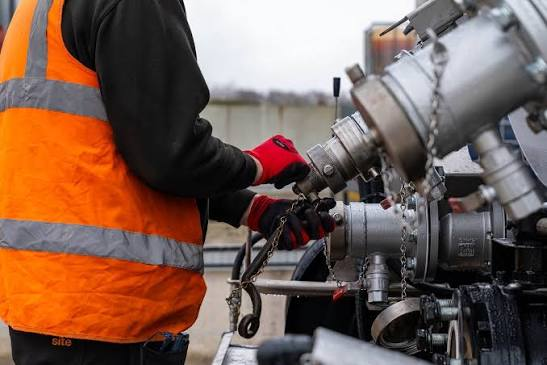
Fleet operators deal with a long list of maintenance priorities, and fuel system integrity rarely sits at the top of the list until something goes wrong. A contaminated fuel tank does not announce itself in advance. It shows up as unexplained engine performance issues, filter replacements that happen too frequently, fuel system component failures, and eventually, costly downtime that disrupts dispatch schedules and strains maintenance budgets.
The challenge is that fuel tank contamination builds gradually. Water intrusion, microbial growth, sediment accumulation, and sludge formation happen over months or years, often without obvious symptoms in the early stages. By the time the effects become visible in vehicle performance or fuel quality reports, the problem has usually been present long enough to cause measurable damage downstream.
Choosing the right service provider before that damage occurs is not just a maintenance decision. It is an operational risk decision. This guide is written for fleet operators, facilities managers, and procurement teams who need to evaluate their options with clarity and without having to sort through promotional material to find the substance.
What Fuel Tank Cleaning Services Actually Involve
The term “tank cleaning” is used broadly in the industry, and not every provider offering it delivers the same scope of work. At its core, professional fuel tank cleaning services involve the physical removal of accumulated contaminants from inside a storage or vehicle fuel tank — including water, sludge, microbial matter, and particulate debris — followed by an inspection of the tank’s internal condition and, in most cases, polishing or reconditioning of the stored fuel itself.
For fleet operators evaluating providers, a thorough understanding of fuel tank cleaning services helps distinguish between surface-level offerings and full remediation work that actually addresses the root contamination. There is a meaningful difference between a provider who vacuums visible sludge and one who conducts a complete clean-down with fuel polishing, microbial treatment if required, and a documented post-service report.
The Scope Problem: Why “Cleaning” Means Different Things
Some providers focus exclusively on above-ground or underground bulk storage tanks. Others specialize in vehicle fuel tanks across diesel, gasoline, and mixed-fuel fleets. A smaller number handle both. Before comparing quotes or evaluating providers, it is important to establish exactly what type of tank infrastructure you are dealing with, because the equipment, safety requirements, and technical procedures differ significantly between a 20,000-gallon bulk storage tank and the fuel tanks on individual fleet vehicles.
Operators who assume any tank cleaning company can handle all their needs sometimes find that a provider equipped for large storage infrastructure lacks the mobile servicing capability or the right tooling to work on individual vehicle tanks efficiently. Confirming scope compatibility early prevents wasted time in the evaluation process.
Evaluating Provider Credentials and Compliance Standards
Fuel tank cleaning involves working with flammable materials, hazardous waste, and in many cases, confined space entry. These are regulated activities under federal and state occupational safety rules, and a provider’s compliance posture is a direct indicator of how seriously they manage risk on site — including risk to your property and personnel.
According to the Occupational Safety and Health Administration, confined space entry requires a written program, trained personnel, and appropriate atmospheric testing before and during entry. Any tank cleaning provider whose personnel enter tanks — which is common during large-scale storage tank work — should be operating under a documented confined space entry program. Asking for evidence of this is a basic due diligence step, not an unusual request.
Licensing, Insurance, and Waste Disposal Documentation
Beyond OSHA compliance, providers working with petroleum waste are generally required to handle and dispose of removed sludge, water, and contaminated fuel in accordance with EPA regulations governing hazardous waste. A provider who cannot produce a waste disposal manifest or who is vague about how removed material is handled is a liability risk. The contaminated material removed from your tank does not stop being your concern once it leaves the site if the disposal chain is not properly documented.
Insurance coverage is equally important. General liability coverage protects against property damage during service. If the provider is sending personnel into tanks or operating heavy equipment near fuel infrastructure, appropriate coverage levels matter. Request certificates of insurance and verify they are current before work begins.
Understanding the Difference Between Cleaning and Fuel Polishing
Fuel polishing is often packaged with tank cleaning but serves a different purpose. Tank cleaning addresses what is inside the tank structure itself — the walls, bottom, and fittings where sludge and microbial colonies accumulate. Fuel polishing is the process of reconditioning stored fuel by passing it through filtration and separation systems to remove water, particulates, and microbial contamination from the fuel itself, then returning usable fuel to service.
For fleet operators with large bulk storage systems, both processes are often necessary together. Cleaning the tank without addressing the fuel means reintroducing treated fuel back into a contaminated environment. Polishing the fuel without cleaning the tank means the reconditioned fuel is immediately exposed to the same conditions that caused contamination in the first place. Providers who offer both as an integrated service, with documented pre- and post-treatment fuel quality data, deliver more complete outcomes than those offering one or the other in isolation.
When Polishing Alone Is Not Enough
There are situations where fuel polishing is used as a maintenance measure to maintain fuel quality in a tank that is otherwise in good structural condition. This can be appropriate for routine upkeep schedules. However, when contamination has reached a point where visible sludge layers or significant microbial growth are present, polishing alone will not resolve the problem. The physical cleaning of the tank is the necessary first step, and operators who try to skip it in favor of polishing only typically find themselves dealing with recurring contamination within a short time frame.
Service Frequency and Long-Term Maintenance Planning
One of the practical questions fleet operators face is how often tank cleaning should occur. The honest answer is that it depends on several variables: how frequently fuel is turned over in the tank, local climate conditions, the quality of fuel being sourced, and whether any contamination has been identified previously. Tanks that sit with static fuel for extended periods accumulate contamination faster than those with regular throughput. Operations in humid climates face higher water intrusion risk, which accelerates microbial growth.
A provider worth working with should be willing to assess your specific tank conditions, fuel turnover rates, and operating environment before giving a service frequency recommendation. Generic recommendations that do not account for these variables are a sign that the provider is not approaching your situation with appropriate depth.
Building a Maintenance Schedule That Reflects Actual Risk
Rather than defaulting to arbitrary annual or biannual cleaning cycles, fleet managers are better served by establishing service schedules tied to observable indicators: fuel filter change intervals, routine fuel sampling results, and visual inspections of tank conditions where accessible. A provider who incorporates fuel sampling into their service offering gives you ongoing data to base maintenance decisions on, rather than guessing at intervals.
Documenting service history for each tank also matters over time. If a tank has a history of recurring contamination despite regular cleaning, that pattern suggests a source problem — water intrusion, supply quality, or tank integrity — that needs to be identified and addressed, not just cleaned around repeatedly.
Comparing Quotes Without Losing Sight of What Matters
Price comparison across fuel tank cleaning providers is legitimate and necessary, but the lowest quote does not always reflect equivalent scope. When reviewing proposals, the detail level of the scope of work is more informative than the price itself. A proposal that clearly specifies what will be removed, how it will be disposed of, what post-cleaning inspection will occur, and what documentation you will receive is more useful than a line-item price without context.
Questions worth asking any provider during the evaluation process include: What does the post-service report include? How is removed waste handled and documented? Do you carry out fuel sampling before and after service? What equipment will be on-site, and how long will the work take? What happens if the tank inspection reveals structural issues? A provider who can answer these questions specifically and without hesitation is operating at a level of professionalism that matters when work is actually underway.
Closing Considerations for Fleet and Facilities Decision-Makers
The decision to contract fuel tank cleaning services is straightforward on the surface, but the quality of the outcome depends entirely on the provider you select, the scope of work you agree to, and how well the service integrates with your broader fuel management practices. Contamination in a fuel system is not a static problem — it compounds over time, and incomplete remediation leaves the conditions in place for rapid recurrence.
The most effective approach is to treat tank cleaning as part of a documented fuel system maintenance program rather than a reactive response to visible problems. Providers who support that approach — with proper credentials, clear documentation, and the ability to service your specific tank types — are the ones worth building a long-term relationship with. Providers who offer quick, undocumented service at minimal cost typically leave more problems behind than they resolve.
For fleet operators managing multiple vehicles or bulk storage infrastructure, getting this decision right the first time reduces the cycle of recurring contamination issues, protects expensive fuel system components, and keeps vehicles available when they need to be. That is the practical return on a well-chosen service provider — not just a cleaner tank, but a more predictable, reliable fuel system across your entire operation.