Every couple of weeks, the same message lands in a Discord server: a screenshot of a scoreboard that doesn’t add up, and a link. Free aimbot. No key. Works as of today.
You already know it isn’t free. Everyone knows. But there is a particular kind of arithmetic that happens at one in the morning, when you are two ranks below where you think you belong. The file is forty megabytes. The guy says it is clean. Three people in the replies say it works. And your antivirus complains about everything anyway.
So you add the exclusion and double-click. Here is what that decision costs, in the order the charges arrive.
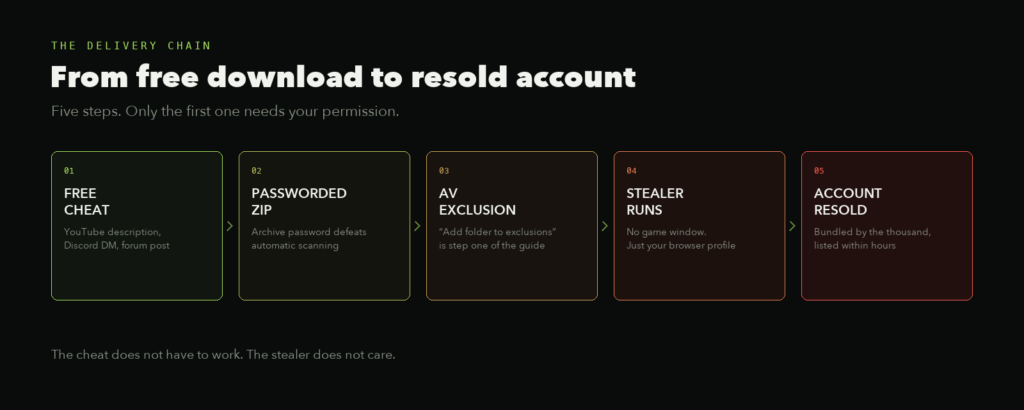
Five steps, and only the first one needs your permission.
Free cheats are a malware business, not a cheating business
There are people who write genuinely good cheats and sell them for thirty dollars a month. They exist. They have a support channel, a changelog and a refund policy, and they mostly don’t want to rob you, because robbing customers is a terrible way to keep customers.
Then there is the other tier, and it is much larger than the first. Cheat tools have become one of the most efficient consumer malware channels going, because the audience arrives pre-conditioned. A cheat needs deep access to a running game. It needs to stay undetected. It needs to hook a process that anti-cheat software is actively watching. To install one, you have to switch protections off, whitelist an unknown executable, and run it as an administrator.
That is not a security bypass the attacker has to engineer. It is a checklist, and you complete it yourself, for free, in exchange for the cheat.
What actually runs when you double-click
The payload is usually an infostealer, and the good ones are boring. No ransom note, no skull on the desktop. They read the places your browser keeps things and copy them out.
Concretely: saved passwords, autofill card details, and the cookie jar. The cookies matter most. A session cookie lets someone resume a session you are already signed into, without your password and without your two-factor code. Your Steam session, your email, your bank — a few kilobytes each, small enough to upload before the installer has finished.
Modern stealers also sweep crypto wallet files, Discord tokens and Telegram session folders. Some grab a screenshot of the desktop. Some drop a loader so the operator can come back in a few weeks, after you have changed everything and relaxed.
None of this needs the game to launch. The cheat can crash on start and never work once. The malware has already finished by then.
The password-protected ZIP is the tell
Almost all of these arrive as an archive with a password printed in the video description, and that is not a packaging quirk.
An encrypted archive cannot be scanned by the gateway that inspects downloads, and on some file hosts it cannot be scanned on upload either. The password protects nothing on your side. It exists to get the file onto your disk without anything looking inside it first.
Put it together. A password to open it, a folder to exclude, real-time protection off. You have been handed a three-step malware installation guide with a screenshot of a working aimbot on top.
Why gamers, specifically
Because the account is worth more than you would guess, and it is easier to monetise than a stolen card.
A Steam library with a decade of purchases is a transferable asset. So is an account carrying rare cosmetics, an old ranked badge, or an inventory of tradable items. These sell for real money, they come with payment methods attached, and they are recoverable enough to stay valuable but painful enough to be worth taking.
The audience matches the payload too. A large share of players run as administrator, rely on Windows Defender alone, reuse one password across the game, the email and the bank, and are young enough not to have been burned yet. That last part is not an insult. It is simply why the targeting works.
Where your account goes next
This is the part that surprises people. Stolen game accounts are not used. They are processed.
A stealer operator is not going to hand-recover one person’s Steam account. They collect logs by the thousand and sort them by what is inside: one bundle of accounts with payment methods, one with valuable inventories, one of plain email logins for credential stuffing somewhere else entirely.
Those bundles get listed and resold through the same grey channels that handle any other stolen credential set, and they turn up in directories like the Hidden Wiki alongside everything else of that kind — not because a link list endorses any of it, but because that is where link lists of this sort always end up. By the time you notice a login from another country, your details have probably changed hands twice and been folded into something larger.
The product was never your rank. It was your inventory’s resale value, plus the email address that resets everything else.
The bill arrives in pieces
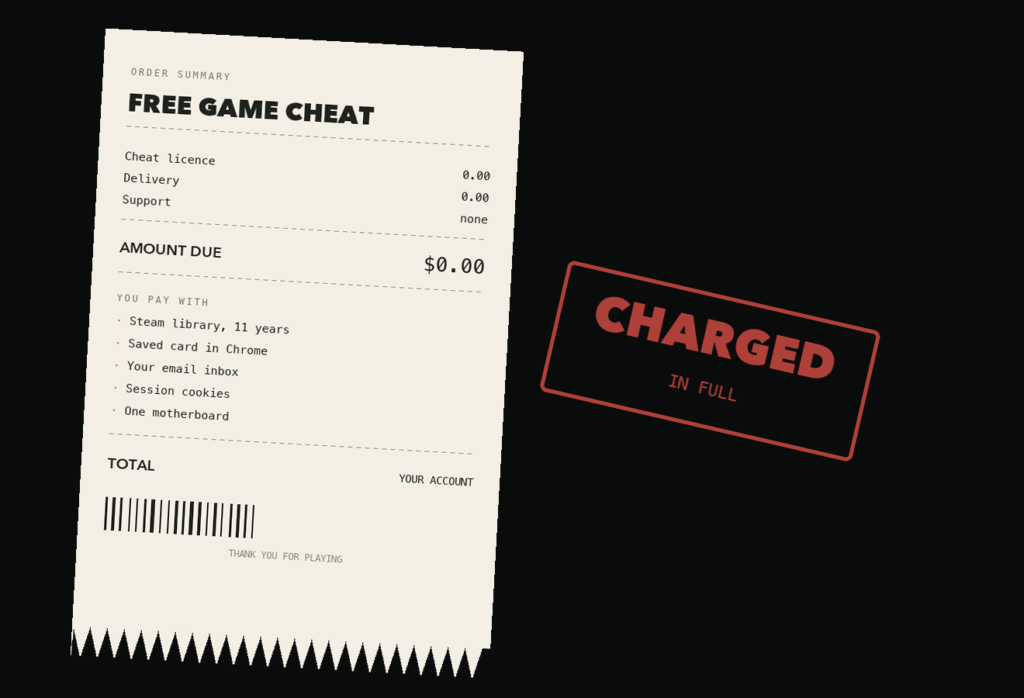
The invoice, itemised. The cheat is the only line that costs nothing.
First, the account. Valve is reasonably good about recovery if you have proof of purchase; other publishers are slower. Either way you are locked out of years of purchases while it is sorted, and anything tradable is gone.
Second, the card. A saved card in a browser profile is a number, an expiry date and a CVV sitting in plain text on disk. Some issuers catch it. Some don’t, and the disputes run for weeks.
Third, the inbox. If the game account shared a password with your email — it usually did — the attacker now has a route to reset everything else. That is the step where a game problem becomes a life problem.
Fourth, the ban. If the cheat did work for an evening, anti-cheat flagged it and you are hardware-banned. That means a new motherboard, or a spoofing tool that gets caught next season. On a good night, you get banned and robbed in the same few hours.
The charge that never shows up on a statement
With your Discord token, an attacker does not need your password. They message your friends from your account, in your voice, with your in-jokes, and they ask for a trade, a loan, or a quick login to “help with something”.
A stolen account is also a delivery mechanism for the next victim, and the next victim is usually someone who trusts you. Which is worth remembering the next time a friend sends you a cheat link out of nowhere.
How to check whether this already happened
Three things, five minutes, in this order.
- Search your email address on a breach-checking service. Recent stealer-log dumps are usually named plainly.
- Deauthorise all devices on Steam, sign back in, and review the authorised device list for anything you don’t recognise.
- Change your email password first, then every game account, using generated passwords rather than variations of one. Move two-factor from SMS to an authenticator app.
Email first. Everything else resets through it.
If you are going to do it anyway
The honest split is this. Single-player trainers and private-server tools are a different risk category from anything that has to survive an anti-cheat check. Modding a single-player game means you are not fighting a kernel-level anti-cheat and you are not installing a driver from a stranger. That is a technical distinction rather than a moral one, and it is why the risk profile changes so much.
For everything else, the checks that matter are unglamorous. Does the download have a stable home that isn’t a link in a chat message? Does the seller have a payment page, a refund policy and a support channel older than a fortnight? Can you find the same tool discussed by people with no financial reason to recommend it?
And keep one thing straight. A link directory tells you that a site can be reached, not that its files are clean. Even the Hidden Wiki states plainly that listing is not endorsement — which is the most honest sentence in this whole corner of the internet, and worth remembering the next time someone posts a link and calls it free.
The arithmetic, restated
Thirty dollars a month buys a cheat with a changelog and somebody to complain to. Free buys a Steam library, a saved card, an inbox and possibly a motherboard — and it might not even work.
The forty megabytes is the cheapest part of the download. Everything after it is charged separately, later, at a time you don’t get to pick.