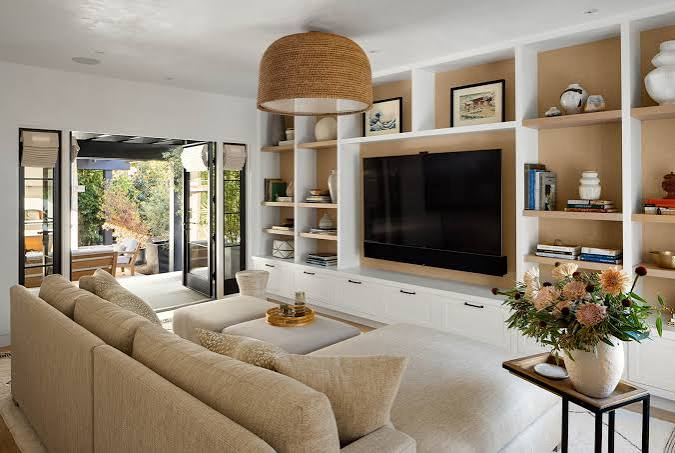
Most homeowners approach an entertainment cabinet purchase the way they approach buying furniture — by dimensions and finish. They measure the wall, check the color against the trim, and order something that fits the space in the most basic sense. What they discover later is that the cabinet does not actually work for the room. Cables have nowhere to go. The television sits at the wrong height. Shelving is too shallow for equipment or too deep to be useful. The doors block the remote signal. Heat builds up and equipment runs hot.
These are not cosmetic problems. They are functional failures that affect how a room is used every day. A living room with a poorly configured entertainment unit becomes a room people work around rather than work in. In a home theater or a dedicated media room, the consequences are more immediate — reduced picture quality, equipment that underperforms, and a layout that does not hold up once the family actually starts using the space.
Specifying a custom entertainment cabinet correctly requires thinking through the room’s purpose, the equipment it will house, the way people move through and use the space, and the long-term flexibility the installation needs to support. This framework helps US homeowners move through those decisions systematically, room by room.
What Custom Specification Actually Means in Practice
Custom does not simply mean built-to-size. A truly custom entertainment cabinet is designed around how a specific room functions — the equipment mix, the seating arrangement, the lighting conditions, the traffic patterns, and the household’s habits over time. When you review a Custom Entertainment Cabinets guide before starting a project, the most useful frameworks are those that begin with the room’s operational context rather than the cabinet’s physical form.
This matters because the decisions that are hardest to reverse — depth of shelving, ventilation provisions, wire management routing, door configurations — are all made before a single piece of material is cut. A homeowner who specifies a cabinet without thinking through these variables ends up either living with the limitations or paying to have work redone.
Starting with Equipment Inventory, Not Aesthetics
Before any design conversation begins, the homeowner should have a clear and complete inventory of every device that will live in or interact with the cabinet. This includes the television, streaming devices, gaming consoles, receivers, amplifiers, subwoofers, disc players, cable boxes, network equipment, and any smart home controllers. Each of these items has specific depth requirements, ventilation needs, and connection footprints that directly influence how the cabinet is designed.
Gaming consoles, for instance, require significantly more vertical clearance and airflow than a thin streaming device. A full AV receiver generates heat and cannot be enclosed in a tight cavity without risking damage to surrounding components. Network switches and routers, often treated as afterthoughts, need to be placed where cable runs are shortest and airflow is consistent. Getting this inventory right before the design phase prevents a situation where the finished cabinet cannot actually house the equipment it was built for.
Understanding the Difference Between a Viewing Room and a Living Room
A living room and a dedicated viewing room are functionally different spaces, and they call for different cabinet configurations even when they house the same equipment. In a living room, the cabinet needs to serve multiple purposes simultaneously — storage, display, ambient lighting, and media playback may all coexist. The design has to remain visually restrained when the television is off and the room is used for other purposes.
A dedicated home theater or media room operates differently. Ambient light is controlled, seating is fixed, and the equipment load is typically heavier. The cabinet in this context is more infrastructure than furniture. It needs to support equipment management at a higher level, with more deliberate provisions for cable organization, equipment access, and thermal control. Treating these two room types with the same specification approach leads to cabinets that serve neither purpose well.
Room-by-Room Structural Considerations
Each room in a home has physical and functional characteristics that bear directly on how a cabinet should be configured. Wall construction, floor type, ceiling height, natural light sources, and traffic patterns all affect the final design in concrete ways.
Living Rooms and Open-Plan Spaces
Open-plan living spaces present a specific challenge for entertainment cabinet design. When a room serves as both a social gathering space and a media viewing area, the cabinet must anchor the media wall without dominating the room’s visual field from multiple sightlines. This often means lower cabinet profiles, integrated lighting that works under both ambient and media-viewing conditions, and closed storage that conceals equipment when not in active use.
Acoustics also become relevant in open spaces. Hard flooring and high ceilings, common in contemporary open-plan homes, create reflective sound environments. A cabinet that directs speaker output into the room rather than into enclosed cavities contributes meaningfully to audio performance. This is a detail that custom fabrication can address and that off-the-shelf units typically cannot.
Bedrooms and Secondary Media Spaces
Bedroom entertainment setups are often treated as simplified versions of living room designs, but they have distinct requirements. Viewing angles are different — often lower, and from a more reclined position. Cable visibility is more consequential in a smaller space. Equipment noise, including fan noise from consoles and receivers, matters more in a sleep environment. The US Department of Energy’s guidance on home electronics notes that standby power draw from entertainment equipment is measurable over time, making accessible power management a practical consideration even in secondary rooms.
In bedroom configurations, custom fabrication allows for a more integrated approach — built-in power management, concealed equipment access, and panel configurations that reduce visible clutter without sacrificing function.
Dedicated Home Theater Rooms
In a home theater, the cabinet is part of a larger audiovisual system, and it needs to be designed with that in mind. Equipment racks, component isolation, and thermal management are not secondary concerns — they are central to the system’s performance and longevity. Custom entertainment cabinets designed for home theater applications need to accommodate the full signal chain, from source devices through processing equipment to amplification, with deliberate attention to how heat is managed and how components can be accessed for maintenance or upgrades.
Rack-mounted equipment and consumer furniture-style components are often mixed in home theater setups. A custom cabinet that bridges these two worlds — providing the thermal management and access of a rack system within the visual language of residential furniture — requires precise coordination between the fabricator and the system integrator before any design is finalized.
Ventilation and Thermal Management as Structural Requirements
Heat is the primary cause of premature equipment failure in enclosed entertainment cabinets. This is not a rare edge case — it is a consistent pattern in installations where equipment is housed in enclosed cavities without adequate airflow. AV receivers and power amplifiers are particularly sensitive. When these components run hot over extended periods, internal components degrade faster, and the result is reduced performance followed by equipment failure.
Custom cabinet design can address this through passive ventilation channels built into the cabinet’s structure, active ventilation using quiet fans with thermostat controls, and deliberate spacing between components that prevents heat from stacking. These provisions need to be specified at the design stage. Adding them after the fact is possible but rarely as effective as designing for them from the beginning.
Wire Management as a Design Discipline
Cable and wire management in a custom entertainment cabinet is not a finishing detail — it is a structural consideration that affects the cabinet’s internal layout from the earliest design stages. Power cables, signal cables, speaker wire, and network cable all need dedicated routing paths that keep them organized, accessible, and separated from each other where signal interference is a concern.
In a well-designed custom installation, cables are routed through dedicated channels within the cabinet’s framework, emerge at the back of each equipment bay, and terminate at clearly labeled connection points. This makes future modifications straightforward — adding a component, replacing a device, or troubleshooting a connection issue does not require dismantling the installation.
Homeowners who treat cable management as an afterthought end up with installations that are difficult to maintain, frustrating to modify, and often visually compromised even when the cabinet itself is well-made.
Material Selection and Long-Term Stability
The materials used in custom entertainment cabinets affect not just appearance but structural integrity over time. Solid wood and high-grade plywood behave differently under the thermal cycling that enclosed electronics produce. Some composite materials expand and contract in ways that affect joinery, door alignment, and finish adhesion. In rooms with variable humidity — common in many US climates — material selection becomes a factor in how the cabinet performs over years, not just how it looks at installation.
The finish also affects maintenance. High-gloss surfaces show fingerprints and require more regular attention. Matte and textured finishes are more forgiving in family environments. Hardware — drawer slides, door hinges, and lift mechanisms — should be rated for the frequency of use the installation will actually see. In a household with children or in a space used daily, hardware rated for light residential use will degrade faster than hardware specified for higher cycle counts.
Bringing the Framework Together Before You Build
The most consistent mistake in custom entertainment cabinet projects is compressing the specification phase. Homeowners eager to move into the fabrication and installation stages make decisions quickly, defer details to the fabricator, or rely on assumptions that turn out not to reflect how the room is actually used. The result is a finished installation that works adequately rather than one that works well.
A methodical approach — room type first, equipment inventory second, structural provisions third, materials and finish fourth — produces a specification that a skilled fabricator can execute with confidence. It also gives the homeowner a clear basis for evaluating proposals, comparing options, and understanding what they are paying for and why.
Custom entertainment cabinets represent a meaningful investment in how a room functions over time. The specification work that precedes fabrication is where that investment is either protected or undermined. Approaching it with the same care given to the design itself is how homeowners end up with installations that hold up, adapt to change, and serve the household as intended for years after the project is complete.